Source: We have been doing this for several years now.
By marchall from San Juan, Puerto Rico
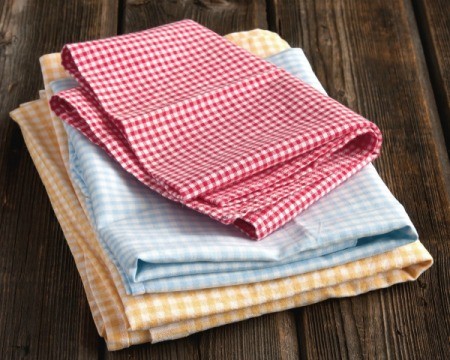
I love to have tons of dinner napkins, but I do not like the high price on them. I go to Walmart and look through their remnant bin for cheap materials. I just took a remnant home that cost 39 cents and made four dinner napkins out of it. All I did was cut a triangle edge on it. If I had owned a pair of pinking shears, I could have done it much faster. These can be used for all around cleaning and little place mats. I love these little dinner napkins, I make them in smaller sizes than what you would buy at the store for the children and normal if not smaller sizes for me. I am happy with my large collection of dinner napkins.
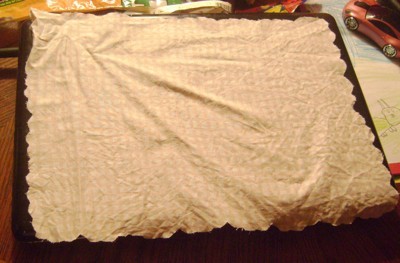
Also the little remnants of string (from using the pinking shears on the sides of the napkins to keep them from unraveling) can be turned into hair bows by tying them into little ribbons and then gluing them onto some sort of hair clasp.
This picture is a dinner napkin I just brought in and it is not completely dry, but it is one of my favorite materials.
By Robyn Fed from Hampton TN
A major expense in any household shouldn't be the napkins that sit on the dining room table, but it is an expense. As we move towards reuse more and more, the question of the paper napkin takes on more importance. They are certainly filling landfills, and each one costs a fraction of a penny. Yet, fabric napkins are a larger initial expense with endless wash cycles awaiting their lifetime. Which is for the better good, both environmentally and economically?
Remember when selecting your fabric napkins that they will have to withstand many, many washes. A thinly woven fabric or straight end stitching may not hold up to the wear and tear that these pieces will need to endure. A good set of fabric napkins that are not on sale will cost $10 for a pair. If your family has four members, you can expect to dirty a dozen napkins a day.
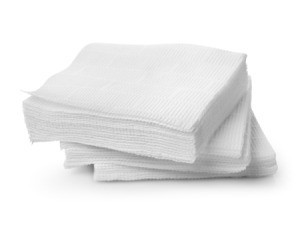
The paper napkins have an obviously lower initial investment. A pack of 250 generic paper napkins can be found on sale for $1.50. This less than $2 investment will last about 21 days if used at the same rate of the fabric napkins above.
It should be noted, however, that the fabric napkins are larger and will absorb more than the paper napkins, making the average use of paper much higher.
WINNER: paper
For fabric napkins, the maintenance is the turnoff for most. Twelve napkins a day turns into 84 napkins per week which is easily two loads of laundry. The average cost for a load of laundry using electrically heated water and an electric clothes dryer is $1.20 per load.
Of course, hanging the napkins out to dry on a line is even more economical, bringing the cost per load down to $0.70. The water, soaps, and electric used are a smaller drain on the environment than the landfill waste of paper napkins, while the economic waste is much higher.
The monthly maintenance of fabric napkins will be about $10. The monthly purchase price of paper napkins is less than $5.
WINNER: environmentally, fabric; economically, paper
In fact, a few eco-friends insist that cotton dying and refining does more environmental damage than the manufacture of low quality paper like the type used in paper napkins. However, organic cotton or linen napkins are created in a much safer and cleaner process, so they would be better for the planet than the paper in that sense.
WINNER: Tie
What seemed like an easy decision may not have come out with the expected winner. Fabric napkins are elegant and scream of environmental correctness, but when it comes down to it they're not the least expensive choice.
By WANJOY
By Cindy K.
By Beth
By Ziggee
By Jennifer
By Coreen
By Cheryl
By Barb
By Louel53
By Dahart
By Rosie