This page contains the following solutions.
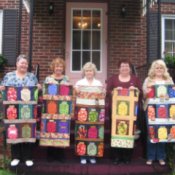 Each year, our family honors my grandmother who was a great seamstress and quilter by having a gathering we call the Barnhouse Bees. We all exchange squares with each other and catch up on what we have done the past year. We all bring a dish and share a meal. Each year, you bring back your squares from the prior year made into a quilt. We all show our quilts and honor the ones who have passed on.
Every time, we meet we choose a theme for the following yearly bee. One year, we used the theme "Grandma's Cellar". We each made 20 squares of the Mason Jar pattern containing something that she would have canned and put in her cellar. Another year, we did the theme of "Grandma's Dresses". Once, I even made extra squares in my mother's memory.
What a great way to make memories for years to come and a wonderful tradition to pass down to our children and grandchildren.
By Sue Hinely from Ludowici, GA
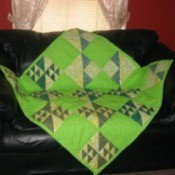
I like to sew a lot. I wanted to make my friend's first baby a special quilt. I made the flock of geese pattern. The quilt was unique and I had a lot of fun with it.
When you make a quilt for someone, make it even more special by making a label saying "This quilt was made with love for:___". Add a second line with the name of the quilt and the date. I realize that a lot of quilts I've seen didn't have a label.
Check this quilt out my friends.
By Maria from Somerville, MA
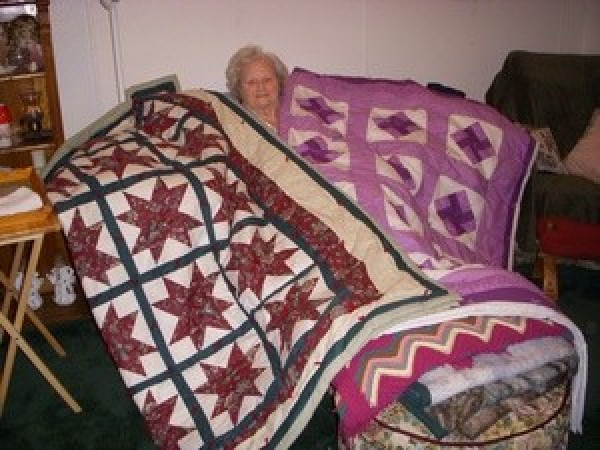
My 85 year old mother-in-law lives with me. We've been buying fabric and notions at thrift stores for about a year now, costing us 2 dollars a Walmart sized bag. We decided it would be neat to make the family quilts for Christmas. We chose easy patterns, she cut and ironed the pieces and I sewed then together.
By Sherry from Paducah, KY
Update: Here is what I mean by "turning". When you make your squares, you turn one square opposite the other square so that one side goes horizontal and the other square the sides go vertical, and there is no need to match the seams.
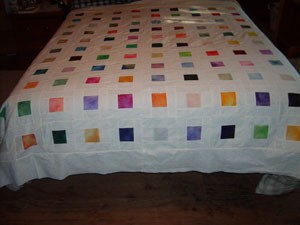
When making quilts, I use old (clean) mattress covers for the fill. Cut to the size that you need.
Everyone who sews has lots of small scraps. I use mine to make quilt tops. Cut muslin or light color fabric into strips 4 inches wide and as long as you want the quilt (maybe 3 yards).
When hand sewing, I am partial to quilting, I like to thread several needles to be ready when I have finished with one length of thread. To be even more organized, I prefer to use a magnet to keep the needles and threads straight so I don't have to stop what I am doing just to thread another needle.
When quilting with thin, flimsy fabrics, use "used" fabric softener sheets as an inexpensive backing. It gives it body and makes it a whole lot easier to work with.
When cutting several of the same shape, staple several layers of the paper needed or fabric needed and cut several at one time. If you are cutting paper put your staples outside your pattern lines on three sides.
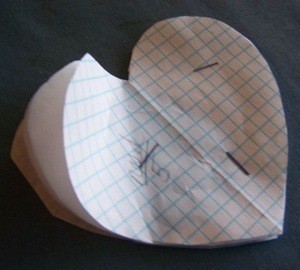
I do a lot of quilting and, as you know, you have to iron a lot of quilt pieces. I was always running out of water for the iron.
Make the quickest most accurate quilt you'll ever make using a gridded stabilizer. It's made with one inch squares, but you can use any size squares you want. I place the squares in the area I choose, use the tip of my iron to make them stick till I get all the squares on.
For drawing quilting paper-pieced blocks, I take a piece of template plastic (available at Joann's very cheap), and then cut small grooves using an Exacto knife and a cutting mat, corresponding to the lines of the pattern.
When you are working on quilt squares, a perfect carrying case for all your stuff you need is a pizza box. The squares stay nice and flat and all your tools and thread fits just fine.
I use iron on backing to make the quilt pieces easier to work with.
Take the small pieces of soap that are left over in the shower, dry them out and presto, you've got a great marking tool for fabrics and quilting.
As you're making your quilt squares, press each time you finish a seam in a pile of squares. If you trim and measure as you are building your seams, your quilt will be much more accurate.
Quilting tips and tricks from our readers. Quilters are all fabricaholics. I don't even throw tiny scraps away. The tiniest scraps go into a jar labeled "quilt jelly".
If you have grid paper, it's fun to design your own quilt squares. Keep it simple, but make sure you have lots of colorful fabric, and you'll be sure to have a great quilt. I like to use a color wheel. I have huge doubts about my tastes in color combinations, but I'm getting better.
Before starting a quilt, be sure to iron the scraps you plan to use.
For people who want to quilt but hate to sew, there are many books in the library just for you. You'll find choices for simple or complicated patterns. Calendar quilts are often done by hand because they use so much applique.
Always buy the best quality of needles to sew your quilt with and use a nice sharp one each time you sew as a sharp needle forms the best stitches for your quilt.
The papers that come on the back of panty shields have just the right curve on one end for the Grandma's Fan (quilt) pattern. Just fold the other end in the get the straight edge you want.
To store larger pattern pieces for applique, I just roll them up and put them in a empty paper towel cardboard tube. I store them in a box large enough that if the pattern is longer than the tube it won't bend or tear.
Here are the questions asked by community members. Read on to see the answers provided by the ThriftyFun community.
I have been working on a queen size quilt and not sure how to tie a quilt. Do I knot the corners of each block which are 9 in blocks? Any suggestions? Thanks
You are probably going to want to tie the quilt about every three to four inches. So put a tie in on each of the corners and one in the middle of the square. I have made a few tie quilts, but my grandmother made a lot of them.
Tie the knot in each corner my wife said. Hope this helps.
I tied one every 3 inches that seemed to work well. I went across and then the next row alternated so the ties staggered and not all in a line. Hope this helps. I used embroirdery thread to tie with. I bought a spool of it for a dollar something.
Thanks so much for all your responses. I managed to finish my quilt and very happy with it.
The info is online. Search for"How to tie a quilt" all info you need is there, good luck.
I have bags of clothing (stained or ripped) that I want to make a simple quilt with. Can anyone tell me the easiest pattern for a beginner? I also have about 40 pairs of jeans.
By Marion R
Can anyone tell me if sheets work well to use for cutting into fabric pieces for quilting? TIA.
By Susan W.
What can I use to redo the lines on my quilter's cutting mat? They are very faded in some places.
By Dot W.
I have cross stitched quilt squares, but need someone to quilt them for me.
By Dreama
I used an acid free, waterproof, permanent marker to write in a quilt block. But when I went to spray starch it, the ink ran. It's already sewn into the quilt top. How do I keep it from running when it's washed? Please help.
By Mary Kay from Bakersfield, CA
The spray starch must have had alchohol or another solvent in it; washing in water based products should not harm it. You can test-wash a sample to be sure.
Someone posted a pet quilt project. I have never made a quilt, do you have a pattern for a very easy one? Thank you.
Mrs. Jim
Cut fabric in squares as in block. Sew them together,make it as large as you want it, put some cotton in between two layers of cloth, then quilt it or tack it. Search for your question, good luck.
Try www.quilterscache.com/. Over 1000 blocks with specific directions for each one from easy to hard. Can't go wrong.
I'm going to buy a free-motion quilting foot for my Brother Low-shank sewing machine. What's better a Clear plastic foot or a metal foot? I assume the metal foot will be stronger, more durable & last longer & the plastic foot will be clear, so more easy to see projects through. Have any of you out there use both feet? And what do you recommend?
I've had two sewing machines, and with each I could only buy a specific type of foot to fit my machine. I had no say as to whether plastic or metal would be more convenient. Have you actually checked to see if both are an option for your machine? Is so, they aren't that expensive, just try one and if you don't like it you can still buy the other.
Yes, I've already checked before I posted this.... I can buy either for my machine... The plastic one is $10 & the metal one is $20... I just want what works best!
Can someone send me a video or show me a method/steps for how to do a "hidden stitch" so my fabric stamped cross stitch baby quilt, so that the stitches do not show on the back of the quilt.