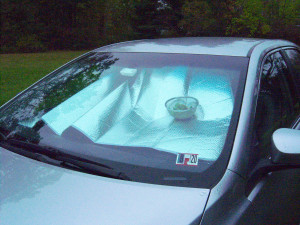
 My car sits in an open sunny spot and frequently is quite warm when I go to use it. Since I had lots of basil to dry, I thought I'd try to dry it in the car and it worked perfectly!
I washed it and left it in a strainer (or your could use a colander) which I placed in front of my reflective window shade in the car. By the end of the half day I left it out there, it was crispy dry and ready to store away! Great quick way to dry herbs/leaves.
Cheaper than using my electric dehydrator or oven, better then waiting forever hanging it in attic (and no worries about dust, dirt, bugs, etc) and so less work for me too. A Solar Solution!
The reflective shade really helped, I think. You could do it without but it may take a little longer.
This page contains the following solutions.
Most herbs dry easily, and if properly preserved, will retain their flavor and aroma long enough to carry you into the next growing season. As with a lot of gardening, timing is everything.
I have lots of herbs growing. When is the best time to harvest them for drying and storage?
Here are the questions asked by community members. Read on to see the answers provided by the ThriftyFun community.
I grew some wonderful lemon basil this summer. How do I dry it so I can enjoy it in the winter time? Many thanks for this great site. I have learned so much!
Hardiness Zone: 5a
By Paula from Niagara Falls, Ontario
Paula, I dry a variety of herbs and Lemon Basil is one of them. I pick the leaves early in the day after all dew or moisture is gone. I place a paper towel in the microwave on the turntable. Next, I spread out the leaves into one layer and try to not put one on top of the other. My microwave has different power levels and I use level #3. Start with 3 minutes then check. They should begin to look wilted. Microwave again for another 3 minutes on level 3.
I have grown sweet basil, purple basil and the very flavorful Thai basil, all of which are really yummy. I have a dehydrator, and have tried them that way, on the temp recommended, which is about 105, as i recall, same as my Greek oregano, but if you want it to taste really good, and have an idea how much you will generally use at a time, take the clean, dry, basil, put the fresh leaves, as many as you expect to use, in a fold of alum. Foil. Make as many folds of alum.
All you really need to do is set them out and let em dry naturally the best type of drying out herbs and em upside down on a piece of string on something up high like a lamp or something else that's able to be high enough so the water can drip out
Hardiness Zone: 8a
Becky from Charlotte, NC
It depends on what you're growing. I'm not sure if you're talking about harvesting the leaves, stems and seeds, or bringing the entire plant in for the winter. Some herbs, like basil for example, tend to taste bitter if harvested after the plant sets seeds. The same is true for most herbs that are harvested for their foliage. Once they bolt (set seed) their flavor is altered. As a general rule, herbs that will be used for their foliage should be harvested before they bolt. Herbs grown for seed should be harvested as their seedpods change from green to brown, but before the seeds drop or shatter.
Ellen
If they have gone to seed, there might be a bitter taste.
Likely. If drying for storage the best time to harvest is when leaves are large and green, not dry. Wrap a medium bundle in large twist tie and hang upside
The residue is usually the seeds in the bottom of the sack, mixed with remnant leaf/stem particles. If possible, separate them by sifting in a flour sifter or finer sifter.
Store seeds in old envelopes, seal, lable and
date, writing any special instructions, descriptions you might not remember.
If all you got is seed and tiny dried up leaves, just use them anyway, being extra careful to remove all stems, and learn for the next year's use.
Store seed in a cool,dry place, not plastic bag. Beware of bugs attracted and able to eat into the paper.
My experience is mostly with Tarragon, Basil,
Good luck and God's blessings to you.
I harvest my herbs all through the season for drying. I also cut off the flowering stem to promote more leaf growth, however I do leave some of the flowers so the butterflies and bees have something to feed on.
This is a page about using a microwave for drying herbs. There are a number of ways you can make your own dried herbs.
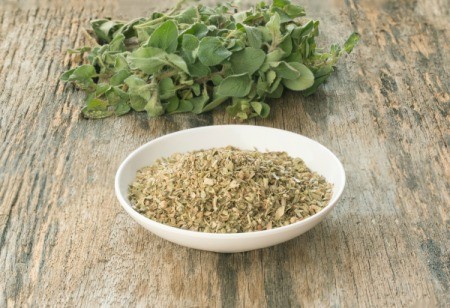
Fresh herbs are great, and it is good to have some dried ones to preserve your summer bounty, or to prevent fresh ones from spoiling before they can be used up. Some people freeze herbs, but they may be ruined with a power outage. Dried herbs stay good for longer.