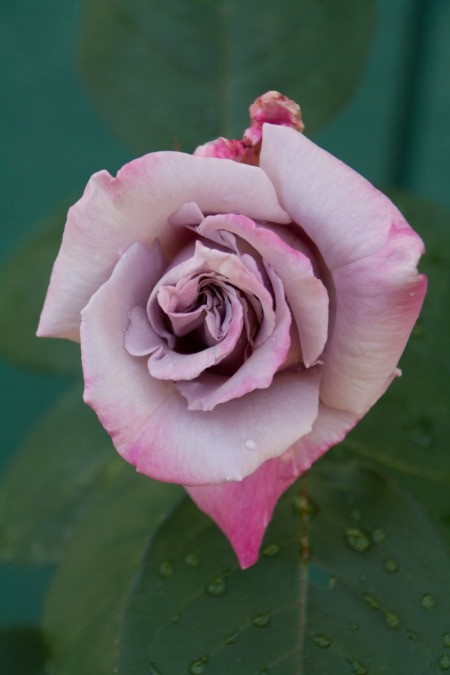
 All plants have their specific needs and roses can be especially tricky. There are many things to consider, including how and when you choose your plants, the make-up of your soil, your planting method, and the manner in which you care for them.
In selecting roses there are a few practices to follow that will increase your chances for success. Although bare-root roses are cheaper than potted ones, potted roses have a better survival rate and are easier to plant. Also, older rose varieties and roses that have maintained their original rootstock tend to be hardiest. Roses should be planted in late spring-early summer in order to give the plant time to develop a strong root system before the winter begins.
You need to plant your roses in good soil-rich earth. Too much clay, sand, or rock will hinder the development of your plant. It is especially important to establish and maintain the correct pH level in your soil. Buy an accurate test kit (inexpensive kits are inaccurate) to measure whether your soil is acidic, neutral or alkaline.
The scale of measurement for pH is from 0 (extremely acidic) to 14 (extremely alkaline) with 7 being the neutral measurement. The perfect pH for roses is 6.5, although the plants will do well with a soil pH between 5.5 and 7.
Your soil's pH level, which should be measured and adjusted in the early spring before planting, can be changed by using organic materials such as humus, which will increase the soil's water and nutrient holding capacity, the soil's reserve of slow release nutrients, and the soil's resistance to pH change.
Roses need room; be sure to check on how much your variety will require. Generally, miniatures should be planted a foot apart, hybrid teas, grandifloras, and floribundas 18 to 30 inches apart, and climbers from 8 to 12 feet apart.
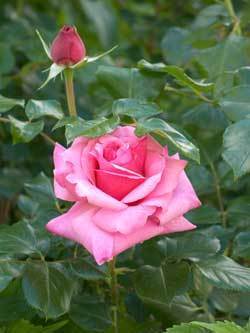
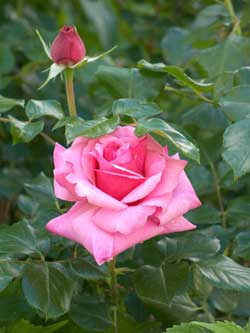 Roses add beauty and grace to any garden. |
The hole for your rose bush should be 2 1/2 times the size of the root-ball. Be sure to put compost into the bottom of the hole and to mix compost with the soil you'll return with the plant. When placing the rose bulb in the hole carefully pack the soil and compost mix under and around the root-ball. To insure proper growth the soil on top of the root-ball should be level with the ground.
Proper care of your roses will give them the best chance for survival. The best time to water your roses is early morning or late afternoon. A good, deep root soaking of about four to five gallons of water once a week is usually best. If you're in an extremely dry region then watering in this manner every three to four days is recommended.
Mulching, adding plant material such as dead leaves and grass to the topsoil around your roses, will increase water retention, enrich the soil, and lead to humus creation. This organic practice will keep your roses healthy and strong.
Roses add beauty and grace to any garden. Whether you plant one rose bush or many varieties, you'll want to follow the simple but important steps outlined above. They'll help insure that you'll have beautiful, flowering plants for years to come.
This page contains the following solutions.
A couple of times in other posts, I mentioned starting a rose bed on a hill at the upper end of my property. Sadly enough, this is it.

Don't like all those chemical dusting to put on flowers to keep the bugs away? Use plain flour instead.
When you read about plants and the pests and diseases that can affect them, you will find some extremes in the figures. Some plants are affected by only one or two pests and/or only one or two diseases.
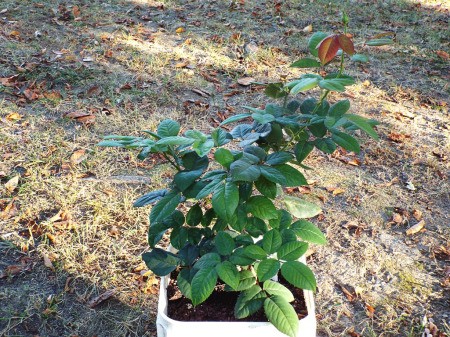
Give your rose bushes the potassium they need by watering them with Gatorade.
I like to use Miracle Gro for roses. It is the best product on on the market as I found out with these rosebushes. My cats are able to get up onto them and get some shade.

I have a few pots of Society garlic in between my rose bushes. It keeps the bugs away and the leaves nice and dark and shiny.
When I plant my roses, I always add a fresh whole unbroken egg to the planting hole. . .
Here are the questions asked by community members. Read on to see the answers provided by the ThriftyFun community.
 I have a climbing rose I planted in April that's been doing very well. I feed and spray for fungus and pests regularly.
Recently, where I live (zone 7b) we had five days of rain during which I could not spray, and when the rain ended I was surprised to find several of the leaves had been holed by small green worms on the underside of the leaves. The damage is quite extensive.
On Tuesday, our first non-rain day, I physically removed as many of the worms I could find and sprayed for pests, and will spray again tomorrow, and I seemed to have stopped them for now.
Here's my question: do I remove the branches with the damaged leaves in the hope the stems leaf out again, or do I leave them alone?
Also, what are the green worms most likely to be? I'm new to roses so any help appreciated.
By Scott A.
If the branches show signs of 'bud break' you should be ok leaving them. Keep an eye out for breaks for reassurance but if you see any sign of tip dieback (the tips of the branches will start to go brown and woody), prune back to about an half-inch above the next healthy looking break.
Be sure to angle your pruning cut slightly downwards and away from the centre of the plant. When you prune, try to keep the image of the 'backwards-foreward slash' in your head as a reminder to angle the cut away from the centre-you want your pruning cut to look like this: \ , not /.
Hope that helps:)
Oh! Meant to add that using a systemic pest and feed does amazing things for roses! You apply it around the base of the plant and water it in; it spreads through the whole plant and works rain or shine.
I used to use the Bayer one but there are several out there and they work wonderfully to feed your roses whilst spreading a nasty taste to plant parts-wowsa does that keep ALL bitey critters off! Worms, aphids, beetles, one bite and they back right off, wonderful stuff!
I planted a rosebush in my front yard. I planted it backwards. What do I do to fix this?
How do you care for roses? I tried using plant food and sunlight from the window sill. I applied spray plant food to plant, not soil. The plant is beginning to wither, what am I missing?
By Loleini
There should be websites you can find by going to Google that will show you how to grow roses indoors.
I have never had luck indoors, either; though I would try with the mini roses every so often. Last time I bought a mini rose, I planted it outdoors immediately; and it thrived! I have added more, and will be adding more this summer for a mini rose garden! I love them!
Growing roses indoors is harder than alot of plants but it can be done. One of the first things to do is grow in a sandier media than normal roses like water but don't like to stay wet. You have to give them at least 6hrs. of sun a day for the best performance ( maybe even a plant light ) and some good air circulation, roses like orchids like a good amount of air circulation and that's what most people don't think of as a plant requirement. Good Luck!
What can I do to get my knockout roses to bloom?
Hardiness Zone: 8a
We just moved to our current home 5 months ago and have the knockout roses for the first time. I put banana peels on mine and they went crazy! I also snip the used/spent blooms down to the cluster of fifth leaves and they will come back again. All roses love banana peels. I just throw them (cut up chunks) on top of the soil.
Have you fed them at all? They like a good feeding early when they are putting on foliage and then again about 6 weeks later. I use a concoction on mine called alfalfa tea. I buy alfalfa meal (you can get it at farm stores) and mix it with water. I feed the plants with this a couple of times during the summer.
I've just started the banana peel thing and hope it works as well!
I planted medium size roses that bloomed in abundance about four years ago. Half of the rose bush stems are drying up from roots to the top of bush.
By Julian
Is it OK to plant roses in raised beds?
Hardiness Zone: 5b
By eekhoff from Grand Bend area, Ontario
Yes you can. Roses can be planted in just about anything.
All but two of my roses are in raised beds and planters. Tree roses, bush roses and mini roses. GG Vi

I have a rose bush that has bloomed white roses for the last four years, now it has the big white blooms starting but there are some small red blooms on it, why?
Hardiness Zone: 5b
By sandy from Longmont, CO
Thise are probably from the root stock the white rose was grafted on to. Growers use a strong hardy plant for the root and graft a prettier but less hardy rose on to that.
I am sad to tell you the white rose grated upper cane must have died and the grafted portion of the hardier root stock is still alive;( that is why it was picked to graft to). I hope the little red roses are at least pretty and fragrant.
Can mini rose bushes be planted in April in New York?
Hardiness Zone: 7a
Tracylynn from NY
I wouldnt plant them in April. I live in Northeastern PA. We are in USDA Hardiness zone of 5B. We don't plant anything outside here until Memorial Day. It's wet here and plants rot. Be sure to wait til all threat of frost is past.
I guess you realize your rose bushes wont last over the winter in NY. They are hardy to zone 7a. They might be beautiful for the summer similar to an annual flower though. I'm not sure. Good luck
I live in the capital region of New York. My mini rose bushes lasted a few years, but not forever. I planted in mid-May. Of course, I never covered them up in the winter either. So give it a try and maybe you will be lucky!
I planted a deep red hybrid tea rose last year. Now this year it is a deep rose pink. Can anyone explain what happened? Thanks.
Hardiness Zone: 4a
By Jo from Kamloops, BC
Some times bees do cross pollinate flowers & etc. I remember a few years ago I planted a sweet pepper near a hot pepper plant, both turned out to be hot pepper, good luck.
How do I go about planting 2 red/white rose bushes in my front yard? I do not know where to begin with this task! Would you help me make this happen?
By Bertha L.
I was given two roses for a present. I planted them in the garden and gave them some Tomatorite fertilizer. The next day the leaves and buds had dropped off. Have I killed them or will they recover?
By John
How do I prepare the soil for growing scented roses and keep them safe? They are not climbing, but grow free standing outside.
By Gerald
Check out these photos.
I have tea roses in my garden to use in bouquets for our church altar to aid in worship. I cut the roses in the morning, sometimes a few days before I use them. I let them stand in water a few hours before I refrigerate them.

If you find a rose that you want to propagate, doing it from a cutting is the best way. Roses generally grow well from cuttings, but doing it right will give you the best results. This is a page about starting roses from cuttings.