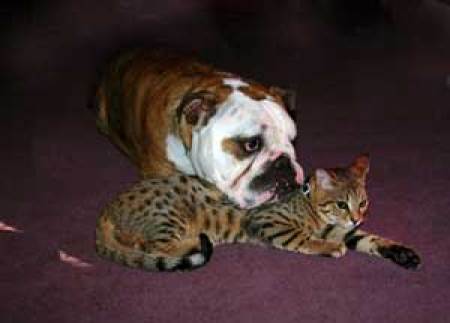
History & Origin: The Bengal breed is the result of crossing domestic shorthair cats with Asian Leopard Cats. This was first done in the 1970s as part of a study on feline leukemia conducted by Dr. Willard Centerwall, a geneticist at the University of California. Eight female hybrids were then acquired by another geneticist in California to use as foundation stock for what would later become the Bengal breed. Bengal were first recognized by the International Cat Association in 1983.
Character & Temperament: Bengal are playful and imaginative and have a unusual affinity for water. This breed has a 'wild' element to its voice and is a skilled climber and hunter. Like their wild counterparts, the Bengal is very agile, athletic and highly intelligent. As a companion the Bengal is outgoing, social, loving and affectionate.
Colors: leopard; marble; snow leopard; snow marble; sorrel; mink
Coat Type: Shorthair; The Bengal has a short to medium coat that is dense and luxuriously soft to the touch.
Grooming: Brush weekly to keep in top form-more when shedding. Claws should be trimmed and ears cleaned only when necessary.
Health Considerations: Unknown
Trivia: The Bengal was initially called the 'Leopardette.' Although hybrid cats usually produce offspring that are infertile, this did not prove to be the case with the Bengal.
Add your voice! Click below to comment. ThriftyFun is powered by your wisdom!
The breed is actually called the Bengal, not the Bengali, but everything else is right.
Add your voice! Click below to comment. ThriftyFun is powered by your wisdom!