Growing and Harvesting Bittersweet
American Bittersweet:
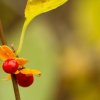
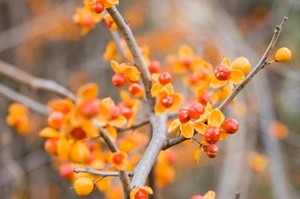
American bittersweet (Celastrus scandens) is a deciduous, perennial vine native to North America. Often found growing over fences or climbing up trees, their typical habitat includes rocky upland woodlands, savannas, thickets, and along shady riverbanks of the central and eastern U.S. American bittersweet has smooth, 2 to 4 inch long green leaves. The vines produce tiny greenish-white flowers in June and in early fall, orange-yellow seed husks peel back to reveal scarlet-colored fruit.
Bittersweet fruits are not safe for human consumption, but when left on the vine, they provide a much appreciated source of late winter food for many birds and small animals.
Chinese Bittersweet:
Unlike its American counterpart, Chinese (Oriental) bittersweet ( Celastrus orbiculatus), is considered an invasive plant in most areas. It can easily climb to heights of 40 ft or more in its quest to strangle nearby trees. Like American bittersweet, Chinese bittersweet is often used for fall decorating. The two would be easily confused if were not for the fact that the young twining shoots of Chinese bittersweet come equipped with a pair of soft thorns and its seed casings are yellow instead of orange.
Bittersweet can be bought from a nursery or propagated from seeds or cuttings. Seeds sown in the spring need to be placed in containers of moist sand or peat and kept in the refrigerator (34 to 41 degrees F) for 3 months to break dormancy.
Bittersweet vines grow well in both full sun and shade, although full sun is critical for fruit production. These vines are not particularly fussy about soil quality and pests seldom bother them. Because of their climbing habit, bittersweet needs a sturdy support-either an upright trellis or a lateral fence. Do not let it climb up a tree, however, because the twining nature of these vines will easily girdle the trunk. Occasional light pruning will keep plants tidy and help reign in their size. Pruning can be done in late winter or early spring.
Cutting back invasive bittersweet plants can stimulate the growth of new stems and root suckers. To kill a mature plant, cut back all top growth, and dig out the stump, making sure you get all remaining pieces of the roots. If necessary, repeat this procedure again in the late summer if new shoots spring up from the old roots.
Bittersweet readily self-sows, so when left unchecked, plants can soon be seen popping up everywhere. If you see plants sprouting where you don't want them, pull them out or relocate them to another part of the garden.
The seeds of more invasive Chinese bittersweet are spread by birds and animals and can remain viable for several years. Pulling parent plants out before they go to seed will assist greatly in eliminating the growth of future plants.
Here are the questions asked by community members. Read on to see the answers provided by the ThriftyFun community.
On a remote island on Lake of the Woods (Northwestern Ontario), there are quite a lot of what I thought was American Bittersweet vines. But looking at the new growth, what must be a shoot arising from the roots, the new leaves have a leaf thorn.
Does that mean this is Oriental Bittersweet?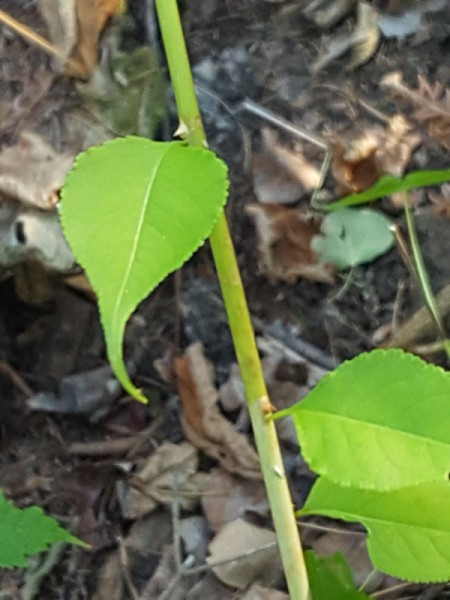
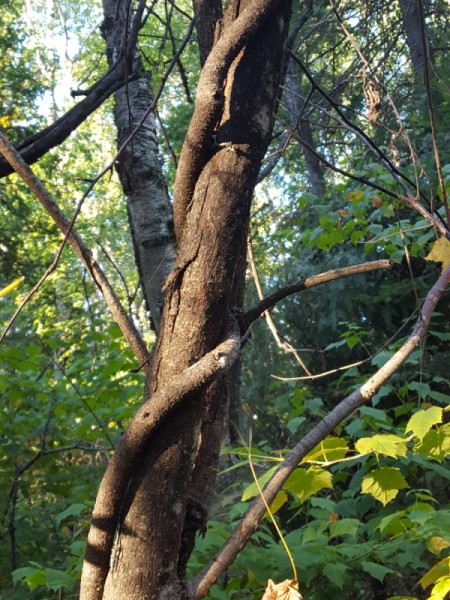
It could be a hybrid. This Michigan article talks about them:
msue.anr.msu.edu/
This second article is interesting also.
www.thespruce.com/
Perhaps your ag ministry can give you ways to control the invasive nature of these vines. Their contact info is below:
From your comments I do not believe this is in your yard but something you are interested in?
If it has thorns then it most likely is the dreaded Oriental bittersweet and will most likely eventually kill that tree it is growing on.
The Oriental bittersweet plant is similar to a lot of other plants that people either love or hate but it seems it is definitely an invasive plant and most cities do not want it in their area.
But - bird people like it because it seems to give birds a lot of food during the cold winter months when not much else is around.
Here is a statement that explains how to distinguish between the American bittersweet and the Oriental bittersweet (besides the thorns):
"Another way to distinguish between American and oriental types is by discerning the location of their berries: the berries of American bittersweet plants appear at the tips of the vines only, while those of the oriental type grow along the vine."
I really found this note interesting as I had not idea this plant was so rare but i live in Florida and this plant is not plentiful in my area.
"American bittersweet plant is becoming so rare in some areas that it is now a protected species."
Here is a very interesting article that discusses the good and bad of both plants and what can be done if it needs to be killed in some area.
www.thespruce.com/
It is possible the Oriental bittersweet is not considered a menace on the island you are talking about (since you say it is remote) but someone from your ministry of agriculture could tell you this.
I am visiting family in Iowa and would love to cut some of the huge amounts of bittersweet at my mom's farm. If I cut it with the berries still green will they eventually turn to the beautiful orange-red as they dry?
I picked some early once, and it just turned brown. But, its worth a try!
no
Once cut, the vine begins to dry immediately and the capsules, as they are called, will split open to reveal the bright orange fruit inside! This can happen quickly, sometimes overnight and sometimes before! Youll want to arrange it as you plan to use it right away in order to preserve the delicate pieces of the dried opened capsule from falling off. Enjoy!!
I have a bitter sweet branch that I placed in a jar of water and it's growing new foliage. Can I some how transplant this branch?
By Dennis R
Eons ago I used to go to davesgarden.com for excellent planting advice. I haven't been there in a long time so I don't know if it is still available. I hope so because they provided me with lots of good advice. You can get good regional info there so if you move from one state to another they can help you. We left Tn and moved to Tx and stayed for 30 years so I had forgotten how to get plants to grow in Tn. I got some good info off that site.
Yes
You can but to produce the pretty berries you need both male and female plants planted close together.
How do I start bittersweet vines from the seeds? Thank you.
By Rebecca from Syracuse, OH
Is it illegal to cut and sell bittersweet in the state of Ohio?
By Carol E.
I received three plants from a respected nursery and planted them three years ago. They struggled, but are now doing well, especially this summer. I live in the Georgia mountains. There are still no berries. Should I have them by now?
By Diana H
Do bittersweet seeds contain both male and female genders, or are some seeds strictly male, and some seeds strictly female?
By Lynn P.
For bittersweet vines they say you have to have female and male vines in order to grow them. Is this true? Also I would like to know how long does it take a bittersweet vine to produce flowers?
Hardiness Zone: 5a
By jenny from Lincoln, IL
I planted my bittersweet plants about 3 years ago. The vine is nice and full and is very healthy (yes, I have a male and female), but this is the first year that I have 3 berries. What is the problem?
Hardiness Zone: 6a
By janice from southwestern Ontario
I received my bittersweet plants in the mail and was wondering if I would use the fall planting instructions to plant them now in April?
Hardiness Zone: 5a
By Lynn from Madison, NE
ThriftyFun is one of the longest running frugal living communities on the Internet. These are archives of older discussions.
I would love to grow bittersweet, but have no knowledge in it.