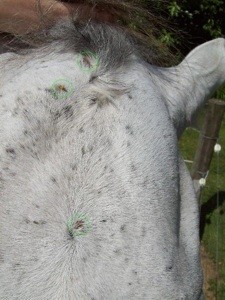
My new horse has relatively small black lumps on her face, mainly in the space between her eyes and forelock. The vet thought they were either insect irritations or melanomas (she's grey) but said it wouldn't stop her from purchasing her.
Add your voice! Click below to answer. ThriftyFun is powered by your wisdom!
The picture doesn't appear to be working.
I've now tried washing them in a watered down solution of betadine to get the crusty stuff off, then dabbed betadine straight onto them and applied filtabac over top. It seems to have improved them slightly, but I am still looking for ideas on what they might be, and the best way to go about treating them.
I think you've done exactly what I would do at this point. Now I would just leave them and hopefully they will just dry out and go away. I have only seem melamonas under the tail on a grey, never on their head, not to say they don't get them, just that I have never seen them.
This might seem a bit odd of a question. Does she take her feed from a plastic pail/tub?
Our cat, Skip was prone to "spots" on his face, when I took him to the vet, she said not to feed him from plastic bowls, as a type of bacteria formed on the plastic that resulted in a form of acne in cats and dogs.
I don't know that it is the same sort of spotting/crusting acne thing the cat had, but you never know.
Also, honey & olive oil, mixed in together, make a superior natural antibiotic healing ointment....also might be worth a try.....Good Luck.
Thanks for that, the picture is working for me now too :D It appears they are starting to heal, but two more have now appeared down near her mouth :o( I am now pretty much certain that they are insect bites though.
I once got a kitten that was lost & I took her in. She had skin things that looked like that, although it's hard to tell from the picture, but the cat had ringworm. If it's ringworm, use iodine. You can get white iodine from any drug store, it doesn't stain. Also, white vinegar might help. Vinegar kills many kinds of yeast based things, but so does iodine. Iodine also kills bacteria. I'd try one on one spot & the other on another spot. They are both cheap & you should b able to tell in 48hrs, whether they work or not. I'd put them on maybe 4 to 6 times a day. Hope your horse is better soon. I love horses.
I think I would check with a different Vet. Why didn't your Vet run some test if he wasn't sure what it was?
If you are still thinking insect bites I would try using some of the wipe on repellent to keep them off the face area. That is what I use on my horses and it seems to do the trick.
Thanks everyone :o)
Danialle, the vet was certain that they were not an issue at the time, and said that unless we were spending BIG money (which we suprisingly didn't for a horse like her, we got a very good bargain) that she really wouldn't worry about getting them tested as they are not painful for her or making her unwell.
I have asked opinions on several other sites, and I am now 99% sure they are an irritation from insects, so I will continue to treat them like that.
Thanks for the idea of wiping insect repellent on with a cloth Justanothercorgirl, I'll try that. I think I may need to find a recipe for one online though as the Stubben insect repellent I have for horses says you should wash your hands immediately if you come in contact with the liquid, and if it shouldn't be touching my skin then I'm not all that confident about spraying it on my horse :o(
I find tea tree oil useful for insect bites (& anything similar) Also Purple Spray...from Joseph Lyddie I think....is great for healing sores & cuts of all sorts as well as having insect repellant properties. It does stain the skin purple for a few days though. A fly veil may help prevent future bites. Or could it be an allergy to a plant your horse is rubbing against?
Add your voice! Click below to answer. ThriftyFun is powered by your wisdom!