Because your cat is such a conscientious groomer, you will find that from time to time he experiences a delightful phenomenon known as a hairball. Ah, hairballs. The hacking, the spitting up, and the singular delight of accidentally stepping in a fresh one.
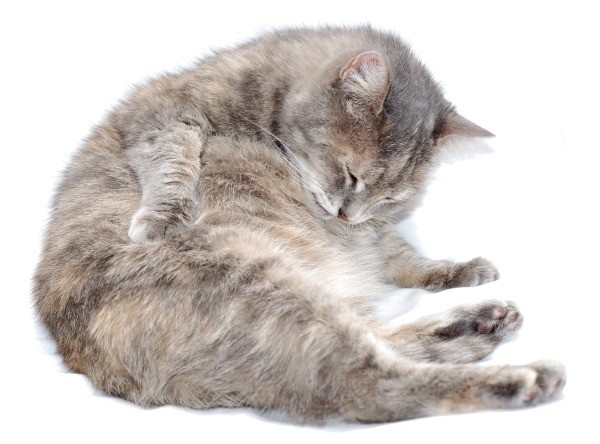
As your cat grooms himself, he dislodges loose fur. Some of that loose fur may be swallowed. Over time, the loose fur collects into a ball, and is regurgitated. You may find that your cat brings up a small hairball every few days or so. And that is perfectly healthy and normal!
Hairballs can be dangerous if they become stuck in the cat's intestine. A cat experiencing a stuck hairball may seem tired and run down, and will often lose his appetite. In extreme cases, your cat may need surgery to remove the blockage. However, a little fish oil in your cat's food may help the ingested hair slide through your cat's system.
Hairballs can also cause your cat to become constipated. Adding a little bran or roughage to your cat's diet can help things move more regularly.
Domesticated cats do not have one yearly shedding time, like cats in the wild do. Thanks to our artificial lights and temperatures of our homes, indoor cats will shed gradually throughout the year, leaving hair on carpets, furniture, and clothes. The constant shed means that hairballs will be a constant part of life with your cat.
And don't think that stopping your cat from grooming himself will stop the hairballs. Grooming is a natural behavior that is an important part of your cat's life! It is an enjoyable activity for your cat; if you have multiple cats, it is also a social activity.
If you brush your cat regularly, you can reduce the amount of loose fur, which will help lessen the frequency and size of hairballs. Grooming your cat also gives you a chance to check your cat for coat and health problems.
Add your voice! Click below to comment. ThriftyFun is powered by your wisdom!
My sister-in-law gave me a great tip for hairballs. Once every 2-3 weeks, I put about a half-a-teaspoon of vasaline on my cats front paws. He hates it and licks it all off right away. In the 4 years I have had him, he has only coughed up a hairball once !! It seems to work !!
Be glad if your cat coughs up hairballs. Mine was sick and I took her to the animal hospital. She was xrayed and it was found she had impacted hairballs in her intestines. She was given an enema. Of course, this was $300. I think she had this condition an entire year because she kept licking her belly area until there was no fur in that location. I think her belly bothered her. Now I'm happy when my kitty coughs.. smiles... I buy hairball formula pet food as well as hairball cat treats...
My cat had hairballs something terrible, often. I noticed when I put coconut oil on my legs, he would try to lick it off. So I got some on my finger, offered it to him, he loved it and it became a daily thing.
My husband and I are now experienced cat owners, but when we had our first kitten, we took him to the vet because he was vomiting. In trying to diagnose the possible problems, our vet did the best imitation EVER of a cat barfing a hairball (whookah, whookah, whookah, uugggss). The diagnosis and the audible take-away was spot on! It still makes us laught to this day :)
Add your voice! Click below to comment. ThriftyFun is powered by your wisdom!