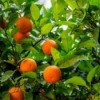
How do I change the color from green to orange on my oranges?
Hardiness Zone: 9b
Raj from Kenya
Hi Raj,
That's the ironic thing about oranges-they aren't always orange. Depending on the variety, sometimes oranges are green, yellow or even spotted. Temperature fluctuations are what cause oranges to change color while still on the tree. The pigment responsible for orange-colored oranges is called carotene. In order for oranges to turn orange, cooler temperatures are needed. This breaks down the chlorophyll (the green pigment) so the carotenes can show through. In climates where temperatures stay warm all of the time (Puerto Rico, Central America, South Pacific, West Africa), the oranges tend to remain green.
Fortunately, the color of an orange has little to do with whether or not it's mature enough to eat or if it will taste good. Apples, bananas and tomatoes all naturally give off ethylene gas while ripening. It might be worth a try to store your green oranges in a cool enclosed area (like the fridge) with one or more of these fruits. Who knows, if enough gas is produced, you might see a color change.
Good luck!
Ellen
About The Author: Ellen Brown is our Green Living and Gardening Expert. Click here to ask Ellen a question! Ellen Brown is an environmental writer and photographer and the owner of Sustainable Media, an environmental media company that specializes in helping businesses and organizations promote eco-friendly products and services. Contact her on the web at http://www.sustainable-media.com
Add your voice! Click below to answer. ThriftyFun is powered by your wisdom!
"Store Oranges" are dyed for the uniform look. Longer the oranges are left on the tree the "oranger" they will get. They are sweet even if they are only half orange. I live in Centeral Louisiana. Don't know what zone.
My sister-in-law had an orange tree in Florida and the oranges were always green! They never turned orange, but they were the sweetest, best tasting oranges I've ever had!
Add your voice! Click below to answer. ThriftyFun is powered by your wisdom!