We have had so many great photo ideas submitted that we have broken this into two articles.
Here is a link to the first section if you still need more ideas. Post your own Christmas card photo here.
Happy Holidays!
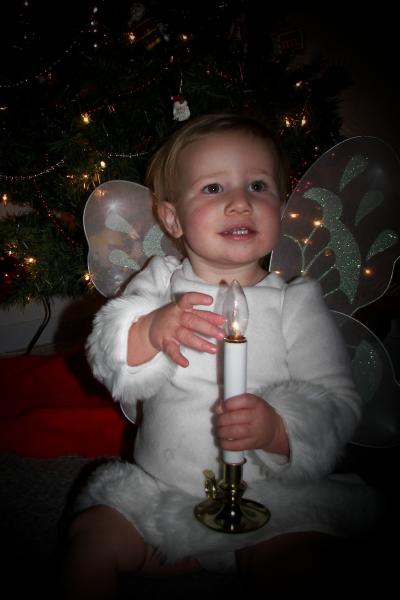
This year, my daughter (19 months) is very entertained with baking, so we put a bowl of flour on the floor of the kitchen, and put her in a Santa hat and a Christmas apron I had made. The I gave her a wooden spoon and a whisk to play with in the flour. The front of my cards say "We Whisk You A Merry Christmas". The other cards I did, I made my daughter a nighty out of white polar fleece and glued faux fur around the cuffs and bottom.
By Diane
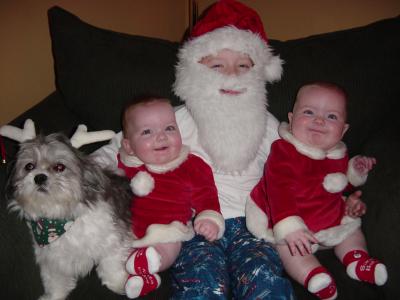
Here's our Christmas card from 2 years ago. We had my son who was 6 dressed as Santa with my 6 month old twin daughters sitting on his lap. We also added our dog Sammy to the mix.
By Amy
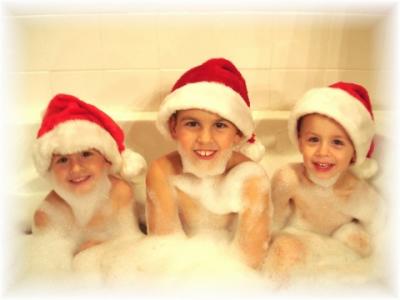
I got the bathtub idea from this site last year and came back for another idea for 2007. I got so many compliments on our card. Thanks for the great idea!! My kids had a blast during the photo shoot!
By Kelley
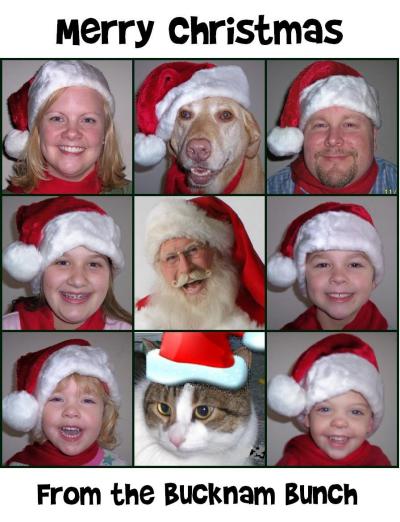
Thanks for the Brady Bunch idea. Here is what our card looks like this year.
By Tabitha
What a great website, thanks for sharing all these creative ideas. I enjoyed everyone's card. Here's another variation of the Reindeer theme. My kids enjoyed hiking through the woods looking for antlers!
By Coni, Evanston, IL

This is the one we used last year.
By Debra from Alabama

A simple Santa suit and a candy cane was all we used to create a classic card. Our daughter was 6 months old when this picture was taken.
By Julie

We had lots of compliments from this Christmas card. Now I'm trying to find something for this year! This one is hard to beat! :)
By Yolanda

A real challenge to get teenage boys interested. We mixed every sport we could into a photo. The big challenge was getting 2 soccer balls balanced at the same time without falling into the tree.
Around the picture we used the word (quote)Soccer balls, basketballs, baseball, track, and more... Oh, what fun we've had this year! We're anything but bored! (sung to the tune of Jingle Bells)(/quote)
When they were smaller, I would dress them in red or green and lay them on the floor in the shape of letters such as J, O, and Y. Photo each letter separately from above and then use a digital editor to cut out the letters and place them on a card.
By Deb from WI

Last year we have one of those big inflatable snow globes in our yard. We slit the back open the entire family climbed inside, taped the slit closed reinflated it and had a friend take our picture. - Adorable
Another year we all fell into the pool sideways and had the caption "May you plunge into the Holidays with love and laughter"
Went to a cotton field and had an Arizona Snowball fight with cotton since we do not get snow.
My 9 year old sat on the floor, my 13 year old knelt behind him, I sat on a chair behind him and my husband stood behind me so we were in a tall stack. We each had on a different style of Santa Hat.
By Peggy - Arizona

I dressed my Yorkie as a snowman. I cut out white poster board into circles, added a green felt scarf, also added a black hat and buttons. Then put it in front of him, made him stand there and took the picture. I added snowflakes and 'Let it snow' in Photoshop. The background was a gray and white bed sheet.
By Cherie
We found this neat extra long Santa hat for our son to wear. The stripes made it neat and candy cane-y.
By Karyl from Oahu

We had put in an outdoor hot tub this year. I put the kids in there with their reindeer ears and holding polyfill and strays of holy behind them. This was our best photo yet!!! Our caption was "Have a Hot & Steamy Holiday"
By Dee

I did this Christmas card last year and everyone who knows us and our dogs got a kick out of it.
By Trisha

We used this picture last year with the caption - Wishing you a very Merry Christmas and a "Royal Flush" New Year!
By lmrauch

I took this one myself in front of our fireplace with poinsettias all around. I layed her in her favorite vibrating chair covered in a Christmas quilt to keep her asleep through the process.
By Amanda


We live in Florida and this was our Christmas card in 1998. Everyone still talks about it!
By Lisa Jane

Having a 15 and a 10 yr old, our house can get pretty crazy! I thought that this was the greatest gift a tired parent could ever hope for! My kids were totally up for this.
By The Byerlys

I found this site and had to do the "Silent Night...Priceless" idea with my boys. We got a great shot of our 4 boys and our dog! We got REALLY great feedback!
By Tina Keppler

This year we dressed our girls in red tutus and Santa hats. Then used the wording "Wishing you a holiday that is "tu-tu" good". Turned out really cute.
By ali

This was my card last year. Notice the pictures of the family above the fireplace, our dogs on the back wall, and the ultrasound picture on the very back wall.
By Turner

This was our card....got lots of good feedback.
By Rhonda

Inside card:
"May the light of the Savior be reflected on you this Christmas"
By Y

I found this cute Elvis costume at the Peabody Hotel in Memphis, that I thought would be so cute for my son to wear for Halloween, but I had to justify to my husband why I was spending that amount of money for a Halloween costume, so I decided to do his Christmas Cards in it as well and, needless to say my husband thought it was adorable. We have had so many compliments on his card!
By Cheryl

We got so many great responses - we think we'll do a fun card like that every year! Thanks to everyone for their ideas - never would have thought of this idea without reading some of yours!
By Michelle

Good for couples that travel a lot.
I did a joy to the world theme and put pictures of all the places my husband and I traveled that year. I created a blank 4x6 inch canvas in Photoshop and cropped all the other pictures to a 1x1 size and inserted them in leaving room for what was originally going to be 4 squares but then switched into 2 that said "Joy to"& "the World". Mine required 18 photos
By Beth

I used one of the ideas on this site and everyone loved it! Grandma had bought a Harley jacket for my son and I read on this site that they used a Harley theme and wrote: Happy Harleydays! That's what I did! I took him to a Harley bike shop and took these photos. I'll be back during this holiday season to get some more ideas! Keep posting!
By Ant

We had fun making a sand snowman... I took a nerf soccer ball, sprayed it with adhesive, and rolled it in the sand to make a nice round head.
By Amber

This is a card that we sent out a few years ago. The photo of our family was taken in 2006 but the living room is authentic 1950s. We just put the two together.
By Theresa

This card was a twist on Norman Rockwell's Illustration "Freedom from Want"
By Theresa

"I Saw Mommy Kissing Santa Claus" was a big hit! Lot of friends still have this on their fridge. Kids are big believers and thought this it was pretty funny that daddy was dressed like the real McCoy!
By Elke

I have four children and 4 years ago we began a series of Christmas photo cards doing our take on Beatles album covers. We began with the Abbey Road album and took a picture of our four kids in order by age crossing the street in the crosswalk. This past Christmas we decided would be the finale in our series and we had a graphic artist friend do an illustration of our kids like the Yellow Submarine cover. We thought it was quite fun and we received many compliments, especially from Beatles fans.
By Stephanie

I came across this page on a fluke but I think the ideas here are wonderful. After seeing everyone's great ideas I feel like it wouldn't be fair not to share my own.
Last Christmas I couldn't decide which family picture to use so I combined a few of my favorites into a montage using some graphics software. It was a smash hit! I've never heard so many compliments on a Christmas card (even from the ladies at Walgreens who printed them).
I think you can get these automatically done now from places like Snapfish or Kodak EasyShare but If you're inclined to try this yourself my only tip is to be careful which aspect ratio you're using--4x6 or 5x7 and do the layout accordingly. (My red border didn't come out symmetric on the prints.) It might take a few tests at your local photo place before you do the "big print."
This definitely raised the bar for me and now I'm on the prowl for 2008 ideas.
By Dan

The caption read, "Treat Santa nice this year"
By Jensen

I loved this website! I got some cool ideas for this year. Last year our card was very simple but it included our very loved dog, this year we're planning something more original and of course, our new addition to the family, our other dog!Thanx to everyone who shared their ideas!
By Mayra

Every year I try to come up with something different... this was the picture for Christmas '07.
By Stephanie

The website is great, love all the ideas.
This picture was taken in my neighbors yard. My sister-in-law said it took a couple of days before she realized it was my kids in the pic. She had to see it hanging in her mom's house before she noticed it. My mom had made the costumes for the kids to attend an Advent celebration at church where the kids were encouraged to dress up.
By Jolice.

My husband and I were monkeys for our Christmas card. The photo was black and white and I went into photo shop to color the hats red, the wreath green, wreath bow red, and the banana yellow. The inside of the card read "Hanging around Atlanta this holiday season. Going bananas for a Christmas filled with...and so on."
By Tiffany

Used this one of our son in 2007.
Caption read
"Let There be Light"
By

This was are Christmas card for last year. It said "Jingle bell, Jingle bell, Jingle bell rock!" on the cover surrounding the picture. On the inside there was another picture of the kids just posing in black and white with the converse kept in red [by photoshop.] On the right of the photo on the inside, "Silent night? forget it. silent days? forget those too." And underneath the photo it said, "life is good." in red. On the bottom half of the card it said, "wishin' you a jammin' 2008 filled with peace and joy. Peace out!
By Monica H

Here is my family's 2008 Christmas card photo. The inside will read:
Wishing you a wild ride into 2009!
By Courtney
This was our 1st Christmas card with our twin daughters. It said "Hope your stockings are stuffed with love this holiday season!"
This was our 2nd Christmas card (the milk and cookies one).
This was our 3rd Christmas card...now with 3 kids. So we did the J-O-Y pictures to make it easier on ourselves.

Inside, it said:
Santa hat...$2
Wooden letters and paint...$5
Choosing a card that didn't require a picture of all 3 kids together...priceless
And in the background is a chaotic picture of all 3, which is what we assumed would happen ;)
By Amber

We did this one last year. What would we do without Photoshop. The composition was created from photos taken in 3 separate stages: bottom, middle, top. My youngest son wasn't that cooperative sitting on his brother's shoulders so I had to take a separate shot of him. The tree topper was illustrated and the tree top was photoshop'd in. I don't know if we can "top" ourselves this year... the inscription read "This circus act performs year 'round. We just up the routine in December. Hope your holidays are head and shoulders above the rest!"
By Seth

Had my 22 month old son dress as Tiny Tim and then made the photo look old/sepia. Then photo shopped a stick/cane under his arm. Title read, "And God Bless Us, Everyone!" Got huge amount of compliments on this one!
By Jeni S.

Tried to get the perfect shot of everyone, but the crazy one was my favorite so here is what I did "Oh Christmas Tree, Oh Whatever!"
By mom of 4

I did this two years ago with my son and I got tons of compliments.
By Shannon

A few years ago, my husband and I used this photo for our Christmas card. It read 'Merry Christmas and Bah-humbug'.
By Jinny S.

Fourjugglers, What a great card! We also try to create the "different" card every year. Here is one of my favorites that we used a few years ago.
By Tammy

Merry Grinchmas! For when your husband really hates the yearly family Christmas photo project. Got the "who" wigs on ebay.
By Metalgal30

We made red & Green Tie Dyed Shirts for a one of a kind Florida Christmas!
By Shirley

Here's our Christmas Card photo for 2007...we had a lot of fun preparing for the photo too!
By Shawn

Everyone loved the kids with the M&M's. We had tried to get a good pic for about 30 minutes and we finally decided to give them the entire bin of M&Ms. They were thrilled.
By Leslie

I gave up chasing the kids around for the perfect photo. Paint always gets their attention! In south Florida there was no reason for all the clothes.
By Carey D

This was our last year's photo - Card said, "I'm Dreaming Of A..." Inside said "White Trash Christmas"
By Shari

We used this photo for our 2007 Christmas Card. We live in Melbourne Australia and took the children to the Royal Botanic Gardens with a few RED Christmas decorations and red tinsil. It worked out lovely, we received so many compliments. The other idea I had was for the children to decorate a tree in the Botancial gardens which turned out lovely as well, but the family vote was for this picture. The red Christmas decorations against the green of the trees is amazing.
By Mary

We dressed up as elves and just used sticky felt on our ears. we took a bunch of pictures of us standing, sitting, kissing, and just picked the one we liked the best. was lot's of fun!
By
A Christmas Story is our favourite holiday movie, so of course I just had to do this one...
Here is last year's card. It was perfect for a not so interested teen! We had the image printed onto card stock, with the caption: "Listening" to the Night Before Christmas. Notice the ipod in my son's ears and one of them looking at a sports magazine; both pretending to listen to their little sister's story!
Here is another: simple yet festive - the kids in their winter finery posing on our decorated front porch. Sometimes simple is good!

Check out my decorating blog for more holiday ideas:
By Restyled Home

Our card read "The (enter last name)'s were nestled all snug in their bed!"
By Cindie

This is our card from last year. We actually did it in our living room and had a friend take the pic. The white background is just a sheet hanging over the bar. I did the black and white in Photo Shop. Our dog was so not feeling the jingle bell collar!
By Kim A

I blew my kids heads up. They looked so funny compared to their bodies.
By ThriftyFun

This was my last years card. Only had one santa hat, had to take all three photos separate and put back together in Photoshop. The inside said "May you see no evil, hear no evil and speak no evil this holiday season". My family expect funny cards every year now!
By Tina

This year, I wanted to do something different than just a picture, so I found a website called yourartnow.com and they did this colored pencil drawing for me. I'm going to use this as my Christmas card. The drawing is an 8x10 but I can easily reduce it to a 5x7 to print on my cards.
By Debra from Alabama

We used this picture for our Christmas Card in 2007. We uploaded this on ritzpix.com and used one of their photocard templates. It turned out so great and we got such good feedback! Perfect for those of us who don't have kiddos yet!
By Courtney

I collect old books and thought this was a good idea for an old fashioned photo. The kids are wearing feety pajamas.
By Eileen

I got this idea from your site last year, we got so many complements on the card! I used Photoshop and tried to get as many characters in the picture as possible. The pic features myself and my boyfriend and I'm holding our hedgehog!

It is always so difficult to get them all happy at once, so we put a nice picture, then this one that read, "Forced Family Fun" from the Holt's!
By The Holt Family
We are a young couple and have no children (except our furbaby). This picture was from our second Christmas together.
Last year our Christmas card featured our cat, Kitty. I found the cutest card from Walgreens that said "Meowy Christmas" and it had little fish and bones, etc on it. She is "reading" 'The Night Before Christmas." We got rave reviews!
By Amy

Add your voice! Click below to comment. ThriftyFun is powered by your wisdom!
We love to do different photos with our dog every Christmas. Everyone can't wait to see what our next card will be. Last year we got look alike PJs for the three of us and here is the results. Love this site, great ideas everyone!

Add your voice! Click below to comment. ThriftyFun is powered by your wisdom!