The irony of saving is that it is more important now than ever, yet it's harder to save today than it was a few years ago. What's the method of savings some extra money without cutting back on the things that you love? The answer is a steady routine and some dedication without falter.
It's the basic savings principle: decide on a small amount of money that you can live without each week. (If you can splurge on a $25 meal each week, then you can cut back on that meal and put the money aside instead.) Thanks to direct deposit programs, you can set up to have $25 or $50 of your pay deposited into your savings account each week. Then, forget it's there.
That's right, don't look at the statements, don't add it up, and don't even think about it. This is your emergency fund, so it's best left alone until an emergency arrives. You can check it each year, probably at tax time, and you can watch for unauthorized activity to keep your account safe but try not to give it any more thought than that.
It would be a good idea to transfer the savings once a year into a CD or another safe investment. Then, forget about that as well. (These are easier to manage since fraudulent activity isn't likely to happen.)
It's amazing how quickly a small amount of money adds up. A $50 deposit each week rapidly grows to $2,600 in a year's time.
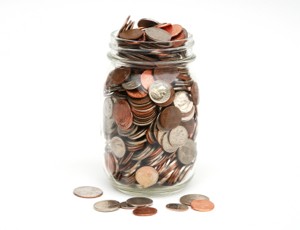
It's an idea as old as Mason jars and blue jeans. In fact, it's such a successful idea that a credit card company used it as a promotion awhile back. When paying for items throughout the day, pay with paper money as much as possible. Then, at the end of the day drop all of your change into a can, jar, or basket. Once the jar is full, take your change to a cash counting machine (or you can count and wrap it yourself if you want to buy your own coin wrappers and end with dirty fingers.)
The trick to using change counting machines (such as Coin Star) is to opt for other forms of payment than cash. Coin Star machines deduct 8% of your total as payment for the counting service if you ask for your cash back in paper bills. However, usually if you roll your change over into the various gift cards or the Amazon.com gift certificates that are offered, no money is deducted from your total. Some stores offer grocery gift cards at the machines that they house, changing your change into groceries.
A good method for keeping tabs on your extra spending as well as saving money for a rainy day is to make deposits when you make withdraws. In other words, every time you spend money on something frivolous, put the same amount in your savings. If your morning coffee costs $1.25, put another $1.25 in a savings jar. If you purchase a music CD for $14, deposit $14 in your savings. Yes, everything costs twice as much. Isn't that enough to make you think twice about spending?
For larger purchases, you can put half of the amount aside. For instance, purchasing a $149 iPod would require a rough $75 deposit into your savings. Think about it this way: if you don't have the extra money to deposit into your savings, should you really be spending the initial money? Savings needs to be a priority. When your budget doesn't allow for saving money, your budget needs to be cut.
Add your voice! Click below to comment. ThriftyFun is powered by your wisdom!
I think the idea about depositing 'twice as much' is another way of wording a thrift tip I read from the Great Depression which was, don't buy a treat until you've got two times the money saved and in hand. Good tips.
Love the thought process behind the double your purchase idea. It's true and makes you stop and think, if you can't afford to put the full amount in, then maybe you should reconsider your purchase.
Add your voice! Click below to comment. ThriftyFun is powered by your wisdom!