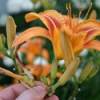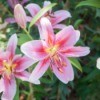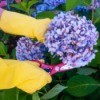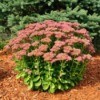
One of the best ways to prolong color in your perennial beds and borders is to deadhead spent flowers. Not only does this encourage reflowering by limiting seed production and self-seeding, it keeps the garden looking neat and tidy by focusing all of the attention on the living flowers. Here are some tips on how to deadhead specific types of perennials.
From a plant's point of view, the sole purpose of a flower is to attract pollinators that will help the plant form seeds for reproduction. Once a flower is pollinated, it wilts. This sends a chemical message to the rest of the plant to put the brakes on flowering and start diverting energy into producing seeds. Deadheading flowers as they fade prevents the "start producing seeds" message from getting sent to the plant. As a result, the plant keeps on funneling all of its energy into flower production.
Deadheading should be done as soon a as a plant's flowers start to fade. The plant is usually pinched back to the next flower, bud or leaf on a stem. Simply pulling off the spent flower petals isn't a good idea, because developing seedpods are often left behind.
Don't worry about buying special tools. You can use your fingers for the job, or a pair of sharp scissors or shears for tougher stems.
Different perennials require different approaches to deadheading. With a little trial and error, you'll figure out which plants in your garden benefit the most from deadheading. Flowers like irises require a strategy beyond the basic method, because they produce new flowers low on their stalks. Other perennials-peonies, for example-will not rebloom with deadheading, but they will look much better in appearance if spent flowers are removed.
Wait until the flowers begin to fade and cut back the entire flowering stem all the way to the ground, if possible.
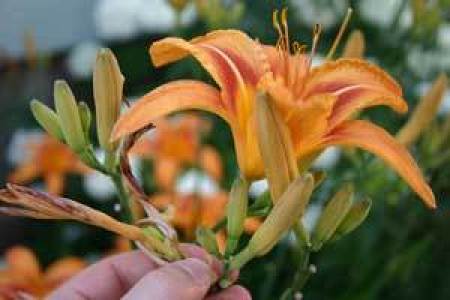
Remove the spent blossoms from lilies just below the bottom of the flower and keep as many leaves on the plant as possible. With daylilies, you can either remove the spent flower every day, or wait until the entire stalk (scape) flowers and cut the stalk down the to the plant's base.
Wait until all of the flowers on a single stalk finish blooming, then cut the entire stem down to the plant's base.
Deadhead the stem at foliage level.
Cut plants back just below the bulk of the flowers.
Deadhead individual flowers.
Shear plants halfway back to the base.
Balloon flower, bellflower, blanket flower, coreopsis, delphinium, foxglove, garden phlox, hollyhock, lupine, monkshoods, spiderwort and yarrow.
Astilbe, barrenwort, begenia, bugbane, goatsbeard, lamb's ears, ligularia, lilyturf, oriental poppy, peony and Siberian iris.
About The Author: Ellen Brown is our Green Living and Gardening Expert. Click here to ask Ellen a question! Ellen Brown is an environmental writer and photographer and the owner of Sustainable Media, an environmental media company that specializes in helping businesses and organizations promote eco-friendly products and services. Contact her on the web at http://www.sustainable-media.com
Add your voice! Click below to comment. ThriftyFun is powered by your wisdom!
Thank you so much. I really needed the help. I have two plants I'm not sure about. One is the hibiscus and the other is the hydrangea. Thanks again.
Thanks for the good info. Do Shasta Daisies actually produce more flowers by deadheading? I've tried it in past years and it didn't seem to make a difference.
Add your voice! Click below to comment. ThriftyFun is powered by your wisdom!