Botanical Name:
Scilla
Life Cycle:
perennial bulb
Planting Time:
fall for spring blooms
Height:
4" to 6" depending on species
Exposure:
prefers light shade
Soil:
average to rich, well-drained soil; prefers moisture in spring
Hardiness:
hardy to zones 2-8
Bloom Time:
later winter or early spring
Flower:
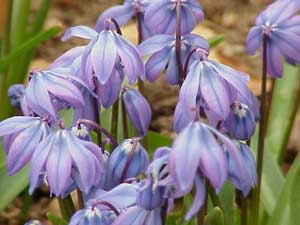
species dependent; white, blue (most popular) and pink
Foliage:
long and narrow, bright green leaves
Propagation:
division is easiest
Suggested Use:
beds, borders, mass plantings and native plantings
Growing Hints:
There are several species of Squill, but Siberian Squill (Scilla siberica) is probably the most commonly grown. It blooms in the spring along with Snowdrops, Tulips, Hyacinth and Crocus and often produces more than one 8 inch stem per bulbs, each with up to 6 start-shaped flowers. Plants in this species are often planted close together for the greatest color effect. Small varieties should be planted 4 inches deep at 2 to 3 inch intervals. Larger species may be planted at the same depth but spaced up to 8 inches apart. Squill does not need to be divided unless you intend to propagate your stock.
Interesting Facts:
Like its namesake, Siberian Squill originates from the frozen tundra of Siberia.