Home |  Index |  Submit Request |  Share Photos |  Share Tips |  Active Topics |  New Feedback  |  Contact Us  |  Search
 User Login:  Username:    Password:      Forgot It?  | Join ThriftyFun!

 Popular Topics
 - Beauty
 - Budget and Finance
 - Christmas *
 - Cleaning
 - Consumer Advice
 - Craft Projects
 - Craft Tips
 - Food Tips
 - Garage Sales
 - Gardening
 - Gifts
 - Green Living
 - Home Improvement
 - Organizing
 - Parenting
 - Parties
 - Pest Control
 - Pets
 - Product Reviews
 - Recipes
 - Repair
 - Thanksgiving
 - Weddings for Less

More Topics

Google Search:

Web thriftyfun.com

About:
RSS Feed
About Us
Media
Advertising
Contact Us
Privacy Statement
Disclaimer

Garden Insects: Bagworms

By Ellen Brown
1x1
Date: 08/12/2006 Topics: Gardening > Pest Control > Garden Insect Guides | Pest Control > Caterpillars  
1x1
1x1
Post Feedback! | Email Friend | Print | Get Responses | Bookmark | del.icio.us | Link | Rate: Thumbs Up Thumbs Down
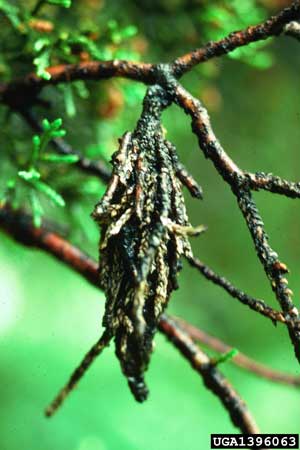
Subject: Bagworms<br>Citation: USDA Forest Service-Northeastern Areas Archives, USDA Forest Service, <a href="http://www.insectimages.org">www.insectimages.org</a>
Subject: Bagworms
Citation: USDA Forest Service-Northeastern Areas Archives, USDA Forest Service, www.insectimages.org

Identification

Bagworms are small, dirt-brown colored caterpillars, which are sometimes difficult to see. They disguise themselves with parts of the shrubs and foliage they eat by forming a spindle-shaped bag that measures 1 1/2 to 2 1/2 inches in length. The bag is formed by gluing parts of leaves together with silk, and carried along with the caterpillar as it feeds. As the larvae grow, the bag grows with it and when disturbed, the larvae will hide inside. In autumn, the bags reach their maximum size of 1-1/2 to 2 inches. At this time the larvae permanently suspend their bags downward from twigs, and transform into the pupa or resting stage before becoming an adult. The females stay in a larva-like stage, never emerging from the bag. The males transform into bee-like adults with clear wings and fur-covered bodies.

Favorite Plants

Bagworms feed on many conifers and deciduous trees. They are especially fond of arborvitae, juniper and cedar.

Damage

Female bagworm larvae cannot fly, so populations may build up on trees. When this occurs, crowded larvae may eat the buds, causing branch dieback and large open dead areas. Older larvae strip evergreens of their needles and consume whole leaves of susceptible deciduous species, leaving only the larger veins. Moderate amounts of defoliation can be unsightly, but excessive amounts may result in severe Damage (even death) to the tree the following season. Mature larvae attach their bags to a branch by wrapping it with extra silk. Be sure to cut off this silk band when removing bags from a plants or it may girdle the branch as the tree grows.
Organic Methods of Control:

Cultural or Mechanical

  • Hand picking the bags is the most effective method for small infestations. This can be done easily in the late fall when deciduous foliage has dropped, or when bits of plant material on the bags turn brown and can be easily located on evergreens.

Biological

  • Spray Bt (Bacillus thuringiensis) on foliage for heavier infestations. Apply in June after all the eggs have hatched.
Jump to Feedback | Post feedback
Related Links:
Previous: Birthday Party Locations in Chicago ThriftyFun Next: Garden Insects: Armyworms (Beet & Fall Armyworms)
1x1
 Feedback
1x1
1x1
1x1
1x1
 Sponsors
1x1
1x1

No Feedback Yet

Be the first to post feedback! Click here to post feedback.

1x1

Post Feedback:
Login using the form on the top of the page to post feedback if you have registered with ThriftyFun. If you have not yet registered, click here. It's FREE!. If you are not registered you can post feedback as a guest below. Please don't use your email address for your name because spam robots can dredge it from our site. Please do not post your feedback more than ONCE. We need to approve all guest feedback and it may take from minutes to hours for that to happen.
(1x1 graphic )
Your Name

Subject

Feedback

text tool text tool text tool text tool

Image Upload: Add an image to your post! Click the "Browse" button below and select an image from your hard drive. Please only select gifs or jpegs. If you have any problems, just email the image to images@thriftyfun.com


If you want to post your email address for responses from readers, obscure it in some way like put spaces between the name and @ sign and service address with (remove spaces) behind it or name (at) server (dot) com . This is for your protection from those creepy Robots.

(1x1 graphic )

© 1997-2008 ThriftyFun.com - Design by Cumuli Design
Disclaimer: ThriftyFun.com cannot accept any responsibility for any injury or damage that you may cause to yourself, others, or property when following any advice given on this site. Read the full disclaimer. If you find any information on ThriftyFun.com or in our newsletters that is either erroneous and/or potentially harmful to others, please Contact Us, immediately.