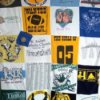
How do I make a quilt out of old clothes? What size are the squares suppose to be? After I sew them together what is my next step? My mother just passed away and I really want to make a quilt out of her clothes.
By connie from Canton, GA
Add your voice! Click below to answer. ThriftyFun is powered by your wisdom!
Great minds run the same channels . . . hee, hee! I've been thinking of doing the same thing with some old family clothes, myself. :) Unfortunately, I've not yet educated myself well enough to offer sound advice.
Do a Goggle (or Bing, or whatever you use) internet search on "fat quarters" (a quilting term.) It might not be exactly what you are looking for but it's a starting point.
Check at your local library to see if there are any quilting groups in your area, and ask at any fabric store if they know of a quilting group or offer quilting classes.
I was fortunate to learn the basics of "piecing" and "hand quilt stitching" from my grandmother but that was many years ago. There are so many more options available today for someone who wants to make a quilt. For example, some folks enjoy the "piecing" and will do so for a fee while others enjoy the actual "quilting" and have fancy machines (again for a fee) that can quilt an item in mere hours. If you get really lucky you just might find a group or individual that offers inexpensive classes, too.
Good luck, and post an essay here if you get it figured out! :)
Kansas Cindy is right - between the library and Google you should be able to get the basics for your quilt. The only thing you might want to consider is if you have wildly varying fabrics they may need to be treated differently.
You can make the squares any size that you want. Myself being I'm not real patient, I make them as large as I can. lol Usually I make about a nine inch square. One thing you don't want to do is mix wovens and knits together. Also real light weight fabrics don't endure real long in a quilt. My Mother made my disabled daughter a quilt out of old clothes one time and the squares that were made out of lighter weight fabrics combined with the fact that they were slightly worn, didn't last as long as the ones made out of heavier cotton type fabrics and the new ones.
Here is a site with instructions on how to make a simple crib quilt, but you can adjust the measurements to make it any size you want.
www.associatedcontent.com/
My sister makes the cutest vests from acquired fabrics. Lightweight fabrics can be cut in to thin strips for crocheting a cloche or toque a trendy item the kids are wearing these days.
If some of the clothes have fancy areas, I would try to make my squares in such a way as to incorporate them. Example, if something had a lace collar, I would cut a square that included the collar. If you wanted, you could sew it flat first. Don't forget to add seam allowances when cutting out squares, usually 1/4 to 1/2 inch. There is also crazy quilting on a recycled sheet the size you want for backing.
Add your voice! Click below to answer. ThriftyFun is powered by your wisdom!