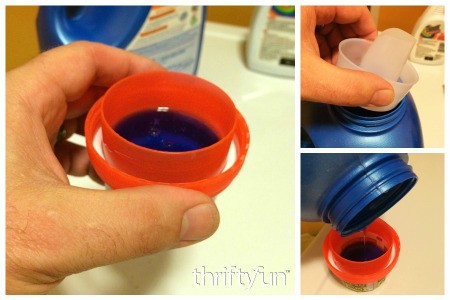
 It's laundry day, and the clothes are separated, the newest energy efficient washer is on, and the water temperature is set to cold. It's a financially efficient laundry load, right? Wrong, with every load you're wasting money because laundry detergent isn't cheap, and Americans use nearly twice as much as they need to use to efficiently clean their clothes.
Method Products Inc. estimates that 53% of people use the wrong amount of laundry detergent. Labeled fill lines are difficult to read, load sizes are tough to estimate, and concentrated formulas are often overlooked. Whether it's an error in measuring due to vaguely labeled detergent caps or pouring in a rush, every ounce of extra detergent means less money in your grocery account.
People tend to believe that more detergent means cleaner clothes. In reality, lingering detergent leaves soap residue on clothes making them look dingy, smell odd, and wear quicker. It also builds up in the machines, shortening their life spans. It's an instance where less is more.
They may be responsible for manufacturing the detergent that cleans clothes, but they might not be the most qualified for measuring the needed amounts of their products. Laundry detergent manufacturers list vague recommendations for measuring their product. However, they may be recommending too much.
The Seventh Generation Company advises that the typical manufacturer's recommended detergent levels are nearly twice of what is required for a clean load of clothes. Whether it's a miscalculation or a method for increasing sales, the amount listed on the detergent's cap is far above the needed amount for even the dirtiest loads.
Clothes are supposed to be clean when they come out of the laundry. Yet, if the claims that Americans are adding too much detergent at the advisory of the manufacturers are true, then this experiment will prove it. Wash one large bath towel as normal. Then, throw it into the washing machine in the hot water cycle without adding any additives to the load. Let it slosh around for a few minutes, and then inspect the washer. Is there suds? Is there any soap residue lingering around the rim of the machine at the water line? These are tell-tale signs that you've used too much laundry soap when the towel was previously washed.
What does extra soap mean? First, it means money poured down the drain, literally. A big brand concentrated laundry soap can cost $13 for a bottle that claims it washes 24 loads per bottle. If you're over-measuring or adding extra for heavily soiled loads, then you're not even getting the advertised number of loads per bottle. Now consider the fact that manufacturers recommend too much soap per load, making even the most precise laundry maid waste her pennies. A $13 bottle might be able to wash 48 loads if the amounts are reduced to the actually needed amounts, but in reality a household probably gets 18 loads out of it. Now that's money wasted.
This page contains the following solutions.
It got really expensive buying good laundry soap for my clothes and the dogs' blankets. I now use my favorite laundry detergent for my linens and clothes.
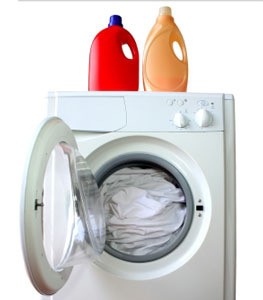
Most people use too much soap thinking that more must be better. Read the instructions on the bottle and carefully measure so you don't use more than you need to.
I've tried cheaper detergents and homemade laundry detergent but I always go back to Tide Coldwater. I love the smell it leaves my clothes.
When I have really small loads of laundry, I like to cut the soap sheets in half. If I have a really dirty bunch of jeans, etc., I like to use one and a half or add a half sheet to my liquid soap.
In my home, we do at least two loads a day so it would get pretty expensive if I didn't do this simple trick.
Laundry detergent may help remove stains and scent your clothes, but it's not the main reason they get clean. Most of the cleaning is done by your washer's agitator and by the clothes rubbing against each other, which loosens dirt.
I buy the economy size jugs of laundry detergent to refill a button-spout type jug for ease of dispensing the soap. I've found that pouring the soap from the regular type jug into the one that has the button spout is messy and quite a bit of detergent remains in the jug because of the configuration of the spout.
Here are the questions asked by community members. Read on to see the answers provided by the ThriftyFun community.
How much dish soap do I use for a load of laundry?
I would never recommend using only dish soap to wash laundry. It does not work well. I tried years ago and I know.
EVERY ONCE AND AWHILE IF I RUN OUT OF LAUNDRY SOAP I USE A SQUIRT OR TWO OF DAWN. MINE SEEMS TO COME OUT CLEAN
This is a page about using every bit of laundry detergent. Many cleaning products that are packaged in plastic bottles or jugs still have product left inside even when they seem to be empty.