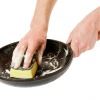
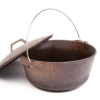
How do I clean the outside of a gummy iron skillet?
By rhonda covington from Rossville, TN
Add your voice! Click below to answer. ThriftyFun is powered by your wisdom!
If you have a self-cleaning oven, put the pans in and run a cycle. If not, put your oven on the highest temp (500+ degrees) and put the pan in for about 30 minutes. It will turn all of that gummy grease into carbon that can be brushed off with a wire brush.
Keep in mind that old cast iron is porous. It is a lot closer to a sponge than to glass. Just like old Diesel engines always used to sweat oil, cast iron frying pans do the same. You can slow down the migration of the oil from the inside to the outside, if you season it and let it build a good patina. Oiling it and heating it enough to cause smoke is not seasoning it. That is just burnishing and rustproofing it.
To properly season a cast iron pan or pot, get it red hot until it stops smoking, and let it cool slowly.
Clean it with a wire brush and vacuum it thoroughly. Keep it totally dry!
Warm it up until it is almost too hot to touch and rub it with bacon rind. When it is all shiny and slick, throw a tablespoon of very dry powdered sage into it and distribute it until it looks fairly even. Then put the pan into the oven or onto a BBQ and heat it gently until it just starts smoking. Don`t get it too hot at this step! The powdered sage will get wicked into the pores of the cast iron and will help seal them. If you don`t see an even sheen everywhere inside the pan, repeat the bacon rind, sage and heating parts.
If the seasoning is done right, then there is a nice and even satiny sheen all over the inside the pan, and it is just as non-stick as if it was a new Teflon frying pan.
Clean the inside as gently as you would a Teflon pan.
Those 3M sponge pads work well.
You can scrub the outside with anything, but purists prefer to use just a wire brush wheel.
Have fun!
DearWebby
webby.com/
Put your cast iron pan in a bonfire. It is the old country method of burning off the crud. Works great.
Yes I agree with the other comments. Use an sos pad and scrub the heck out of it with hot water.
Add your voice! Click below to answer. ThriftyFun is powered by your wisdom!
Why do my cast iron skillets get this gummy sticky residue on them? I thought I had cured it well, and I wash it with only water. What can I do to get it back to good shape?
Nancy from Nebraska
I have had this happen when seasoning them too well. And don't wipe the excess oil off from them. What I do is wash them really good with hot soapy water and an SOS pad, then just season again. (09/01/2006)
I agree. I'm lazy though. I wash the outside with hot soapy water, the inside with just water and a scratch pad if it's needed. When the skillet is just too gunked up, I put it in the bottom of my self cleaning oven and clean it, then begin again re-seasoning. I also store my skillet in the oven, upside down after washing. My skillets came from my grandmother who was born in the 1880s. (09/01/2006)
To bring your cast iron pots back to new, soak them in a 5 gallon bucket with 1 can Red Devil Lye. It depends on how bad the pot is on how long you soak it. I have some soaking now that has been in for 2 days. They were in pretty bad shape, as I got them at garage sales. When clean take them out and wash them good with dawn dish liquid. Season as usual. Just like new again. (09/02/2006)
I was told by my grandmother, NEVER put soap or detergent on a cast iron pan. You should either heat them up and try to wipe out the stickiness. Or, you could just add boiling water and wipe them down. In the future, always clean the pans right after cooking, while they are still hot and use kosher salt for the abrasive action and re-season with oil or shortening. Be sure to wipe off any excess. When you use soap, the patina of the pan degrades and you will lose the non-stick ability of a well seasoned cast iron pan. Good Luck! (09/04/2006)
By kathy
I agree - soap it down, use a brillo pad if need be, and then re-season. I think it's a good idea to do this periodically, even if it isn't too gunked up. (09/07/2006)
By Claudia-MD
Use oven cleaner, then re-season. (02/10/2009)
By 1stborn
Please do not use over cleaner. Cast iron absorbs those toxic chemicals. Soak it in very hot water with salt and soda, Then use an SOS pad and a salt/soda mixture. Soak in some water with vinegar if needed. Dry on stove top and re-season with vegetable shortening. (02/11/2009)
By Jeane