Does anyone know how to make cream soap without lye? Especially whipped soap that I have seen on freshwhipped.com.
Add your voice! Click below to answer. ThriftyFun is powered by your wisdom!
Lye is not difficult to work with if you use your common sense and take precautions. Lye combines with oil to make a salt called soap. But I can understand that making soap using lye is not everyone's cup of tea. If you don't want to buy cream soap there is a way to make it without making it from scratch. I do not guarantee the quailty of it but here it is if you still want it.
1 1/2 shredded soap (please use soap and not detergent/beauty bars. look at the ingredients, it should say sodium palmite, sodium ...)
5 oz distilled water
1 tbsp glycerin
1 tbsp olive oil
I use one of those small crockpots, melt all ingredients in crock pot on low until all is liquid and melted. add a EO if you want to have fragrance. Beat until creamy and airy. Enjoy. HTH
Editor's Note: The shredded soap bars were previously made with lye but it has been converted.
I think lye is why I can not use homemade soap so If I try making it I will probably try goats milk.
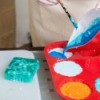
There are "melt and pour" soaps at JoAnn Fabrics, Michael's, etc., you just portion it out, melt it in the microwave, add color and Essential Oils, pour in your molds and let it cool (you can speed it up in the freezer).
I enjoy the "old time" method of making soap with Lye and fats, it's like a science project and there are wonderful books out there that gives you all the portions, to make beautiful soap.
Any of you people saying soap can be made without lye are flat out wrong. Yes, there are natural plants and such out there that contain saponin, a soap-like substance, but they are NOT soap. Here is the definition from dictionary.com-
Soap (noun):
a substance used for washing and cleansing purposes, usually made by treating a fat with an alkali, as sodium or potassium hydroxide, and consisting chiefly of the sodium or potassium salts of the acids contained in the fat.
If you are scared to use lye for whatever reason, as other people have already stated, you can buy melt and pour soap from any craft store. Any of the good brands are made with (surprise) lye. The not so good products are made from synthetic detergents, and are classified as "syndet" bars. They are not soap, and they are not good for your skin at all.
Again, going back to natural saponin products, you can find things like soapnuts (soapberry tree) to do your laundry with, etc.
When you make lye-based soap, the final product does not actually contain lye. It's used to force a chemical reaction with the oils to trigger saponification- which is what makes soap. Another reference is wikipedia (look for soap) and it will detail the chemistry behind the process itself.
Solutions of baking soda and oils do not a soap product make. Sodium Bicarbonate (aka Baking Soda) does have cleansing properties of a sort (that's why it is contained is several toothpastes). It can also be used with sugar as a pesticide or to clean tarnish off of silver.
Anyway, my final thoughts would be to further research saponin plants on your own if you're looking for a non-lye soap-type product.
It is not true that real soap is made with lye. Lye is used in combination with fat to create a substance that mimics real soap. Real soap comes from plants, see:
en.wikipedia.org/
en.wikipedia.org/
en.wikipedia.org/
Making soap without lye is not only possible, but safer and healthier.
Editor's Note: Although the above plants are natural sources of saponin, they are not true soap. Soap is defined as "a salt of a fatty acid". True soap would be made with lye and a source of fat which is safely combined in a chemical process known as saponification.
If you start with soap, even a small amount, I don't consider that soap making. I also don't plan to use lye for soap making. Although no specific formula I could find online gave me this, I can guess the entire process in, from what I have seen. Here's a formula, but the amounts will require trial and error:
1-a plant oil, such as sunflower seed oil, corn oil, linseed/flaxseed oil or perhaps, soybean oil;
2-water-you'll likely need at least some;
3-a caking material, such as cornstarch, flour, oatmeal;
4-your choice of fragrance, such as vanilla, lemon, rose, etc.
5-saponins from soap wort, yucca or another plant with these chemicals.
Proportions of water, oil and caking material will likely determine how hard or soft the finished product is. The oil will help removbe body oils; the saponins will cleanse most body parts and the fragrance will make it smell nice.
A shampoo formula is similar:
1-Jojoba oil (preferred for hair);
2-water;
3-whole egg(s);
4-Fragrance;
5-saponins
That's my take, anyhow. If you were stuck in the middle of nowhere and wanted to make soap for yourself, you can't just find lye or bars of seed soap lying around. Good luck.
The book that is referred to above "Janita Morris, The Soap Maker" has recipes for rebatching all of which originally were made with LYE.
You can make soap without lye and lye is actually derived from plant ash. Look up soap nut recipes, soapwort recipes. My laundry soap is made from soap bark and it is a commercial brand. www.ecos.com
You can't make solid bars of soap, but you can use it in many ways as a liquid form.
To you people asking about lye and 'ancient' methods: You need* sodium or potassium hydroxides (lye or 'pot ash') to properly sapon-ify the base oils, plain and simple. There are some plants that contain diluted salts that 'foam' when added to water and agitated but it's not 'soap' in the concentration us modern people have come to accept.
** Please, enough with the 'hurrr, ancient people didn't have lye powder around so lye isn't needed'. At first they didn't know what 'magic' allowed this to happen. Once the ancients realized that the muds and water near their sacrificial zones would froth and clothes were cleaner when washed there, it didn't take long for them to realize it was something in the location, the combination between the wood and the flesh of those burnt offerings that was causing it.
in hindsight, we know that plant or wood ashes , when soaked with water, will leech out a strong alkali solution. once discovered and pre-industrialized, they would take this solution and boil it down until the water evaporated and the white crystals (now called 'lye') were collected and stored. Lye powder is very stable and easy to store compared to a 'lye' solution, so long as you never get it wet. ;-) It will degrade over time and with exposure to moisture in the air.
I have heard that a solution of a LOT of baking soda and a little water will get a relatively high ph and when mixed with a smaller amount of olive oil and heated will create a mildly foaming 'soap', but you're not breaking down enough oils to create those saponins
I have buddies that make their own 'lye' by soaking hardwood ashes from their smokers in a 5 gallon bucket of water. you keep adding ashes and wait until the PH reaches the desired level. You can either use that solution for cooking (pretzels and bagels especially) or you can boil it down and harvest the crystals.
This isn't much different than making your own salt petre from hay & urine.
Add your voice! Click below to answer. ThriftyFun is powered by your wisdom!