Here are the questions asked by community members. Read on to see the answers provided by the ThriftyFun community.
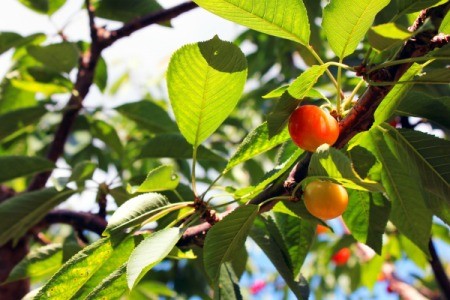
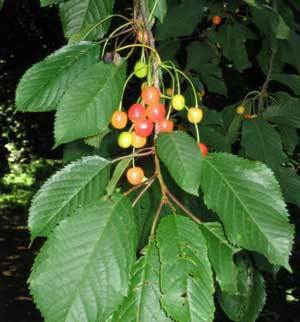
We are asking for advice on how to increase the size of our cherries. Our cherries have pits inside them as well. We have not fertilize them at all, but the trees are watered. We have not sprayed the trees with any type of pesticides. Please advise as to what we should do. Thank you.
Alex
Here are some possible reasons for small fruit size on your cherry trees:
I hope this information helps!
Ellen
It sounds like you might have Nanking cherry trees. If they bloomed in early spring with lots of pale pink flowers, this is probably what they are. Nanking cherries are naturally small and loved by birds especially, although they are good to eat for humans, too. You need both trees for cross pollination to get fruit. Sounds like you're doing everything right, but there's no way to make these cherries any larger if this is what they are.
It wouldnt hurt to try using some fertilizer. Compost, manure or any natural fertilizer is best. But fertilizer you buy in a bag will be quicker.
Fruit bearing bushes and trees require a LOT of water. Be sure you are giving them enough water.
I'll bet you have Nanking cherries or Hansen's bush cherries. Our bushes get covered with them, just like clusters of grapes. I juice them and then make jelly using the cherry recipe in Sure-Jell or MCP pectin. It's my most favorite of all the varieties I've ever tasted. It has just enough tartness and enough sweetness! Don't let the birds get them all, even if you have to throw a net over the bushes.
The fruit on my cherry trees remain hard. If I pick them will they get soft in time and ready to eat.
Are you sure its an edible cherry tree? (Some are decoration only) And, are you waiting until it is actual harvest time? Are they a deep red? They should ripen, makes me wonder if you are trying to pick them too soon.
Sweet cherries get sweetest right before they are ready to harvest, so don't pick too soon. They should be a deep red. Taste one before you pick
My trees are not bearing fruit; why?
By Glenda
Cherry trees need partner trees in order to cross pollenate to bear fruit. Ask someone at your local nursery about this.
I need to know the gallons per hour watering needs for sweet cherry trees.
Hardiness Zone: 9a
By betsy from Bangor, CA
Trees will need regular watering during their first year. It is important for root development that the tree receives plenty of water. After the first year, water as you would other fruit trees. Organic mulch around the base of tree will keep the soil from drying out and also help to control the growth of weeds. Good luck.
Mrs. Mitchell
Is the drying up and shriveling confined only to the fruits, or are some of the leaves and branches affected, too? Has your cherry tree ever successfully produced cherries? There are many possibilities here, so let's start at the beginning and play the process of elimination game.
If your tree has produced a successful crop in the past, you may be witnessing a phenomenon called Cherry Run Off. What happens is that every few years the tree produces more fruit than it can support so it drops the cherries prematurely in order to conserve energy. This type of drop is most likely to happen if temperatures are low (and the sun scarce) during the blossom stage, as well as during the early stages of fruit development. Climatic factors (late frosts, sudden changes in temperature or humidity) cause certain internal hormones to come into play, and before you know it, fruit production gets all out of whack. Another reason a tree might produce more fruit than it can sustain is prolific flowering and excess pollination. Again, the overproduction of fruit will cause the tree to release what it cannot sustain.
Fruit drop can also be a symptom that certain environmental factors are at work. Soil deficiencies, herbicide drift, improper nutrition, and irregular irrigation practices can all lead to fruit drop.
Fruit drop may also be pest related, although this is more likely to occur later in the season as fruits begin to near maturity.
Two things you can do to help prevent fruit drop:
1. Thin your fruit (or thin your blossoms). This will encourage your tree to put more energy into the fruit that remains.
2. Avoid unfavorable environmental conditions. Eliminate the use of herbicides and implement effective irrigation and fertilization programs (a soil test will alert you to any soil deficiencies).
Good luck!
Ellen
If your trees aren't getting enough water the fruit will dry up. Are you getting any ripe fruit? There's a happening called "June Drop" no one's figured out why, but trees just do it and usually in June but also as early as May and as late as July. This is normal. Like the tree is getting rid of excess fruit on it's own. If you're not getting fruit, I'd get a hold of your state's department of agriculture and see what they say. It may be something in your soil... either missing or in excess.
Good Luck!
This is a page about pruning cherry trees. Pruning your fruit trees is important for their health and fruit production.

This is a page about growing Rainier cherries. The Rainier cherry is a pretty red and yellow, sugary sweet hybridized cherry.