A chain link fence is durable and long lasting. It is a great choice for defining property boundaries and keeping your children and pets safe. Unfortunately, the dull, utilitarian look of the metal can also look stark and unattractive. Here are some ideas for adding some charm to your chain link fence that will help it blend more seamlessly into your landscape.
Vines and climbers: The very structure of chain link makes it the ideal, ready-made trellis for vines and other climbing plants that twine or cling to supports. Perennial vines such as clematis and honeysuckle produce beautiful flowers, or you can go with vines grown primarily for their foliage such as Dutchman's pipe (Aristolochia macrophylla) or English Ivy (Hedera helix).
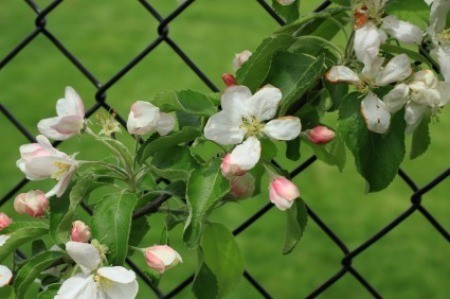
Fruit trees: For an edible alternative, many varieties of standard, semi-dwarf, and dwarf fruit trees can be espaliered (trained to grow on a flat plane) and grown on chain link fences. Examples include apple, apricot, peach, nectarine, fig, persimmon, and pomegranate trees. The downside is that an espaliered fruit tree requires pruning at least two or three times a year to maintain its shape. The upside is fresh, edible fruits right from the fence. Fruit trees require full sun and good soil drainage, so your fence needs to be positioned appropriately.
Skirt the bottom of your fence with clump-forming perennials, such as daylilies and irises, to help control weeds and reduce mowing and trimming tasks.
Before you plant a perennial vine or espalier fruit tree near your chain link fence, it's a good idea to experiment with some annual vines first. You may even find that you prefer the flexibility of being able to play with different colors and amounts of coverage each year, rather than being stuck with plants that are permanent.
The following are examples of vines that have vigorous growing habits and often reseed themselves. Research how these plants respond to your particular growing zone, as a few may become invasive under the right conditions.
Black-eyed Susan vine (Thunbergia alata)
morning glory (Ipomoea tricolor)
cup-and-saucer vine (Cobaea scandens)
scarlet runner bean (Phaseolus coccineus)
Over time, chain link fences tend to rust and fade. One way to improve their appearance is to paint them black or dark green. Painting your fence will make it look less industrial and help it to blend more seamlessly into the surrounding landscape. A dark color like black or green will also help showcase your plantings. The best tool for painting a chain link fence is a deep pile paint roller and a medium brush for touch-ups and painting the posts and poles. Use a rust-inhibiting, self-priming paint for good coverage with just one coat. Plan on one quart of paint per 20 feet of standard 4-foot-tall fencing and follow the directions on the can for prepping the surface before painting.
About The Author: Ellen Brown is an environmental writer and photographer and the owner of Sustainable Media, an environmental media company that specializes in helping businesses and organizations promote eco-friendly products and services.
Add your voice! Click below to comment. ThriftyFun is powered by your wisdom!
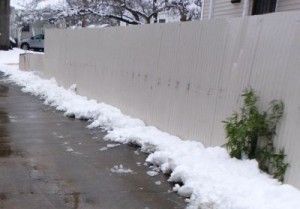
I have used my worn, industrial looking fences as "frames" for attaching PVC corrugated panels to. The panels can be tied together with vinyl coated wire (Garden wire) running through drilled holes in top corners, base and onto several parts of the chain link fence.
PVC panels like vinyl siding, are pre-colored usually, beige, white, green and translucent so require little maintenance other than pressure washing occasionally. The material is sold at Home Depot etc. under the names "TUFTEX" or "PALRUF" at about $14.00 for a 36 inch by 8 or 10 feet high. The only downside is sometimes minor wind damage(attached to low chain link fences) in severe cold but they often can be "bent" back into upright position.
When attached to 6 foot high fence most wind except very high velocity will not do much to the panels. Don't tie panels on with plastic zip ties because these become brittle in extreme cold and snap under wind loads letting panels blow off and "fly" away!
Also when attached to low 4 foot fences protect from wind BENDS by sliding an equally high metal pole between panel and fence rail and wire into place. Use one every 3 panels or so depending on wind load exposure.
I enjoy your articles on gardening and including trees. You really spell out the beginning to end planting and care. Thank you for sharing.
Wonderful that you are so environmentally friendly. In this country u.k who have loathsome councils, like South Holland council in Lincolnshire that tax people wanting to use green energy like solar panels and turbines, by forcing them to pay planning permission.
Thank you so much, I can't wait to get started! I planted Clematis last year and it's taken off like a rocket! Now I can fancy up my whole yard.
I grew clematis on my chain link fence too. Just make sure to tuck in the new growth to encourage it to wind through. Every fall and winter, just trim it back to the fenceline, leaving the largest stems wound through. Next year, you will have twice as many stems and flowers.
This article is fantastic! I love how it gives us creative ideas for transforming a standard chain link fence into something truly unique and beautiful. The best part? These updates won't break the bank. I can see so many homeowners using these tips to add some much-needed personality to their outdoor spaces. I hope the author keeps the inspiration coming!
Add your voice! Click below to comment. ThriftyFun is powered by your wisdom!