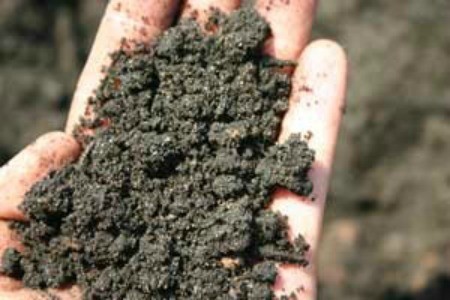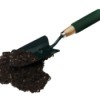
To test for alkalinity: Put a few drops of cider vinegar to the soil. If it fizzes, it is alkaline. Use peat moss to reduces alkalinity.
Source: Reader's Digest 1001 Hints and Tips For Your Garden
By Robyn Fed from Hampton, TN
Grab a handful of medium-dry soil and look at its texture. A soil with good structure will simply crumble when you squeeze it in your hand. If you can squeeze it into a ball, it contains a high content of clay. If you can leave scratches on the surface of the clod, it contains a significant amount of sand. If, on the other hand, it feels greasy in your hands, your soil contains a fair amount of silt.
Dig a hole two feet in depth next to some plants in your garden so you can examine the development of their roots. Good workable soil will allow roots to develop straight down into the soil. If the roots of your plants start to run laterally at some point along their development, they have reached a hardpan or plow pan layer-a layer of compact soil that needs to be broken up.
To test the your soil's drainage performance, dig a 2 ft deep hole in your garden and fill it with water. If the water remains pooled after a reasonable amount of time, you need to improve your soil's drainage.
There are a couple of ways to determine if there are high quantities of rich, organic matter in your soil.
Worms: Because earthworms naturally gravitate to areas high in organic nutrients, you can tell a lot about your soil's health by the number of worms present in your garden. Sift through a cubic foot of soil from your garden (1ft x 1ft x 1ft hole) and count the number of worms you find. Soil healthy in organic matter will have at least 10 worms in a cubic foot-a good barometer of the overall life present in your soil. Fewer worms mean less life is present and you need to increase the nutrients available in your soil.
Tomatoes: If you garden is lacking in nutrients, your plants will be usually your best indicators. Tomatoes, for example, respond to a variety of soil deficiencies:
Nitrogen Fixing Plants: Dig up and examine the nodules of nitrogen fixing plants, like peas, beans, alfalfa and clover. When broken open, the nodules should be pink if they are fixing and storing nitrogen like they are supposed to be.
Look no further than the native weeds growing in and around your garden to get an idea of your soil's pH levels. Hawkweed, horsetail, lady's thumb, dock and sorrel, for example, all prefer to grow in acidic soil. You can find inexpensive, do-it-yourself pH test kits available at most garden centers.
Unlike the weather, soil is one of the few aspects of gardening over which we have total control. If we have a basic understanding of what type of soil we're starting with, we can amend the soil as needed and achieve the best balance for our plants. If after these simple tests you still feel the need to have you soil tested professionally, contact your local extension service for advice specific to your area.
By Ellen Brown
bbleackley from Saskatchewan
You can make your own kit to test your soil's pH, but keep in mind that it will only give you a general indication of acidity or alkalinity. Most plants grow best in soil with a pH of 6.0 to 7.5. it won't be as accurate as getting your soil tested by a certified lab. To make your own pH testing kit, you'll need a couple of glass jars, some vinegar and some baking soda. Start by spooning several tablespoons of soil from your garden into a jar. Take two to three samples of dirt from the topsoil and two to three samples from 3-4 inches deep. Mix all of the dirt together. Now spoon two tablespoons of the mixed soil into each jar and mix in a little bit of water until the soil is just moistened.
In a separate container, mix a tablespoon of baking soda with two tablespoons of water. Pour this into one of the jars containing soil. If the soil starts to bubble or fizz, it may mean your soil is on the acidic side of the pH scale. If it doesn't fizz at all, you may have alkaline soil.
Now add a tablespoon of white vinegar into the second jar containing a mixture of your soil. This time if it fizzes, it may mean your soil is more on the alkaline side of the pH scale.
If your soil is acidic, you will want to increase soil pH. Lime is most commonly used. To lower the pH of alkaline soils, use compost and manure. Remember, changing your soil's pH takes time. The best time to perform a soil test and add amendments to your soil is in the fall.
I was wondering, how do you test the soil in your garden?
Thank you.
Hardiness Zone: 5a
By Joyce wis from Janesville, WI
Go to your local Extension Service Office. They have a kit that you can buy (reasonable) and they will tell you how to collect the soil in different areas. You then send the sample away where it will be checked and you will get a reply.When you talk to the extension office-they explain every thing to you. Good luck. If you don't test your soil, how will you know how to amendent it. You will be wasting money, if you add some thing to your soil that is not necessary. Jeannnette
How do I test my soil? Do I hire someone to do it or is it a DYI project?
By Judy from Riverside, CA
In my state the University has a cooperative extention service that does soil testing. When I contacted them they sent me instructions and a box to put the soil sample in to mail back to them. In a couple of weeks I recieved a print out and information on how to improve the soil. The cost was about 10 dollars.
By testing your soil in your lawn every 3-4 years, you can keep on track if your lawn needs to have nitrogen added or not. Nitrogen is the key nutrient needed for a thick, green lawn.

By Terri H.
By ThriftyFun