 I have been so encouraged and greatly helped by the tips I have read here, I hope this little tip will help someone too!
I used to be easily discouraged about ever getting a handle on our finances. I just couldn't find a method that I could stick to or that actually made sense to me. After trying the usual methods for bill paying and keeping track of our expenditures, here is something that has helped me to not only pay our bills on time, but actually keep track of them.
I made the electronic leap of faith, and scheduled all regular bills to be paid automatically. On the plus side, there were no more late fees, but the challenge was making sure the money was there! So I bought a large, cheap wall calendar and wrote on it when each bill was due to be paid. I look at the calendar often anyway (it's the most useful tool to organization and planning, right?), so each week I know to be sure the money is there for the bills coming up for payment that week.
Sounds so simple, but just getting the paper clutter off my desk, the 'remembering' out of my head, made such a difference in my attitude. Now we are actually getting out of debt and improving our credit rating each month because of this simple start.
I hope this helps someone out there who feels overwhelmed - you can do it! As someone once said to me, "you can't start any sooner than today"
By MT from Tampa, FL
This page contains the following solutions.
Ever sit down and wonder where your money goes? Many of us put a lump sum of cash in our pocket and when that money is gone just withdraw more money from our checking account or use the good ole debit card.
Organizing the household bills and making sure they get paid on time shouldn't be a problem. I open all mail immediately upon bringing it into the house.
I purchased a Rubbermaid sorter in the office supply section at Wal-mart. When I get my bills in the mail, I instantly open them. On the front of the envelope I put the date that the bill needs paid by and amount to be paid.
I use baggies for everything. When all my bills are paid I put all the invoices in a baggie and put the month/year on outside. That way if I ever have to go back to find something it's easy.
I am the one who handles the finances in our home. One day, my husband called me and asked, "Where is the last cable bill and who is it with?"
Years ago when I was in college, I got financial aid, and would pay all the bills for three months ahead, like rent, cable, insurance, etc. Then, my daughter and I would know that "this is our money for a cheap movie or a new jacket for school".
Always use an odd amount for transferring money electronically or paying bills. For example, if transferring monies, use $99.98, or $100.01, or $100.02, but never the same amount during a 6 month period.
I am on Social Security and I pay all my bills on the 3rd of each month. When a bill comes in I open it, write the amount in a notebook, and place the bill in a old refrigerator bin I keep in my desk.
After years of struggling to keep all of my monthly statements and bills in a filing box, I decided to think about what would work better for me. The problem I have is every time I open the filing box, my bills, statements and receipts are hard to find.
I start my checkbook register at the middle of the register. I have found that I can usually write a month's worth of checks on one page of the register using the front (and back if necessary).
When you are budgeting for the year ahead, I have one of the simplest and worry free ways to deal with big annual bills like car insurance, property taxes and any other bill that is going to hit your pocketbook once a year.
A desk by the front door with a desk calendar are necessities for me. I open all mail immediately and log bill due dates on the calendar.
After trying every type of organization system possible for a house with four people, I have found the best solution. I put a big basket on the kitchen island, where everything seems to land. Every single piece of paper goes into it.
Every year, I buy a monthly planner at the dollar store. When my bills arrive, either in the mail or online, I put them in the appropriate month in my planner.
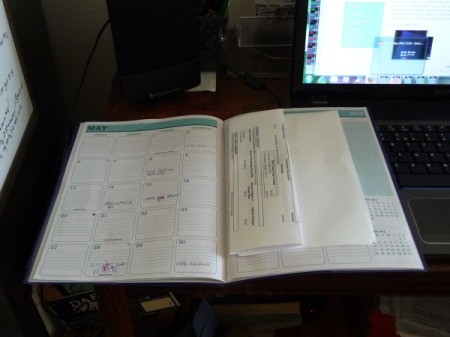
I use a Home Finance Bill Organizer to organize when and how much I pay each month. It has a page for each month with a pocket for bills and notes, a section to list date due, expense type, amount and when paid.
For several years now I've used the box folders, the ones that have handles on top and 18 or more slots) some have medical, rent, etc. I put my own labels on the folders in the order that works best for us.
As soon as I open a bill, I put it on my computer keyboard. Next time I'm online, I schedule the payment to be made 2 days before it is due.
Here are the questions asked by community members. Read on to see the answers provided by the ThriftyFun community.
How do you organize your files with your bank statements, credit card statements, tax deductible items, home insurance, medical insurance, pay stubs, etc.? Year after year.

By Maria Gracia
1. KEEP YOUR PENDING BILLS TOGETHER, IN ONE DESIGNATED AREA.
As soon as your mail arrives, or at your designated mail sorting time, sort through the mail, separating your pending bills from all of your other mail. When done sorting, immediately place your pending bills in an envelope, pocket folder or Pending Bills basket.
2. DO NOT SEPARATE EACH PENDING BILL INTO A SEPARATE FOLDER.
Whatever you do, don't put your utility bill in one folder, your car insurance bill in another folder and your membership dues bill in another. All pending bills should be together in an envelope, pocket folder or basket so they can be paid without having to search 10 different places to find them. My husband and I use a Bill Paying Pocket Folder Book which has about 20 Pocket Folders inside. All of our Pending Bills go together in the very first pocket folder. All Paid Invoices/Receipts then get filed in the individual categorized pocket folders that follow. This system works like a dream for us.
3. DESIGNATE 2 TO 4 REGULAR DAYS PER MONTH TO PAY YOUR BILLS.
Ninety-nine percent of the time, you don't have to drop everything you're doing when you get a bill in the mail to pay it immediately. Designate 2 to 4 days per month and do all of your bill paying on those days. My husband and I pay our bills on the 8th and 22nd of each month. You may do the same, or perhaps you might want to pay any pending bills one day per week, such as, every Friday.
4. PAY YOUR BILLS IN ONE PLACE AND KEEP ALL OF YOUR BILL PAYING SUPPLIES TOGETHER.
In order to speed up your bill paying efforts, always pay your bills in one place, whether that place be your desk, the kitchen table, etc. Wherever it is, this area should be equipped with your bills, checkbook, envelopes, stamps, pens, pencils, a calculator, tape, a stapler and return address labels. If you don't have drawers to keep your supplies in, get yourself a small plastic box, or even a shoe box, and keep everything inside.
5. IMMEDIATELY RECORD YOUR PAID BILLS.
As soon as you pay each bill, immediately record the payment in your check register or computer software register. Don't wait until later because if you do, there's a good chance you will forget. And once you forget, you'll have to waste time and money later dealing with overdrawn account fees.
6. PLACE PAID INVOICES/RECEIPTS INTO A BILL PAYING POCKET FOLDER BOOK OR CATEGORIZED FILE FOLDERS.
Once you pay your bills, mark your copy or section of the invoice with the Date Paid, Check Number and Amount Paid. Then, file each into the appropriate pocket of your Bill Paying Folder-- with one pocket for each; i.e. Utilities, Insurance, MasterCard, Visa, etc.) or into categorized folders in your filing cabinet.
7. ORGANIZE YOUR CANCELLED CHECKS AND CHECKING ACCOUNT STATEMENTS.
Every month you will receive checking account statement(s), and possibly cancelled checks, from your bank. Immediately place them in a folder until your designated monthly date rolls around to reconcile your checking account. Then, keep your statements and cancelled checks all together in a folder for the year. You may need to retrieve them later for your accountant when tax season rolls around. By the way, any bank statements and/or cancelled checks more than a year old can be stored away in a different area than your current files. You may also consider checking with your accountant to determine how long he or she suggests you need to keep this information.
8. CONDENSE YOUR CREDIT CARDS.
The more credit cards you have, the more difficult it is going to be to keep them organized, and the longer it's going to take you to pay your bills. Whenever possible, condense your many credit cards into 2 or 3 credit cards, and get rid of the rest.
9. PREPARE ENVELOPES FOR RECURRING BILLS BEFOREHAND.
For recurring bills, such as mortgage, rent or loan payments, you'll save a lot of time preparing a bunch of envelopes for each beforehand. For example, let's say you have to pay the rent each month. Make a year's worth of envelopes out with your landlord's name and mailing address, your return address and a stamp. This way, everything will be all set to go each month. You just write out a check, place it in the prepared envelope and mail.
10. SIMPLIFY EVEN MORE WITH INEXPENSIVE MONEY MANAGEMENT SOFTWARE.
If you're paying your bills manually, you may consider purchasing inexpensive, money management software. My husband and I use Quicken. It's a breeze to set up and reduces the time it takes us to pay our bills by more than 50%. Plus, it's a great time saver at tax time because it will automatically organize all of your income and expenses, with a print-out, ready for your accountant.
About The Author: by Maria Gracia - Get Organized Now! http://www.getorganizednow.com FREE Idea-Pak and E-zine filled with tips, ideas, articles and more to help you organize your home, your office and your life at the Get Organized Now! Web site!
I have a 3 ring binder and I use page protectors
In addition to my bidget forms and bills I ALSO include copies of all my insurance policies and investments. If we were threatened by a tornado I'd take the binder to the basement with me
If I were to die my DH could pay te bills AND collect the life insurance policy all by going to the same binder! LOL
THIS HAS NOTHING TO DO WITH ORGANIZING BILLS, BUT ..WE USE A LEDGER TO POST OUR BILLS IN.I PUT THE DATE DUE, THE NAME OF THE BILL
AND PLACE A CHECK MARK BESIDE IT WEHN IT GETS PAID ALONG WITH A CHECK NUMBER SO IF I EVER NEED TO VERIFY THAT SOMETHING HAS BEEN PAID I SIMPLY LOOK UP THE CHECK NUMBER IN MY REGISTER AND CAN TELL YOU EXACTLY WHEN IT GOT PAID. I CAN GO BACK FOR THAT LAST 10 YEARS IN OUR LEDGERS AND KNOW WHAT WE PAID THEN AND TO WHOM
I have bills automatically taken our of checking account. I use my savings account for everything else. It makes it simple and worry free.
I use this online service to remind me about upcoming bills and budget. It works great! You can check it out at http://www.whatbills.com
Now if I could just decrease my credit card debt!
Anna
We started doing it this way last year:
In our big filing cabinet, we have a hanging file for each category-- electric bill, bank statements, etc.
In our little filing cabinet, we have manila filing folders, one for each category with the year labeled, too-- electric bills 2007, bank statements 2007 etc.
Throughout the year, we put stuff in the little filing cabinet as we receive it. At the end of the year, we take the manila folders from the little filing cabinet and put them in the hanging folders in the big filing cabinet. Then make new manila folders for the little cabinet-- electric bills 2008, bank statements 2008, etc.
We started this in 2006 and it has worked pretty well.
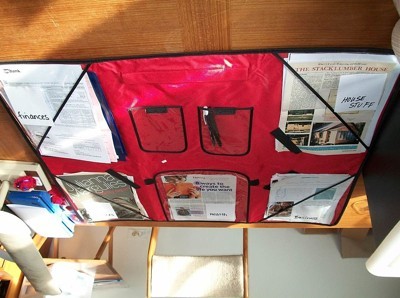
I KNOW THAT THIS WILL SOUND STRANGE, BUT...I DO NOT HAVE A DESK AND THE FILE FOLDERS WERE JUST NOT WORKING. I TOOK AN HANGING SHOE ORGANIZER AND HUNG IT ON MY BEDROOM DOOR. IN EACH SLOT I KEEP VARIOUS IMPORTANT PAPERS.MY BILLS, BANK STATEMENTS, MEDICAL INFORMATION EVEN MY SHOPPING CIRCULARS, IT MAKES IT SO MUCH EASIER TO SPOT WHAT I AM LOOKING FOR AND DEPENDING ON THE SIZE OF THE ORGANIZER, YOU CAN DO MONTHLY COMPARTMENTS. I HOPE THAT THIS HELPS. HEATHER
I have a realy strong magnet with a clip on it that I put all my unpaid bill on that I keep on my refig. I write the amount and date due on each envelope. When paid I write ck# on bill or staple online reciept to bill and place in monthtly bills file. I have files for credit card info, pay stubs, online purchases and bank statements. Just remember to file the same way everytime ie most resent in front. Also purge your files everyonce in a while. Might want to consider a fire safe for valubles like wills, home and car titles, savings bonds etc.
Do I need to keep a full year of bill statements?
By Karen
I print out a list of our bills by month for a year in columns. As I pay them, I check them off the list. That way I know at a glance what needs to be paid and I don't have any slip by unpaid that I had forgotten.
Check out these photos.
I just purchased a Wonderfile and I have to tell you that I highly recommend them.
Keeping track of household expenditures does not need to be a complex process. This is a page about simple household bookkeeping system.
ThriftyFun is one of the longest running frugal living communities on the Internet. These are archives of older discussions.