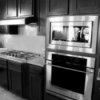
I have recently purchased a dual fuel stove. The top of the stove is gas while the main oven is electric. It has the option of regular bake or convection bake. If anyone has any advice or recipes for the convection bake setting I would love to have them. No detail is too small.
By paula from MO
Add your voice! Click below to answer. ThriftyFun is powered by your wisdom!

For best results, here are 8 rules you should know.
1. When cooking in convection ovens, use cookie sheets and Shallow pans (up to 1" sides). Pans with high sides should not be used. The sides interfere with air circulation and can decrease browning.
2. When using a roasting pan, or if the food will be covered when cooked, or when using roasting bags, use a conventional oven
3. Preheat the oven. When roasting, preheating is not necessary.
6. Dark or dull pans should only be used when you want dark, crisp crusts. Shiny pans reflect heat, resulting in more browning. Cookies should be baked on shiny metal pans without sides. For 2 cookie sheets, place one directly over the other in the center of the oven. This will allow for more even browning.
7. When baking cakes, pies or other foods in pans that do have sides, the pans should be staggered, not directly above another pan.
8. Pans should be placed at least 1" apart and at least 1" away from the oven walls.
You can use the same recipes in a convection oven as a standard one, but for best results, here are the rules that apply:
1. Reduce the oven temperature by 25° F, cooking times will be about the same.
3. When roasting, the temperature stays the same, but the cooking time is reduced. The time will depend on the size of the food. For example, if the recipe says bake a roast at 400 degrees for 50 min, in a convection oven you would cook it at 400 degrees for about 30 to 35 min.
4. If baking on more than one rack, additional baking time may be needed for items on the middle rack. Add 30 to 60 additional seconds for thin foods like cookies and 1 to 2 additional min. for thicker items like biscuits.
My oven has a convection feature, and here's what I've learned:
*don't use convection for baking--it's too fast and sometimes, particularly with biscuits, the outside will brown too quickly and the inside won't be done.
*It's perfect for potatoes, and most anything you're in a hurry for, such as meat, just watch it closely!
Recipes
Turkey:
www.convectionovennow.com/
On this page, scroll down until you get to the recipes. This is page 1:
whatscookin.proboards.com/
This is page 2:
whatscookin.proboards.com/
Working in the food business for 18 years (including restaurant kitchens) convection ovens are the best! They have been used in professional kitchens long before they came to residential homes. The only difference is that there is a fan in there, so I don't agree with a change in cooking temperature is needed from conventional oven recipes. You will have to shorten the cooking time, however. The fan allows for even cooking, no hot/cold spots in the oven.
I learned (professionally) that the only thing you cannot cook in a convection oven is egg based recipes (i.e., souffles and breakfast items with eggs). I am a big baker (professional) and bake practically everything in my convection oven. When you cook your regularly made items in there for the first time, use an internal thermometer for meats, and watch everything carefully noting how long it took to cook and make a note on your recipe for next time.
Add your voice! Click below to answer. ThriftyFun is powered by your wisdom!