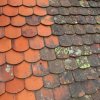
Does anyone know of any paint-on materials we can put on our black shingle roof to make it reflect the sun?
By Cookie Stephens from Splendora, TX
Add your voice! Click below to answer. ThriftyFun is powered by your wisdom!
Forget painting your roof. It would'nt last. Any decent exterior latex paint can be used on the asbestos shingles. I really doubt that paint will stick well to the asphalt shingles, but then, you have little to loose...at worst, you can shingle over the existing shingles with new asphalt shingle of a color you like. Asphalt shingles are not that expensive.
Installing No-Tear Radiant Barrier in an Attic
May 19th, 2009
The roof is one of the most vulnerable places in your home to incoming heat gain, but even if you live in the Upper Midwest, you can still lose heat in the winter.
We recommend using No-Tear Radiant Barrier in your attic, because it's designed to reflect 97% of the radiant heat that hits it, while fiberglass can only block 10% of that. And considering radiant heat is responsible for 90% of summer heat gain and 75% of summer heat loss, you need insulation that will stop the heat gain/loss. Fiberglass and other mass insulation just won't do that by itself. But by adding No-Tear to your attic, you can reduce your energy bills by as much as 40%.
There are two ways to install No-Tear, and it all depends on where you live. If you live in a warm weather climate, like Texas or Florida, you should install the No-Tear on the roof line. If you live in a part of the country where it gets really cold in the winter (Minnesota, New York), you should install it on the floor of the attic. Here's how to do it:
There are 2 methods to installing No-Tear.
Installation #1: Warm Weather Climates (US Southeast, Southwest)
1) Measure the length of No-Tear needed and cut it on the ground floor (this saves time up in the attic). You can use a band saw or even an inexpensive coping saw to cut the No-Tear.
2) Unroll the length horizontally, and staple it on the roof line perpendicular to the rafters.
3) Leave a gap 3" - 6" from the eaves and from the peak to allow airflow behind the insulation.
4) You do not need to tape the seams.
Installation Method #2: Cold Weather Climates (Upper Midwest, US Northeast)
1) Measure the length of No-Tear needed, and cut it on the ground floor. Do NOT use Solid (non-perfo-
rated) No-Tear for this installation.
2) Unroll on top of the mass insulation, and staple it perpendicular to the ceiling joists. If your joists are
Safety tips
First and foremost, remember to only walk on the wood joists, not on the insulation. Otherwise, you'll end up going through the ceiling.
Do NOT lay No-Tear, or any reflective insulation, on exposed electrical wiring or boxes.
Make sure all joists and trusses are solid before placing weight on them.
Dust masks, protective headgear and gloves should always be used while working in an attic.
Make sure all bath and kitchen exhaust fans vent to the outside so that moisture does not escape into the attic. Exhaust fans should not vent into the attic.
Installing rFoil Reflective Insulation in Your Ceiling
May 14th, 2009
If you're building a new house, you're in a great position to install Foil reflective insulation in any and all parts of your house. A commonly overlooked place to install it is in the ceiling. When my daughter and her husband were finishing the second floor of their house, they insulated the ceiling of their house, putting R-40 on top of the rFoil.
We recommend using Single Bubble Foil, since you're already using other mass insulation.
Benefits of using rFoil in the ceiling
Used by itself or in conjunction with mass insulation
Installing rFoil
1) Staple leading edge of rFoil to end truss/rafter and then again on the side of the truss/rafter as in illustration.
2) Wrap foil around the truss/rafter, stapling it to the edge to tack it into place. Continue around to the other side, as shown in the installation.
3) Continue to staple rFoil along the roof line, ensuring that the Foil is recessed into the cavity to provide at least a 1' space on either side.
4) Seal all seams with 2' Aluminum Tape (All tape should be applied using a flat edge taping tool to ensure good adhesion).
5) Attach drywall or paneling using usual method.
Not sure why you want to reflect the sun unless you mean to reflect the heat away to keep it cooler insider your home. I have never used it, but I was told there is a paint that reflects the heat away that can be used on metal. Check with your local paint dealers. They would have all the info.
There is a thick paint type material that is used on mobile home roofs. A dealer will be able to tell you where to get it.
If you are thinking of painting over a shingle or asbestos shingle roof, I would check with someone knowing about roofs-- might be a big no no.
Roof spinners are "cheap" and can be installed by a handyman. and really work to get rid of heat over your ceilings look into them, too. Good luck
Hi! I think you will have a terrible time getting anything to stick to a shingle. However, there are some really, really good roll insulation that reflect radiant heat. 97% of it. It's the same principle as a space blanket for camping, or thermal reflective curtains for the windows. You lay it inside the house under the roof or on top of your ceiling, and it reflects the sun out and the heat and/or cold back into your house. I believe you can get it from Home Depot, but the best price and product I've found is from a company called FarmTek and it's sold for insulating agricultural buildings. Inexpensive way to stop that unwanted solar gain. I've been thinking of how to make some roll up curtains out of it for the windows, too.
Good luck!
Thanks to all of you who answered my question. We will be investigating more on this.
There are several products that are made to paint over any surface including shingles. It isn't beautiful, but it does significantly cool the interior of the home and will even stop small leaks. Many were made for desert climates so don't degrade in the heat like so much else does here. A couple of brands to look for are solar-tek and polar-tek. Home depot carries a brand I don't know, but if you want to use it, make sure you get the one made for cooling as I noticed they had a couple of formulations.
It depends upon the weather condition. We lived in Baroda Gujarat where the summer were pretty hot. We did white wash the roof with limestone and glue. It was good enough for three to four months. As soon as rainy season starts it will wash away in a few days. However it was very effective to reflect heat of the sun.
Add your voice! Click below to answer. ThriftyFun is powered by your wisdom!