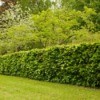
Hedges are an attractive way to define the boundaries of your yard and garden. Unlike privacy fences, hedges can be used to create an almost impenetrable barrier around small or narrow lots. They also provide shelter from the sun and wind, add year round interest to the garden, and let you retain a sense of openness with your neighbors.
Do you consider yourself formal or informal? Ideally, a newly planted hedge will blend in with your existing landscape. This means that the size, shape, and behavior of a hedge must be considered before purchase or planting. Hedges can be used to define a border, create a barrier, or give your garden a sense of privacy, but regardless of their purpose, they should be dense and compact, so plants with medium to fine leaves make the best hedges.
Deciduous hedges will give you privacy in the summer, but leave you exposed when they loose their leaves in the fall. If pruned severely over a period of time, some varieties will form dense tangles for increased winter privacy. Evergreen shrubs will retain their leaves and a privacy screen year round, but their foliage may not add as much color and interest as seasons change. Many gardeners remedy this by covering their hedges will colorful climbing plants like morning glory or clematis.
Here are just a few of the most popular hedges and their characteristics.
Hedges are usually planted in trenches rather than holes. Other than that, the planting procedure is similar to that of ornamental trees and shrubs. (Plants should be set in the ground at their original soil levels.) Small plants intended for formal hedges should be spaced 6-8 inches apart and larger plants 18-30 inches apart. Plants used for informal or untrimmed hedges can be spaced slightly farther apart. Tall hedges that require little or no trimming, like conifers planted for tall screens, should be planted about 6 ft. apart. Staggering the plants along two rows (space the rows 2 ft. apart) will create a thicker hedge.
Don't plant hedges if you're looking for a low maintenance landscape. Hedges need trimming, even informal hedges, so adding them to your landscape is making a commitment. The time of year to trim them depends on the type of species you're growing and the degree to which you want them to maintain a desired shape. Formal hedges generally need trimming more frequently than informal hedges (usually twice per season), but the rate at which growth occurs also depends on your growing zone.
Training by trimming during the first few years is important if you want your hedge to look good over time. Hand shears will work well for most hedge trimming jobs, but a power hedge trimmer will cover large areas more efficiently providing the plant doesn't have too large of leaves. Whichever tool you decide to use, maintain a straight line by keeping the blades parallel to the hedge while trimming.
When first forming the shape, don't try to eyeball it. Use stakes and a heavy cord or rope as a guide. Slope the sides inward so that the hedge is wider at the base and narrower at the top. This will prevent the top from shading the lower branches and ensure all parts of the plant receive enough light. In colder climates, a pointed (informal) or narrow flat top (formal) will help prevent snow accumulation and possible breakage.
Don't let your hedges grow too tall before cutting, or your hedge will not end up well branched to the ground. Once your hedges become established, cut them back almost to the old wood each time.

About The Author: Ellen Brown is an environmental writer and photographer and the owner of Sustainable Media, an environmental media company that specializes in helping businesses and organizations promote eco-friendly products and services. Contact her on the web at http://www.sustainable-media.com
Add your voice! Click below to comment. ThriftyFun is powered by your wisdom!
When I moved into my home I had the kind of hedge that just starts growing up randomly. It had various young trees growing in it. My neighbor took the unsightly hedge down on both sides of his yard.
Add your voice! Click below to comment. ThriftyFun is powered by your wisdom!