Browse   Newsletters   Contests   Ask   Share   Account   About Us

Making a Paper Pieced Quilt

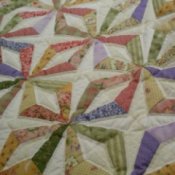
Paper pieced quilt top, endless chains pattern.Paper piecing has become a popular way to piece a quilt top. By sewing through the paper pattern the crafter is able to create a very intricate block more easily. This is a guide about making a paper pieced quilt.
     

Solutions: Making a Paper Pieced Quilt

Read and rate the best solutions below by giving them a "thumbs up".

Use Phone Book Pages for Paper Piecing

Use pages from your old phone books for paper-piecing when making quilts. You can trim them down to whatever size you need. The paper is thin enough to tear away fairly easily from your stitching, and the torn pieces can then go into the paper recycling bin. This works especially well for making "crazy quilts".

Source: I must have read this somewhere because it's too smart of an idea for me to have thought of it myself!

By soapermom from TX

5 0SharePrintFollow1 Feedback

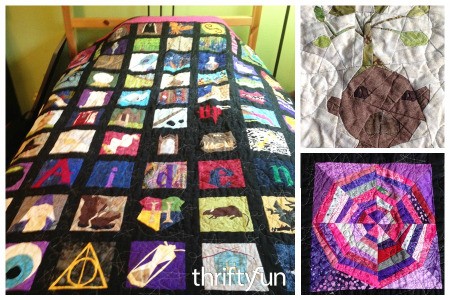
Update on Harry Potter Quilt

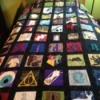
There is light at the end of my two year long tunnel, regarding the Harry Potter paper pieced quilt I began in the spring of 2011.

As you can see in the photo, I have added the sashing to the smaller blocks. There is one final 5 inch block in process: Nearly Headless Nick. Then I will be stitching together the rows and adjusting the sashing to incorporate the larger spiderweb blocks and the 10 inch Harry Potter ones. Next, will be deciding on the border and backing. Finally, the sandwiching of the layers and the quilting itself. Whew, almost makes me tired just thinking of what is left. But the rest should hopefully go faster than what has been done so far. The plan is to finish it before my grandson graduates from high school; he is in the fifth grade. Just kidding.

The spiderweb blocks were inspired by a pattern I found online at: quilterscache.com. The 5 and 10 inch HP blocks can be found on Jennifer Ofenstein's site fandominstitches.com.

The blocks off to the right side will be the bottom row.

This has been a fun project, but the next one, if paper pieced will be made using larger blocks :)

Harry Potter quilt in process.

By R Barbara

4 0SharePrintFollowPost Feedback

Craft Project: Instructions for Paper Pieced Quilt Block

Ready to give quilting a try? Paper piecing allows you to more easily piece intricate patterns for your quilt blocks. Here are the instructions to make a simple paper pieced block. Once you have mastered this block you will be off to try more difficult patterns.
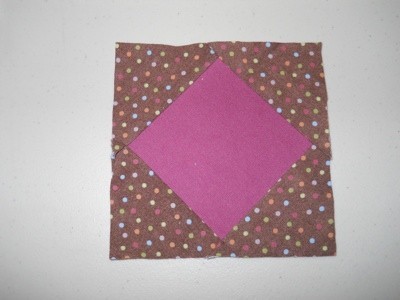
Remember that newly purchased fabric will need to be washed and dried prior to use. This will pre-shrink the fabric. You will also want to test for colorfastness at this time (reds in particular). After washing and drying it, iron the fabric and trim off any stray threads along the edges.

Approximate Time: 20 minutes

Supplies:

  • fabric scraps (for this sample square)
  • coordinating thread
  • scissors
  • sewing machine
  • printed piecing pattern
  • tape, pins, or glue stick

Instructions:

First print or copy the number of pattern blocks you will need for the project. Here we are making a sample block, so we only needed one pattern page. Be sure to measure your copy to verify that it is the correct size. The foundation paper piecing technique will destroy the paper pattern, as you will be tearing the paper pattern off, once the block is complete. So be sure to make enough, when making a full-sized project and check them all for size.

Set the stitch length on your sewing machine to a small/short stitch, approximately 12-18 stitches per inch, or 1.5 on a machine with a stitch range of 0 - 5. It is recommended that you use a larger needle (90/14). The larger needle and shorter stitch length will allow you to remove the paper more easily.

Cut a piece of fabric large enough to cover the area labeled #1. Make sure this piece is at least 1/4 inch larger all the way around. Now center the fabric RIGHT side up on the "unprinted" side of your paper pattern. You can use a small piece of tape, a pin, or dab from a glue stick to hold this first piece in place.

ppfirststep400x300.jpg

Turn the paper over and hold it up to a light. Make sure that the fabric extends beyond the stitching lines.

Now cut your next piece of fabric large enough to cover the #2 space, including 1/4 inch all the way around. Place this piece "right side down" on the first piece. Once again hold up to a light and check coverage. Make sure that you have your #2 (and subsequent) pieces oriented correctly so that they fold back from the seam and cover the correct area of the pattern, with the right side of the fabric facing up.

Once you are sure of correct placement turn paper and fabric over and sew pieces 1 and 2 along the stitching line on the printed side of the paper pattern.

ppsecondstep400x300.jpg

Note: Some quilters recommend that you begin and end the stitching inside of the 1/4 inch seam allowance.

Backstitching does not replace the cross seaming that occurs when your seams extend into the 1/4 inch seam allowance area. This step will help reduce the chance of a gap occurring in the patchwork as subsequent pieces are added.

After adding each new piece of fabric, trim the seam allowance to 1/4 inch. Take care not to cut the paper pattern.

ppthirdstep400x300.jpg

Now open the piece out from the seam and press flat (on the right side of the fabric) using either a dry iron or specialized tool.

ppstepfour389x300.jpg

Continue this process adding pieces in numerical order. Once your block is finished give it a final pressing.

ppfifthstep374x300.jpg

Carefully trim away the excess fabric along the outside of the 1/4 inch seamline of the foundation paper. DO NOT sew along the outer seamline at this time. You will be piecing the blocks later and taking a 1/4 inch seam at that time.

The foundation paper can be removed at this point or it can be left on the blocks until they have been sewn together. Removing will help reduce the bulk, but leaving it attached adds some stability. You can be the judge based on the fabric being used. If it is stretchy you will probably want to leave the paper attached.

You are now ready to move on to your next block. Happy paper piecing.

Coming Attractions: We will be posting an example of a more intricate paper pieced block in the coming weeks.

By Laurel and Barbara from Port Orchard

2 0SharePrintFollowPost Feedback
Share Your Feedback: Once you try any of the above solutions, be sure to come back and give a "thumbs up" to the solution that worked the best for you. Do you have a better solution? Click "Share a Solution" above!

Questions

Do you have a question related to this page?
Follow ThriftyFun