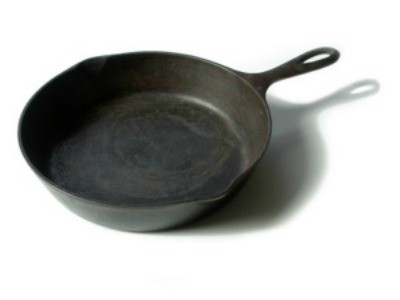
 Easy, excellent nonstick way to clean and care for cast iron! For years I washed my cast iron skillet with water, thinking that was the only way to get off stuck-on egg. The shiny black surface (called 'seasoning') was constantly breaking down so that things would stick, and rust was always a danger. Then I stumbled on the easy, traditional way to clean it, and it keeps it so smooth and nonstick that getting stuck-on food off is no longer even an issue!
By the way, if you sniff your cast iron, and it smells metallic, the seasoning is in need of repair. If it is well seasoned, it will not smell that way, and will be shiny and black as coal. If the skillet is in seriously bad shape, you can put it through a self-cleaning cycle in the oven to burn it down to bare metal and start seasoning over from scratch, or you can just start treating it as I describe, and the seasoning will repair and become maintained over time.
Here's what you do: after cooking, you remove whatever food scraps or liquid may remain, put about half a teaspoon (more for a big job) of regular table salt in, and scour it with an old rag. I cut up ratty holey socks and other ruined cloth and keep handy for things like this.
When the surface is clean and smooth, tip the dirty salt into the trash or sink, and then rub with a clean soft bit of cloth with a dab of shortening or grease until the surface is again shiny and black. Again, I keep a small square of clean soft cotton cloth in my shortening can, for this purpose, and reuse it. So long as the skillet was scoured clean with the salt, the shortening cloth stays clean enough to use many times before washing or replacing.
Hang skillet on the wall until next use (or store in the oven). By not washing or rinsing my skillet in water, and never using soap (or especially detergents) on it, the natural nonstick surface stays healthy and food never sticks.
The other trick is, you have to know what level of heat is best, and heat the skillet thoroughly before adding food. Eggs require a much gentler heat than things like bacon or other meats. Cooking eggs on high will glue them to the pan (and result in tough eggs).
So, watch the heat level for the type of food, heat the skillet 5 to 10 minutes before adding food, and keep the natural "seasoning" healthy by scouring with salt and oiling after each use, and cooking with cast iron will be a pleasure!
By cruncymamamaine from Maine
This page contains the following solutions.
Pretty sets of cookware are tempting, but pretty wears off with the enamel or Teflon. Cast iron lasts a lifetime if properly cared for. It cooks evenly, predictably and they're the only few pieces of cookware you'll ever need.
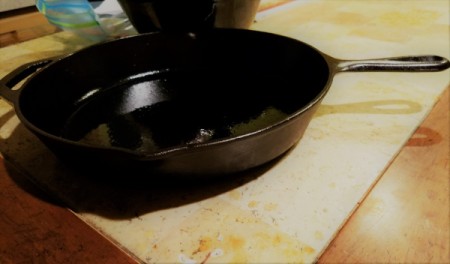
Whenever possible, use cast iron cookware. The iron from the pan really does "leech out" into the foods you cook, adding iron to your diet.
Here are the questions asked by community members. Read on to see the answers provided by the ThriftyFun community.
I have a cast iron 10" skillet that has 3 notches on the bottom. Having an electric range all my life I never noticed the notches. Now that I bought a gas range I see the notches fit the grates perfectly. My other pans all seem to be slippery on the bottoms.
I looked online and couldn't find any cast iron cookware that has the 3 notches. Does anyone know what's going on with the notches? Any help you can give me for cooking on a gas range will be good!
***Thank you***
Here is a good read about cast iron pans:
thepan-handler.com/
OR, here is just the part about notches on the pan bottoms:
Tip #5: Look At The Bottom
These were intended to snugly fit your electric heating filament. Other pans have extruded heat rings (e.g. Griswold pans), or they might have three or four projecting nodes or notches. These nodes or notches enable your pan to sit on gas grills or electric heating plates without slipping off. Lodge pans commonly used between one and three heating notches at the bottom.
I found this on a you tube video:
www.youtube.com/
The #10 unmarked Lodge skillet (easily identified by the signature 3 notch heat ring) is an impressive size at 12 inches wide (diameter without the handle) - capable of handling even the hungriest of crowds."
Does your pan have any markings on the bottom, such as numbers or letters? Can you post any pictures of the pan's inside and bottom?
Google and you tube searches can help you find more info. Good luck and stay healthy.
Here is a little article about the notches:
www.leaf.tv/
Best guidance for using on a gas range is to use the burner that is the closest to the size of the pan to get the most even cooking. Hubby LOVES his cast iron and uses them often. He even uses them on the propane grill and in the oven (although be super careful when removing them from the oven since the handles can often make it feel unbalanced (or maybe it is me) and I tip out the meal if I am not careful.
Keep it well seasoned and it will last you for many years!
Cast iron cookware is probably one of the few things that started in the 1800's (maybe earlier) and is still being used today.
Women have always been protective of their cast iron pieces because anyone unfamiliar with cooking or cleaning them could cause a mess of trouble for the 'lady of the house'.
I have had several pieces but they cannot be used on my glass top stove so I've sorted them out to my children - even my sons like cooking with them.
You've been informed about the notches, which are kinda rare I think, but it's nice that you it's something you can still use after switching to a gas range.
Gas flames can get very hot if placed on high (just like an electric range on high) and a lover of cast iron cookware told me that I should never use high heat with my cookware as if not properly used it could warp the pan. So maybe you could use high heat sparingly.
I believe learning how to regulate the simmering part will be your biggest challenge. I recently read where someone used 2 or 3 cast iron stove top 'trivets' to keep his food on low simmer for longer periods of time. Something to think about if you ever need it
www.amazon.com/
Some things to remember:
Always match the flame to the pot/pan - not lapping over the sides.
Practice simmering as this little technique has a learning curve and takes a little practice to get it right. Some burners on your range may 'simmer' better than others because no matter if your range has 'click' knobs or free turning knobs they will not all work exactly the same.
Gas ranges are easier to clean up spills than an electric but it's best to that job as soon as possible. Most parts of a gas range are dishwasher safe but may need a little extra scrub sometimes.
I like to grill bagels with butter in my cast iron skillet. However, sometimes the bagels will not lay flat and part of the bagel will not be grilled. I priced a grill presser which was made out of heavy cast iron for $20. The kind they use in restaurants to lay on top of bacon. Before I purchase this expensive item does anyone have any other ideas that might help?
How about the good old Flat Iron? I'm sure these can still be found at a Garage Sale or some other charity sale or shop.
Do you have another skillet or pot the same size or smaller that you can use?
I always grill my English Muffins in a cast iron pan. All I do is set a smaller cast iron pan on top of them!
The Food Network cooks like to wrap a brick in foil and use that.
Why not cover a brick with foil and use that to keep your bagels flat....or perhaps some other heavy object. The brick should be washed first as good as possible but covering with some foil will keep from transferring anything dirty from the brick. I have seen them use foil covered bricks on foodnetwork to do paninis.
You might save a large sized can, pour in enough water to weight it, and place it directly on top of the bagel. I personally like the Brick'n foil method, but the can is somewhat easier if you're a little gal.
This isn't for a cast iron skillet, but what I do is butter them and then I broil them in the oven for a minute or two.
if you have a george forman grill, this is great for grilling bagels, sandwiches, paninis, etc.
take care, claudia
I use brick that has been washed and covered with heavy duty foil. Works like a charm.
If you have a pan (pie pan, cookie sheet for a toaster oven...) that can withstand the heat of the skillet and is small enough to fit, place it on top of the bagels and then put a heavy can on top of this to weight it down. Know however, that this weighted can can come tumbling off with changes in heat as the bagels may shift.
I have tried the washed brick in foil, and have to tell you that my conscience always grumbles because I wonder if it is really and truly clean or if something is leaking through the foil or the openings in the foil.
Can you just go to a hardware store and buy a bacon press? I did and am a lot happier.
Hit a couple of flea market/junk stores, I have seen them in the past. Should not cost too much, just clean real well.
I vote for another cast iron skillet on top to smoosh 'em down. That's how I cook panini-style sandwiches!
I always put a fry pan on top of the item and weight it down with my "cooking brick". I bought a new brick, scrubbed it down well and covered it with aluminum foil, which can be changed as needed. Works great.
Fran H
CT
I have a cast-iron grill pan that is perfect for this. I always weight it down with another skillet. I have 6 cast-iron skillets from 6" to 14" sizes. If they are seasoned right, you never have to worry about things sticking. Use lard to grease them and then throw them in the fire for a while to season or just heat them on the stove and rub crisco or lard in them with a paper towel.
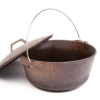
My friend gave me a cast iron Dutch oven. I made a beef stew in it. It appeared as though some old gook from the pot had made its way into the stew. It looked kind of greenish. Does it mean that the pot is no good?
By Tyara
I've never heard of cast iron going bad. I would scrub the inside like crazy (I'd start with a green Scotch Brite, and move on to steel wool if necessary), then season it. That's what I had to do with a wonderful old rusty pan I picked up at an antique shop. I scoured away all the rust and seasoned it and it was fine. Do you know how to season cast iron? My mom puts oil/grease on hers and sets it on a high burner (gas) for a while. I have a pan my dad bought for me when I moved out, and it has instructions on the bottom. It says to scour the pan, coat in cooking oil, leave in a 300-degree oven for one hour, then wipe off excess oil. It took time for mine to get a good finish on it, but this should help. After it is well-seasoned, you shouldn't have to soak it in soapy water and scrub too much. If I cook something that sticks (like something that caramelizes), I put hot water in it and let it sit while I'm washing the rest of the dishes. Then I just use the green Scotch Brite to clean it. Afterwards I wipe on a little more oil, and that's it. I don't heat it in the oven again. With experience, you'll be able to tell how it looks after you've cleaned it if you need to season in the oven again.
Thank you, Mrs Story, I will do that and post a feed back. I threw out the stew. Afraid to poison everybody! I am a little scared to try again. I must admit.

The food is turning black because either it isn't seasoned well enough, you're using very acidic food, or you're letting the food sit in it too long. As far as I know, it's not going to really hurt anyone to eat the food if it's not a real dark color, but it might have a metallic taste that's not too great. However I wouldn't recommend letting small children or pregnant women eat much of the food that is black/greenish, because of the high iron content.
I used to cook my spaghetti sauce in my cast iron dutch oven, because acidic foods draw even more iron out & I had a problem with anemia. I discovered that if I didn't season the pot after cooking acidic food, then the next time I used it to roast a chicken & veggies in the oven, they all came out with that greenish/black tinge. I was horrified the 1st time it happened & threw everything out. Then I learned it was safe & didn't taste bad if it was only slightly discolored - if you can get past the color, LOL! When I finally remembered to re-season after my spaghetti sauce, the problem was solved.
Here's a great site with all kinds of recipes & information on how to use your cast iron cookware:
www.cookingincastiron.com/
I want to buy a cast iron griddle for grilling chicken indoors. Are the long rectangular flat bottom cast iron griddle designed for electric stoves? It seems like they would slide off. Never owned one before and would like your input. Thanks.
I use one on my electric stove and have no problems with it sliding off, they are heavy enough to stay in place. I also use it in the broiler and have no problems.
Mine works great.
ps Never thought of using it in the broiler, thanks!
If you have a smooth-top range, do not slide the skillet on it. This will scratch the cooktop. I pick mine up and then set somewhere else. I use my cast iron skillets for everything. I even have a cast-iron dutch oven that makes the best anything I choose to cook, especially stews.
ThriftyFun is one of the longest running frugal living communities on the Internet. These are archives of older discussions.
I have a cast iron pan that has been around for many years. It is very well seasoned and I don't clean it with soap, just hot water. But after making ground beef with chili seasoning or any other meal with a lot of spices, (stir fry, fish) the aroma stays in the pan.