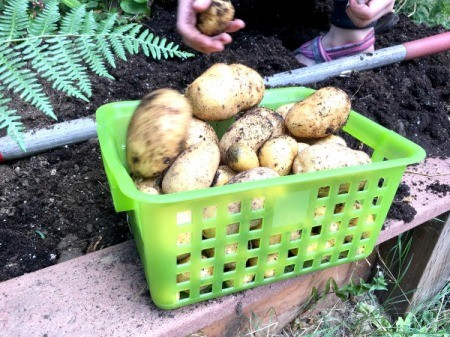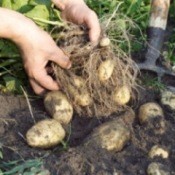
If you like potatoes, consider planting a few hills in your garden. For the small amount of space they take up, they will easily earn their keep by providing you with a high return on your investment. Not only do fresh garden-grown potatoes taste better than store-bought potatoes, but they also keep better in storage. Here are some tips for harvesting and storing them.
"New" Potatoes: The small, thin-skinned potatoes you see at the grocery store that are commonly referred to as "new" potatoes are actually young, immature potatoes. They are a delicious treat when boiled (keep the skins on) and can be harvested as soon as your potato plants start to blossom.
To harvest them, simply sweep aside the dirt around the base of the plants and gently pick off tubers of the appropriate size. You can remove several tubers without hurting the plant and sacrificing your later harvest. Early potatoes have very thin skins and don't store well. It's best to harvest what you need and wash and eat them immediately after harvesting.
Mature Potatoes: When your potato plants turn brown and start to die back, they have sent the last of their energy into the ground to the growing tubers. It's at this point that your potatoes have officially reached maturity and are ready for harvest. You can dig beneath the plants by hand and remove them individually, or lift several out several at once by digging along the edge of a row using a 5-pronged garden fork.
Try to avoid spearing or nicking any of the potatoes, since damaged potatoes don't store well and need to be eaten right away. Don't worry about removing any attached stems. They will fall off as your potatoes dry. Lay newly harvested potatoes out in the open to dry out for a couple of hours (in the shade), then brush of any remaining dirt with a soft cloth. Don't wash them to get them clean, as they are very hard to get dry again.
Green Spots: Green spots on potatoes indicate the presence of solanine, a toxic, bitter tasting substance that develops when potatoes are exposed to light-either while growing or while they are in storage. Solanine can make you seriously ill when ingested in large enough quantities. Because the damage is usually located just under the skin, you can usually peel or cut away green spots and eliminate the problem. If the potato is more than half green, throw it out.
Potatoes are relatively thin-skinned and will invariably suffer a few minor dings and bruises during harvesting. In order to extend their storage life without a loss of flavor and seal up any minor wounds, it's necessary to toughen up their skins through the process of curing. To do this, spread your potatoes out on newspapers in a dark place where the temperature is about 50 F to 60 F and the humidity high. Leave them to cure for about 2 weeks before moving them to storage.
The key to successful storage of your potato harvest is providing them with the correct conditions. This means storing them in a dark, moderately humid location at temperatures around 40 F. Your potatoes are still "breathing" and carrying out a certain number of biological processes during storage, so the ideal container needs to provide plenty of air circulation.
Store them in wooden barrels, crates, or bushel baskets. Metal or plastic garbage cans will work as long as there are ample air holes punched in the sides and bottom. You can also pile potatoes loosely in the corner, provided you don't pile them too deep.
Additional storage tips:
Wow, I just harvested potatoes a couple of days ago. Good timing.
I planted some sprouting grocery store potatoes in the spring. Too bad I didn't see this first, I made a couple of mistakes.
Here are the questions asked by community members. Read on to see the answers provided by the ThriftyFun community.
How do I know when to harvest potatoes?
Hardiness Zone: 5b
In general, when the potato plants begin to yellow, that's time.
To be sure, you could always check.
Also, I left mine in too long this year and some of them began to rot. I live in zone 8b, though, so 'hot' for me is probably not 'hot for you! Good luck.
We wait until the vines are nearly dead, then dig the tubers and spread them on a tarp to dry for overnight. Then store them in a cool, dark, dry place.
Keep checking and using as summer comes along. Dig a hill here and there, allows you to keep track. Usually potato digging time in the zone 5 would be Sept, Oct, as you put away your garden spot for winter. Even a nice Nov is good. I am zone 4.
We live in zone 5 and dig new potatoes in July, dig them up for good in August and September.
I forgot to write down from my potato package how long it would be before they would be ready to dig.
Thank you.
By Linda B
It depends on if you're growing early or maincrop potatoes. Earlies are usually ready about 10-12 weeks after sowing, about a couple weeks after the plant blooms. Maincrop potatoes are usually ready in about 18-20 weeks, after the foliage has begun to wilt.
I grew potatoes in my garden, the vines are dying and the potatoes are done. The problem is it is still too hot to store them, can I leave them in the ground until cooler weather?
Hardiness Zone: 6a
By Robert from Columbus, OH
YES! By all means! You can leave them in the ground till it gets cold outside- so as long as the ground itself [or taters] does not freeze.
I have done this successfully in my zone 4- zone 5 till way past 'gardening season' [ meaning till late October, early November]. The taters were still quite hard, fresh and good! They will not grow any more though.
I have done this while I waited for enough room to put them away. Plus you can still harvest a few to eat any night you want.
If you have never done this before, after you harvest, they will need a few days out of the ground to 'cure'. Not in any place sunny [ they'll turn green!] but in an area free from moisture. I used to put them in single layers on an old window screen for a few days. Do not wash, just wipe dirt off with hand or brush. Use any bruised or cut pieces sooner than later.
After curing, you can store in cold area of basement in baskets or bins or boxes [all with aeration]. Some folks like to put them away in a refrigerator.
Also weigh your harvest to see how 'good' you did.
1 lb of taters planted in spring should yield about 10 lbs in fall.
Less that that is a bit of a poor harvest and more is pretty darn good. [ Some varieties will produce better than others]
Some taters will want to sprout while in storage over the winter-- that's OK. Either snip off sprouts or save those sprouted spuds to plant for next spring!
Also visit any health food store in the winter and try all of their organic potato varieties. Whichever ones you like can be purchased, stored and then used as your 'seed potatoes' next spring. Sometimes this is much cheaper [ and healthier] than any garden catalog offerings!
Remember the 1 lb / 10 lb rule above. Or try a few different types ...and grow them all! One year we did 10 different organic types: red, white, blue, yellow, purple, etc. Yum!]
Hope this has been helpful to you!
I dug up 6 rows of my potatoes and there is hardly any skin to the potatoes. The tops of the plants are all brown now as we have had 2 heavy frosts. My question is should I leave them in the basement (our basement is warm) for a few days before putting in the cool cellar or should I put them right in the cellar? I let the potatoes dry outside before bringing them in.
This year we put a fair amount of peat moss and sand in our garden. The last 3 or more years the ground has been so hard that I couldn't get the weeds pulled out. What do you suggest? Why do you think my potatoes did not form a thick skin?
Waiting, wondering, and hoping they will keep!
Thanks.
By Norine from St. Paul, Alberta Canada
Check out these photos.
I won't give you any tips on growing spuds, they're easy as pie. And I should have left them growing in the container til the plants bloomed. But, I have so many things to water, I just get tired sometimes. I will tell you I started them from sprouting taters I got from the grocery store.
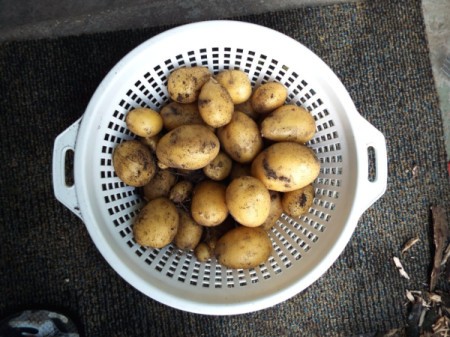
This is a page about harvesting potatoes from a potato tower. Potato towers are a great way to grow a crop of spuds in a small footprint. If it it a wooden tower you simply lift off each segment and begin harvesting.