 I remember when I was little, I absolutely LOVED to play dress-up. What's more, I loved to use my mom's clothes. While I was talking with Mom yesterday, we touched on that topic and on a very funny memory, and I thought that you might like to know about it.
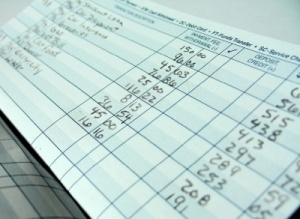
One day while I played dress-up, I had decided that I needed to go to the "store", so wearing one of Mom's white tee shirts, a scarf, and my mom's tennis shoes, I grabbed her purse and proceeded to put my play food in a little basket. I ended up dropping the purse, and since it was my mom's, it was fairly full and several things fell out. I started to pick them up and found mom's checkbook.
When I grabbed it, I saw that in the checkbook mom had a register just like the one that she used to teach me to add and subtract, so I asked her what it was for. I knew that she already knew how to add and subtract, so I didn't see why she had one. So she told me that she used it to pay bills. Then I asked the question that all parents seem to dread: Why? "Well", she said, "because we used the services the company offered and we had to pay them for it." Being confused, I asked why again.
Seeing that I wasn't going to let the topic go, mom sat me down at the table and went through her checkbook with me. She showed me what her paycheck was, then she went down the list: Electric Company so that we could turn on the lights, watch TV., and have the air conditioner in the summer; Gas Company so that we could cook our food and heat the house in the winter; House and Car payments, plus insurance; Gas for the car; Doctor bill; etc; etc. I remember getting scared at that point because I didn't know if mom made enough to cover everything. So she showed me her math and explained that not every bill was due to be paid at the same time, so I was less scared.
Then I asked her what I could do to help, which surprised her greatly. So she explained that if I and my brother would turn off lights and the TV when we didn't need them or weren't using them, it would save money. She also explained that to save money was why we only used the AC (a window unit) to cool the living room and bedrooms, and why we wore sweaters in the winter to help us stay warm. Then with a big hug and kiss, she sent me back to my room to finish cleaning the mess I had made while she started to make supper. After I was done and went to help her, I made sure to turn off the light! ;)
So the lessons I learned from my mom?
By Krystal from Newton, IA
This page contains the following solutions.
When your children receive cash gifts for the holidays or their birthdays, it's a parent's job to be fiscally responsible with it. You want your children to enjoy it, but you want them to learn how to manage their money at the same time.
My daughter looked at me like I was a little weird when I suggested she should not use a 39-cent stamp when a 24-cent stamp would suffice. So, does 15 cents really matter?
Children are great at breaking a budget, but it's important to set boundaries. What do you do when your child asks for something that is financially out of the question?

If your kids were to get jobs where they'll be running cash registers. Help them. Gather up some cash and change, sit down with them. Give them an amount of your pretend purchase, you pretend to "pay" for something and let them count out what change they'd give you back.
We have tried to prepare our daughters for the real world in terms of finances and here are some of the strategies we have employed.

If your adolescent seems to have no idea about money and budgeting issues, set up a monthly or quarterly clothing allowance. When it's gone, that's it.
In a time when materialism is at a high, the task of teaching children the value of a dollar becomes difficult. Someone recently told me, "What you teach your children in the first ten years of their lives is what molds them into the people they become."

Mum gave us weekly pocket money which was about double what we needed and used to tell us "Right, this is your money for the week. It's up to you how you spend it. Don't come asking for more before the week is up because you'll get nothing."
I give children money: a dollar bill, 4 quarters, 10 dimes, 20 nickels and 100 pennies. I then teach them about money, showing them that the change is equal to the dollar bill.
Here are the questions asked by community members. Read on to see the answers provided by the ThriftyFun community.
 It is so easy to spoil our children and miss the opportunity to teach them about saving, choices and sacrifice. It is important for children to understand the value of money.

They can also learn the value of money if they have to do chores before they receive an allowance.
Mum used a very simple rule when we were schoolchildren.
She gave us weekly pocket money which was about double what we needed and used to tell us "Right this is your money for the week. It's up to you how you spend it. Don't come asking for more before the week is up because you'll get nothing."
We never did and I remember actually saving from my allowance!
Very good advice. Remember when raising a child, you are raising them to one day be able to take care of themselves. They grow up fast.
Our kids received an allowance and had three jars. One jar held their ten percent tithe for church, one held 25 percent to be saved for something special, and thr rest was theirs to spend.
Often the best way to teach your children how to budget is by example or by giving them a set budget for things like back to school supplies or clothing. Talk to them about the choices they made and the insights they acquired by having to make spending choices. This page contains suggestions for teaching kids how to budget.

This is a page about teaching children to manage money. Teaching your children the value of money and how to manage it is a good lesson that will help them out when they live on their own.

ThriftyFun is one of the longest running frugal living communities on the Internet. These are archives of older discussions.
This is for those with kids in the 'tween years. My daughter couldn't understand why daddy's pay while it sounded like a lot when you said the total, really wasn't.