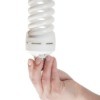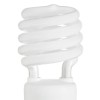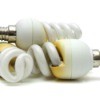
According to the EPA, if every household in the U.S. replaced one light bulb with one of their ENERGY STAR rated compact fluorescent bulbs, it would be the pollution equivalent of pulling one million cars off the road. That sounds easy enough right, so why isn't everyone doing it?
Probably the biggest obstacle standing in the way of a mass switch to CFLs is the up front cost. Most consumers still assume they're too hard on the budget. The truth is, CFLs have come down considerably in price. Now, not only are they good for the planet, but they're good for the pocketbook.
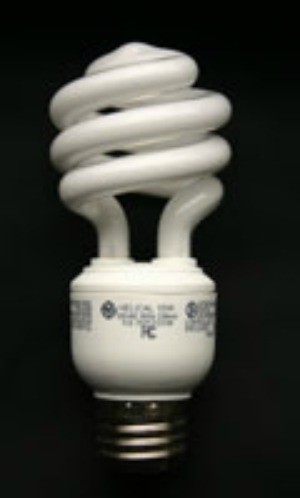
CFL's use 1/4 to 1/3 the amount of electricity as incandescent bulbs. That's because incandescent bulbs waste 90% of their energy putting out heat and use only 10% for visible light. CFL's burn at an average of 100°F, where incandescent bulbs burn hot enough to fry an egg!
A typical household spends $110 dollars per year on lighting. CFL's have a much longer lifespan than regular incandescent bulbs-up to 10 times as long. Replace a regular bulb with a CFL and you can avoid buying ten 75watt bulbs.
CFL's help fight global warming in two ways. First, they operate using less electricity. Second, using a CFL means making less incandescent bulbs-a process that produces carbon dioxide. That means that in places where coal is used to produce electricity (in most places), each CFL will cut carbon dioxide emissions by about 1,300 lbs over its lifetime.
CFL's might cost a little more up front, but they still offer more savings than cheap, inefficient incandescent bulbs by using less electricity to operate and reducing the need to buy replacement bulbs. The average CFL will save you $45 in energy costs alone over the life (10,000 hours) of the lamp (based on $.10/kWh).
Advances in CFL technology have greatly improved their operating efficiency and their performance. No more heavy bulbs, and humming, flickering lights. CFLs are now instant on, quietly flicker-free, and light as a feather.
For the greatest energy savings, use CFLs in fixtures you use most often. They operate most efficiently when they are used for 2 or more hours at a time. Handle CFLs by the plastic base when inserting and removing from fixtures.
Use CFLs in hard to reach fixtures or fixtures where bulbs are difficult to change, like ceiling fans and enclosed outdoor lights.
CFLs contain less than 4.0 mg of Mercury (assists in starting). That is about 1/1000th of an ounce. Because coal-fired plants making electricity release mercury in their emissions, the use of energy efficient CFLs results in a net reduction of mercury released into the atmosphere compared to using incandescent bulbs.
This amount of mercury isn't considered dangerous in the home, even if a CFL breaks. Still, spent CFLs should be disposed of at hazard waste collection sites like products such as paint, car batteries and thermostats.
About The Author: Ellen Brown is an environmental writer and photographer and the owner of Sustainable Media, an environmental media company that specializes in helping businesses and organizations promote eco-friendly products and services. Contact her on the web at http://www.sustainable-media.com
Add your voice! Click below to comment. ThriftyFun is powered by your wisdom!
Where do you buy these and is there a brand difference? And what is the average price?
I hear there's a new LED light coming on the market soon that's even better than the CFLs. Art Bell was talking about it Friday night, 4/20. I wonder how much it will cost and whether it's worth waiting for it.
Energy saving tips and ideas are terrific! We've all been using and abusing our resources without regard to consequences and it's good to see a change in mind set, good to see us being more responsible. However, when it comes to global warming, there's simply no scientific evidence that mankind has any impact whatsoever on climate. Thus far, it's all rhetoric and propaganda. Don't believe it? Check for yourselves.
Add your voice! Click below to comment. ThriftyFun is powered by your wisdom!