Herbs become invasive in one of two ways. Some freely scatter their seeds, that seem to sprout with ease even in the most inhospitable conditions. Others send out rhizomes (root-like stems) that meander along just under the soil's surface; sprouting new plants as they go. Both are highly efficient ways to overrun your garden and choke out existing plants. Here are some ways to keep these invasive herbal companions in check.
If you find that one of the invasive herbs in your garden has managed to escape, dig up the unwanted seedlings, making sure to remove the entire root system. Then sift through the soil with a digging fork to make sure you get any leftover pieces. Keep an eye on the area for several months, and either dig out any plants that reappear or clip them off at soil level and smother them for several weeks with a heavy layer of newspaper or a large, flat stone.
Catalogue Clues: When shopping for herbs in garden catalogs, invasive herbs should come with a warning (mint in particular), but they usually don't, so you'll need to do your homework as well as learn to read between the lines. Plant descriptions such as 'carefree", "vigorous", "establishes quickly", or 'grows anywhere" may be code for invasive tendencies. When acquiring herbs locally, consult other gardeners, local nurseries, and your local extension agent about herbs that are invasive in your area.
This page contains the following solutions.
Each year millions of dollars are spent, and tons of herbicides are applied, in what is sometimes a futile attempt to combat the spread of invasive plants. Here is what you need to know about the invasive plant problem and what you can do to help.
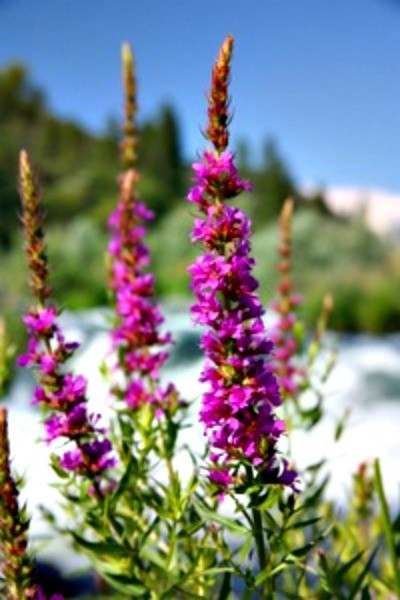
Many plants, especially herbs, are very invasive and will spread and quickly take over your garden. To prevent this, place the plant, like this spearmint, in a container.
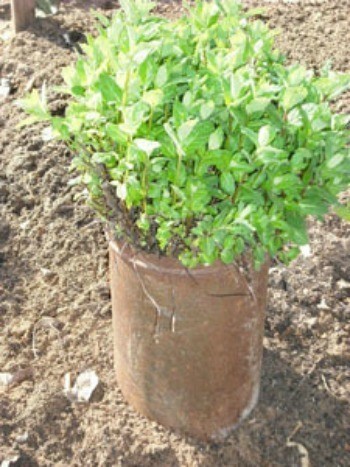
When planting a plant that is liable to take over your garden, it is best to get a small plastic bucket and set it into a previously dug hole.
Here are the questions asked by community members. Read on to see the answers provided by the ThriftyFun community.
I would like to find a practically invasive ground cover to plant in the worst area that might inhibit, or at least challenge, this weed the next time it rears its ugly leaves. It would be great if it was evergreen and shade-loving, but at this point I'll take any suggestions. Does anyone have any ideas as to what I might use? Thanks so much!
Hardiness Zone: 8a
Tripleb from Greenville, AL
A: Tripleb,
Congratulations on getting rid of your very invasive weed. There are several options for ground covers that many people would consider "invasive." Examples include: English ivy, wintercreeper, crownvetch, ajuga, periwinkle, Liriope spicata and certain types of honeysuckle. Of these examples, wintercreeper grows wonderfully in the shade and is highly competitive with under-story plants. Lily-turf is an evergreen that quickly spreads to form a dense mat and can be used to cover a large area. It produces spikes of purple or white flowers, which eventually transform into clusters of black berries. It also provides and interesting texture and grows equally well in sun or shade. It tolerates a wide variety of soil conditions, although it prefers moist, nutrient-rich soil. All of these examples should perform well in your zone.
Good Luck!
Ellen
possibilities: cover the ground with cardboard boxes or black plastic to kill off the weed
plant mint (it's invasive too) or maybe wild strawberries (shade-loving)
I also have a fern problem on occasion, but when I pull them up regularly they don't take over.
Cantate in Zone 8-9
I think mint would grow well in the area you have the weeds &/or seeds. It can also be invasive, but it makes a lovely lawn as it smells lovely when walked on ..... is delicious in your kitchen & smells 'cooling' when mown in the summer.
If you don't want to plant mint, find another herb you do like .......
Nothing nicer than a herb lawn & it's practical.
Cheers
Wendy M. from Oz.
Sounds like a vetch (coronilla sp.).
Cut the plant down to ground level early spring or as soon as it establishes i.e before the flowers appear then cover with black plastic sheeting and keep covered for at least 3 seasons. Alternately keep it cut back every season until it exhausts itself - we hope.
I live in Pensacola, Florida and I have a plant that would suite your needs...My mother and I call it "the daisy from hell". It grows about a foot a day and can take over an area in about a week. It has a close growing mat of leaves and yellow daisy like flowers. There are some nurserys in our area that actually sell this plant. But beware you must really love it where you plant it because it is near impossible to remove it once in an area. I have been trying to remove it from my garden for the last six years and I am losing the battle!
Request a picture if you are interested and I will post one.
kmcl59
I purchased a home that was professionally landscaped about 18 years ago but the previous owners did not maintain the beds. A ground cover called "Snow on the Mountain" was used in the largest bed and has taken over. I pulled so much of it out in the fall (including roots) that I thought I'd at least have one spot that was clear but it's back and taking over again! Does anyone have any idea how I can tame this creature? It's a beautiful ground cover so I don't want to kill it entirely but I need to control it.
I have Snow on the Mountain too, and as far as I am concerned, it is an invasive plant.
To get rid of it totally, you need to use "Round Up" repeatedly; it just keeps coming back! I have used a shovel and have dug clumps of it out; pulling it out seems to leave some remnants of the root behind and it just regrows. But, just as fast as I can dig out the clumps, the rest of it grows and refills the area!
I have reclaimed one small area by digging out the plant, filling in the holes with bagged topsoil, covering the spot with black plastic (not the landscape type that has the holes in it) and I covered the plastic with mulched wood chips. So far, there is no "Snow on the Mountain" growing and it is now the second season....I think I may have won the battle!
I have Bishop's weed (sometimes confused with Snow on the Mt). This too is an invasive weed. I was told to cover it with black plastic, use rocks to secure it and leave it for 1 year. Check to see if any little sprouts are escaping and pull them. Perhaps combined with Round Up? I do know it is very, very (darn near impossible) to get rid of.
How do you kill snow on the mountain ground cover?
By cmills
Round up will kill it and the root system, digging it up and giving it to others would be nice but probably wouldn't get rid of root system.