Browse   Newsletters   Contests   Ask   Share   Account   About

Using Recycled Materials in the Garden

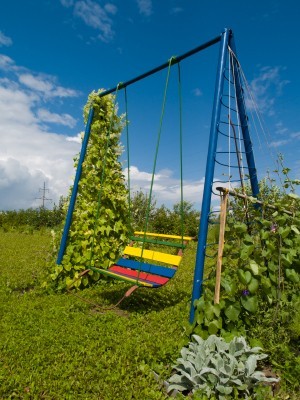
Garden swing with wire woven between side bars and vine growing up the sideThere are many ways to repurpose stuff in your yard and garden. This guide is about using recycled materials in the garden.
     

Solutions: Using Recycled Materials in the Garden

Read and rate the best solutions below by giving them a "thumbs up".

My Frugal Life: Recycling In the Garden

My Frugal LifeThere is nothing better than something cold in the hot weather, and ice cream fills the bill for us! I frequently plant pinto beans in these wonderful containers. As you can see in the picture, they are so adorable. A plant growing in an outdoor container. I move them around as I need to. I find them easy to punch holes in, and they are easy to label with a permanent marker.
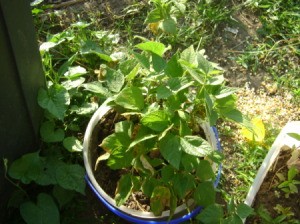
I also use one of these ice cream containers to sift dirt from the garden when I am ready to plant another bucket of beans. If you poke holes in the bottom, the smaller the holes, the smaller the dirt will be that comes out of it. My sifting buckets have holes in the bottom of about an inch around. Any clumps of dirt that come through are easily pulled apart when I mix it together using recycled utensils from the kitchen or a sturdy stick or branch. I like my dirt to be soft and not packed. Packed dirt won't grow well, as I have found out before.

Of course, I use mine for a large amount of different seeds, and as you can see they are holding down the chicken netting around Phoenix's play area (Phoenix is a house rooster).
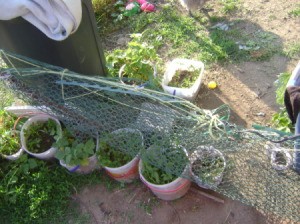
Chicken wire being used in an outdoor garden.

The ice cream containers are very useful for a number of other things around the garden also, such as dipping out water from my rain barrel which is really just a trash receptacle strategically placed at a broken gutter that happens to be by my garden. Everytime it rains, Voila! Water for the green beans! Plastic tubs work just as well too. Watch out for small children who like to go play in any kind of standing water. Kids could fall head first into a tall kitchen sized garbage receptacle. My yard is fenced and I still watch it.

I also like using old clear soda bottles for putting the seed packet upside down in then sticking the open bottle in a branch. It protects it from the rain, and you can see into the bottle to see a photo of what you planted.

Every time it gets warm, I place a two liter soda bottle high over my animals water bowl, with holes placed in the bottom, about two inches from the bottom of the soda bottle. It is too hard to punch holes in the actual bottom of the soda bottle. I punch the holes on the same side, so they will not over shoot the water bowl. It makes a little water fountain over the water bowl. I like the sound of it also. This also works when you set the bottle on two rocks and let it leak out onto the plant. I usually carry a teapot full of water to pour in the bottle once I have it set up.

One of my favorite things to do is place a square of heavy plastic on the ground and surround it with rocks. Blue plastic looks like the ocean, and clear plastic hides the fact that it is there. The rocks anchor it down and then I push a little on top and make it uneven. Then when it rains or I place a 2 liter bottle above it by tying it on a string from a tree or setting it up with rocks, then it makes a little bird bath and it attracts birds.

I have three fire pits in my yard, mainly because the dogs run around them and at their age of eight they need them to keep fit. They are circles, and they are dug down a little, and I can put an old oven rack on top of the hole I have dug. I have pretty large fire pits and the oven rack does not cover the whole thing. I also have an old popcorn tin that I can burn little things in. I keep it out of the way when I am not using it. The fire pits are an area of interest, but lately I have been only burning logs in the fire pit or else cardboard since a lot of toxic fumes can come from trash.

I am always taking apart box fans to either clean the grates or to recycle them. We use them in the Summer and Spring to keep cool as we have no central air conditioning. I have one metal box fan housing that is acting as a fire pit. It is placed inside a circle of rocks. I can also use it for a flower garden and fill it up with dirt and then there you have a little flowerbed for flowers.

I like to use anything that I can in my recycle-garden. There is really no end to the things you can use to decorate your garden. Gardening this way is one of my favorite things to do, and I started it when I read about a Freedom Garden on this site.

Blessings and have a great warm gardening season!

By Robyn Fed from Tri-Cities, TN

Do you have a frugal story to share with the ThriftyFun community? Submit your essay here: http://www.thriftyfun.com/post_myfrugallife.ldml

9 0SharePrintFollow5 Feedbacks

Garden Cheapies

Garden swing with wire woven between side bars and vine growing up the sideAfter perusing your local garden store you'll realize that the summer growing season means big business for these companies. Whether they're selling decorative ornaments or coated tomato cages in high fashion colors, they're counting on you to invest heavily in your seasonal needs.
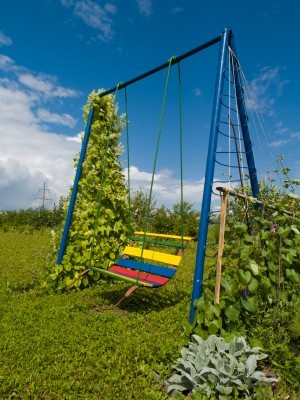
However, when the point of the garden is to produce beauty and food with plants, you don't want to spend all your money maintaining it. Instead, look for some recycling options that keep your garden and your wallet healthy.

Protection Comes Cheaply

After seasons of watching black birds make a quick meal of my raspberries, I invested in a piece of netting to keep them out. Not only was the netting expensive, but it wasn't woven tightly enough. The birds reached between the weave and selected their pieces delicately. When the season ended, it stuck to every thorn and tore huge holes in itself.

It wasn't until I came across an entire bolt of heavy white tulle at a yard sale that I gave it another try. With a few guessing measurements and a pair of scissors, I wrapped sheets of the tulle around my raspberries. It worked perfectly.

The openings are too small for the birds to fit their beaks through, and if I double it on itself it works even better. It's much cheaper than the commercial netting, even if I buy it at a fabric store, and it's heavy enough to withstand a little tugging. When the season was over it easily folded up for winter storage, something the commercial netting never did.

Keeps Dogs In But Keeps Others Out, Too!

After crate training our dog, she decided that she'd had enough of the den. Resale on the crates is low, but it's non-existent if the dog has chewed and clawed her way to freedom a few times. It needed to be re-purposed.

In order to successfully grow a batch of my favorite sunflowers these days I need to erect the Fort Knox of barriers. Birds eat the seeds, groundhogs munch the seedlings, and deer eat the grown plants.

After dragging the dog crate into the yard, I set it on its side and placed it on top of the planted seeds, anchoring it in place with a few yard stakes. The plants could grow through the bars and very little could get inside the crate to bother them.

It works for tomato plants as well, especially in deer prone areas. Dig the hole for the tomato plant, and place the plant inside the cage before planting. Settle the crate on top of the hole and work the roots through the bars so you can plant them. It helps to have someone tilt the crate and support it while you dig. Situate the crate so the door is on the side. This will allow you to access the tomatoes as they ripen. Keep in mind, you need a big dog crate to house a large tomato plant.

Refitting the Swing Set

Once your children outgrow their swing set, you're faced with a structure you can't use. Both metal and wooden sets can be retrofitted for garden use after their days of play are over. The hooks that hold the swings naturally adapt to hanging plant hooks. Ladders work as bean poles or trellises for attractive vines like clematis or morning glory.

Play sets that have "houses" on top can look quaint with flower boxes attached to the windows and large potted plants of various sizes filling the doorways and decks. Use the space under the roof for storage of tools and other gardening items that are rarely used.

By removing the slide, you'll provide extra access to your clubhouse storage. You can add more space for hanging plants since the slide doesn't convert to garden use very well. Add a cargo net from the ground to the attachment point of the slide, and you have another trellis support. Now your children's memories can be your garden's centerpiece.

By Kelly Ann Butterbaugh

4 0SharePrintFollow1 Feedback

Garden Irrigation System With Recycled Materials

Want to feed your plants while you are away for the weekend? Well I have carried out a school project where each child has a grow bag growing vegetables and flowers. For weekends to save parents having to turn out to water, I designed an irrigation system using 2 litre coke bottles. First, I cleaned the bottles, took the lid off and stuffed the bottle with absorbent materials, such as old socks, towels and old sweaters. This absorbs the water and enables the flow to be slow and ensures water gets to the roots.

Then I pierced the bottle at the base, using a quick unpick or a pin. Be careful not to prick your finger! About four holes will do. Make a hole in the compost or planter so that the holes are beneath the soil level and pack around the base ensuring the bottle is standing secure. Take the lid off the bottle and fill with water. The key is to replace the lid which will cause a vacuum. Hey presto!

The bottle will drip feed your grow bag or planter whilst you are away. If you are feeding your tomatoes you could always add feed to the bottle and it will feed your plants too! Happy gardening.

Source: After a visit to The Edan Project UK

By beeky from Hertforshire UK

1 0SharePrintFollowPost Feedback

Recycling In The Garden

For a year I saved all the plastic bottles, paper egg cartons, towel and toilet paper cardboard rolls for such a time as this:

When most of my seedlings got up with their first leaves, not yet with their "true leaves", I was in the midst of mixed weather, having to bring them in and outside a lot. To eliminate the toll to each tiny transported seedling, I cut each cardboard roll into the appropriate height and carefully placed it around the fragile seedling, providing further support and conserving it's moisture.

One must keep in mind that in carrying each seed tray, wind and touching are the most likely factors to break a tiny stem. The other is some sort of pest that has invaded the tray while they were outside. These protective collars can wick moisture away from the seedling, so be careful to keep the seedlings evenly moist.

After using the soil from a trench near the compost bins for composting, the 12' deep empty trench will be filled with both sifted compost, soil and sand to make a bed to plant the root crops for my first adventure with them. Do all sifting on a still day gently and be careful not to inhale any of the debris, soil dust, or to get too close to the sifting process. I got in a hurry and forgot, breathing a quantity of the sifted materials and got pneumonia from it. It was an expensive lesson which I am now recuperating from, I hope. It came right after I was attacked by the neighborhood flu bug along with many others. Use extreme caution with garden supplies and allow plenty of time to think things through before taking on a new project.

Save and recycle those cardboard rolls from toilet paper and paper towels. Their diameter is perfect for the average paper egg carton planted with seedlings. Make certain they are firmly set into the surrounding soil so that their roundness can buffer winds. If done just right, all the same height, you can paperclip each one to the other to keep them stable.

The necks of plastic bottles are coming in handy for all of my lettuces by turning them upside down over the stem to offer all sorts of "dish-like" support for the heads until they are big enough to cut off. It discourages bugs from cutting the stem as well. I then cover the growing plants with the remaining gallon plastic bottles until strong and near harvesting. They seem to really appreciate the protection. If the plastic neck collars are trimmed slightly before placing around the plant, they will more easily fit well into the bottle for support as the lettuce head matures and the sun warms up.

Remember to poke several small nail holes in the bottoms of each gallon jug to allow moisture to escape, but not bugs in. I plan to use plastic bottle halves with tiny punched drain holes under the vine crop fruit to keep them from rotting on hay straw while I wrap each piece with nylon to discourage mice, rats and birds. This is one reason it's called a "nursery".

By Lynda from TX

0 0SharePrintFollow3 Feedbacks
Share Your Feedback: Once you try any of the above solutions, be sure to come back and give a "thumbs up" to the solution that worked the best for you. Do you have a better solution? Click "Share a Solution" above!

Questions

Do you have a question related to this page?
Follow ThriftyFun