This page contains the following solutions.
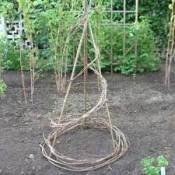
At Christmas one year, I bought one of those lighted spiral decoration trees. After a few years, it just didn't work. I was looking for a trellis for some plants, and guess what I used? The spiral frame made the flowering vine that grew up it, look like a tree in my yard. Everyone would ask what kind of tree it was.
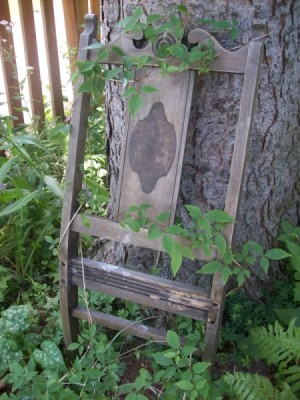
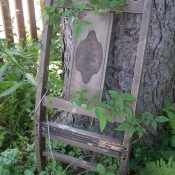 Keep an eye open for old chairs at garage sales, thrift stores, or better yet, pick one up that's been trashed at the curb. Some have beautiful ornamentation and can be used in lots of ways other than a place to park your backside. In this photo, I'm using the back portion of a broken "curb alert" chair as a trellis. My new clematis is pretty happy with it. Sink the side pieces into the soft soil, or like this, just lean it against a tree. Use the left-over seat portion of the chair to hold a potted plant or birdbath bowl.
By ~gloria from western NY
Plant any kind of vining plant below an old clothesline. As the plant grows, you can anchor it to the pole with string or yarn. When it reaches the top of the pole, you can train it across the clothesline itself by attaching it to the line with clothespins. I planted a wild blackberry bush under my old line and it not only looks great, but it's easier to harvest the berries each year.
By Marie from West Dundee, IL
 A rustic looking ladder for sweet peas or other climbers to scramble up in your garden or in a planter on your patio.
Leave the trellis outside for the winter if you like. It makes an elegant addition to a winter garden!
With limited space for a garden, I have to come up with new ways to grow things. This is the new hanging trellis I made to grow cantaloupes on.
Make a trellis for your climbing plant (indoor or out). Shape the triangular part of a clothes hanger into any shape you like, then straighten the hook. Stick the straightened hook into the soil then train your plant around the the wire.
In my garden for the beans and peas I use chain link gates that were no longer needed to get in and out of my back yard. There is a decorative top to the gate so it looks quite attractive. It would be great for clematis or climbing roses, too.
Here are the questions asked by community members. Read on to see the answers provided by the ThriftyFun community.
The seat to my lawn swing rusted and broke off the main frame. The frame itself is still in good condition and I'd like to have some pretty vines trailing up the frame. I was told by someone that the frame would get too hot in the Texas heat unless I insulated it with something like chicken wire. I've never worked with chicken wire so I'd have to figure it out. I'm wondering if any of my ThrftyFun friends have a simpler solution, other than the chicken wire.
By Betty
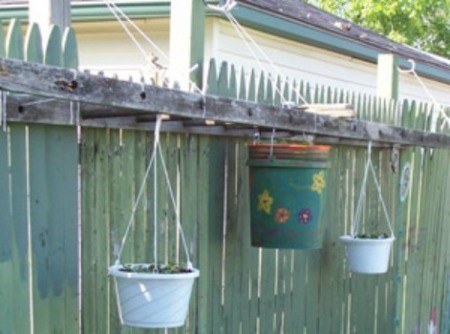
Having moved back to Tennessee after 30 years in Houston I agree that the frame would be too hot for vines to touch. What about hanging pots of petunias, begonias, etc. They could grow nicely without actually touching the framework.
I just thought of something else... a hanging herb garden would be really nice.
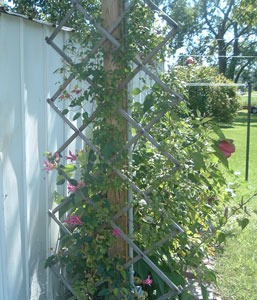
Could you get wooden lattice at the lumberyard and attach to the frame with wire? Or you could get wire (maybe at a plant nursery) and make a support system for the vines on the frame.
Could you paint the frame with one of the insulating paints that throw off heat?
I used KoolSeal on my shed roofs back in AL and GA (I live in NE Scotland now) and it kept the metal cool to the touch.
We used the metal frame from a trampoline to make an arched grape arbor, and it works perfectly. The metal does not get too hot, especially once the vines start growing on them (or at least that has been my experience). We also have gourd vines growing on an old metal gate. Wisteria would be fine, too, as would rambling roses.
Check out these photos.
I have lots of branches and I always weave them on the top and bottom into the fence in different designs, some of the crosses, some of them different shapes to get my morning glories to grow up them. I have just started on mine this year. I am always pruning trees and bushes and I have tons! It gets them out of the way and also provides a little bit of privacy if you have enough of them. Also you can stick little short ones crossways at the corner of the fence and hang things on them. I haven't hung any chimes or anything on mine yet.
By Robyn Fed from Hampton, TN
Reuse an old baby gate as a trellis. If you don't have one in storage they can often be found at garage sales and thrift stores. This is a page about using a baby gate for as a garden trellis.
If you have an old fashioned brass or metal bedstand, upcycle it into a different kind of bed. Using a head and/or footboard in your garden beds will add a touch of whimsy to your yard.
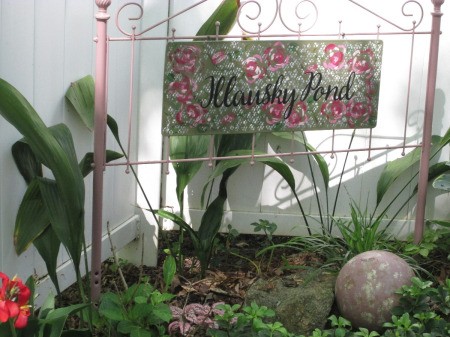
There are so many reusable and repurposable items that can be incorporated into your garden as decorations or as functional items such as a trellis. This page contains some ideas about how to make a trellis out of an old box spring.
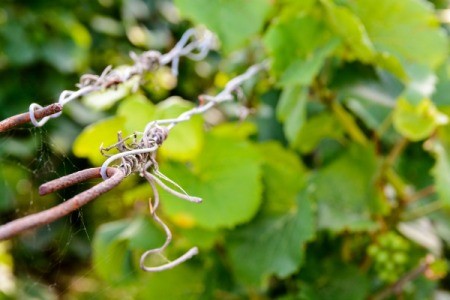
When choosing a trellis, select one that complements your garden and is also made of appropriate materials and designed to provide the best support for the plant that it will support. This is a page about choosing the right trellis.