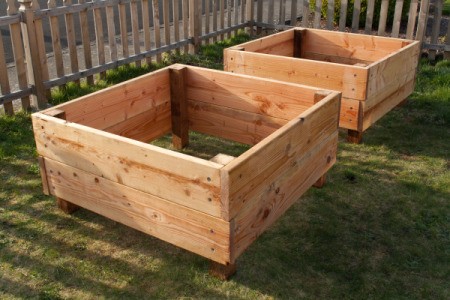
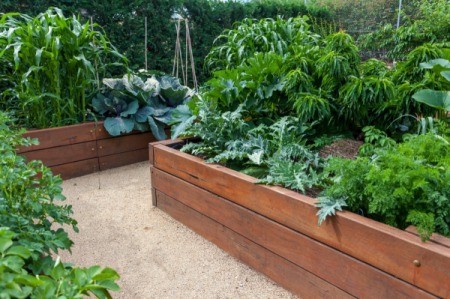
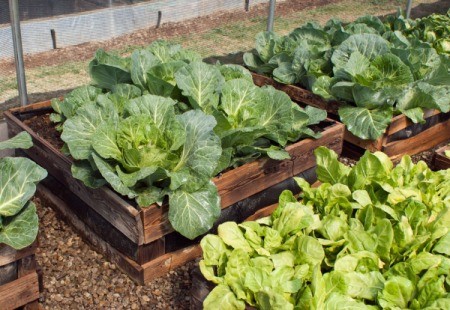
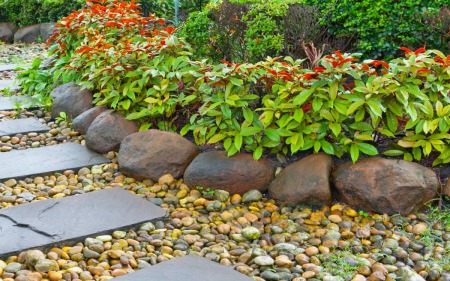
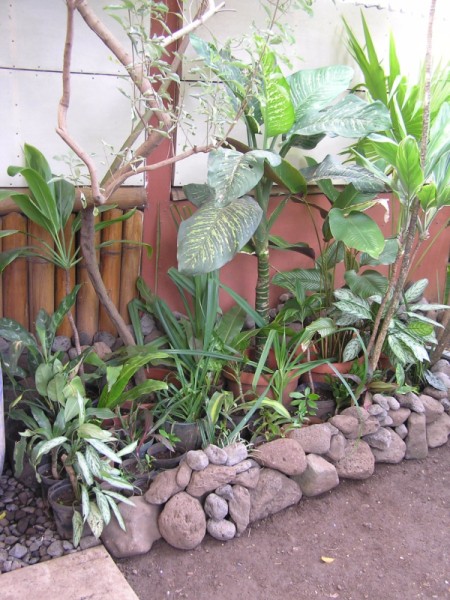
There are several advantages to using raised beds when gardening. They provide excellent drainage, warm soil earlier in the spring, prevent soil compaction, maximize yields in a minimum amount of space, and for gardeners with limited mobility, they can be built to any height. Perhaps best of all, raised beds also keep your garden looking neat and tidy.
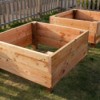
Length & Width: A convenient size is 4 x 4-foot box, because lumber is readily available in 4-foot lengths. This also allows you easy access to the center of your beds from either side. Set the beds end to end to create larger gardens (4 x 8-foot or 4 x 12-foot, etc.) or arrange them in interesting patterns. If you are planting vegetables, building 3 to 4 raised beds of this size will allow for adequate crop rotation. If the bed will be positioned against a wall or fence (accessible only by three sides), limit the width to 2-3 feet so you can easily reach the plants growing in back.
Depth: Most plants need at least a 6-12 inch root zone, so your boxes should be at least 12 inches deep to allow plenty of room for roots. Using 12-inch wide lumber to construct the boxes makes this easy.
Construct your beds on a firm, flat surface (e.g. driveway, patio, or garage floor). Set the boards up on their sides and nail the ends together to create a box. Use 4 to 5 nails on each board in an off-set pattern to help prevent the wood from splitting. If you're doing this project alone, it's helpful to brace one board against a wall to hold it steady while you pound in the nails.
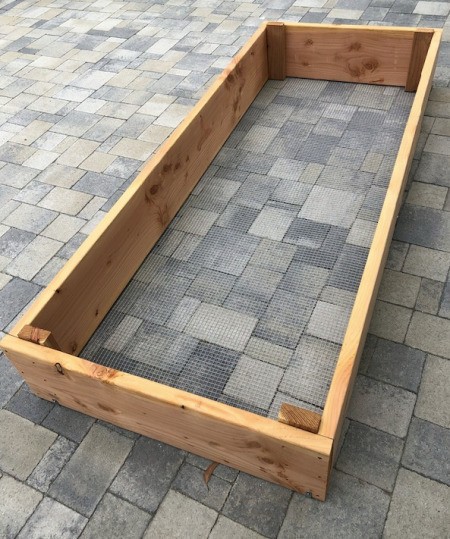
Optional: If you line the bottom of a raised bed with chicken wire, you can easily control gophers and other marauding rodents. Cut a piece of chicken wire/hardware cloth so it's a few inches larger than the inside dimensions of your box. Lay the wire inside of the box. Bend the excess wire up the inside walls and use a staple gun to attach it securely it to the box.
Use a sharp spade to loosen up the top few inches of soil at the bottom of the box. This will help ensure good drainage. Fill the beds with equal parts of compost, topsoil, and well-rotted manure. Water well. Allow a few days to a week for settling to occur and add extra soil if necessary.
By Ellen Brown
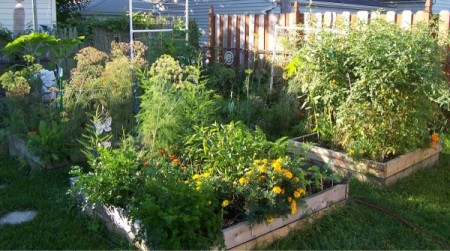
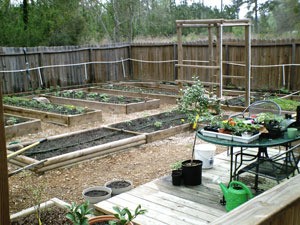
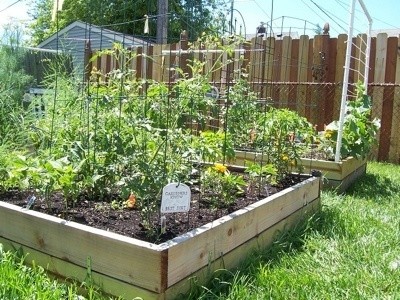
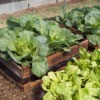
In the foreground bed (5.5ft x 5.5ft) is asparagus, parsley, jalapenos, yellow and green sweet peppers, carrots, radishes, lettuce and green beans. To the right is 3 tomato plants (4ft x 4ft). To the left (4ft x 4ft) is where I grew garlic (which is now harvested), dill and sorrel. In back of the 3 beds is my Herb area, also cucumbers and snap peas on trellises. The dill comes up from seeding itself every year. I pull out some. The rest I use for pickles and so the butterflies can munch on it. There are various flowers throughout.
By Melissa from Lincoln Park, MI
The best part about assembling them in this way is that there is no real need for precision. If you drill the holes off by a bit or a couple of the boards aren't exactly 4 feet long, it isn't a big deal. The bed will still be plenty stable and hold enough dirt to make a great garden plot.
Making the garden beds 4 feet square would work well for anyone utilizing the square foot gardening method. They are easy to reach across and tall enough that they are more comfortable to work in than a shorter bed.
Total spent for 4 garden beds:
Total = $207.65 or $51.91 per garden bed
Cut your boards down to the proper length. The 4x4s are 24 inches and the 2x10s are 48 inches.
I bought the lumber at Home Depot, and they will cut it down to size for free. They used to charge $1 per cut but seem to have stopped doing that. I am not sure if that is a national policy or just local, but it sure saved me a lot of time and money.
The longer boards tend to be cheaper per linear foot. So, for the 2x10s we purchased 12 foot boards and had them cut into thirds, making them all basically 4 feet long.
Thrifty Tip: Check the bargain wood bin that is usually back by the cutting center. We found a bunch of four foot pressure treated 4x4s, that they were just getting ready to mark as discounted. They marked each as $4.01 then cut them down into the 2 foot sections we needed.
When I got to the cashier though, I noticed the 8 foot pressure treat 4x4s were $7.97 each, thus making my wood from the bargain bin more expensive. It was only $.04 a board, but I still asked the cashier how something from the bargain bin would cost more. She agreed with me and cut the price to $2.01 each. So all told, I got sixteen 2 foot long pressure treated 4x4s for about a dollar a piece ($16.08). Now that's a bargain!
Measure 2 inches in from one end of the board on all of the 2x10s and mark them there. This is where the screws will line up with the center of the 4x4s from the end of the 2x10.
Measure 3.5 inches in from the opposite end on all of the 2x10s and mark them there. This is where the screws will line up with the center of the 4x4s when it is butted up against the other 2x10.
At the 2 inch and 3.5 inch marks, measure across the board and mark it at 3 inches and 7 inches on both ends.
Pre-drill the 4 marked spots on each board with a bit slightly smaller than the diameter of the screws you will be using.
At each of the 4 holes, use a 3/4 inch boring bit to create a counter sink for the washer and screw head.
Stain the 2x10s with a wood sealant. Be sure to soak the screw holes and end of the boards well. I like the natural wood look so I used a light stain to bring out the natural color of the douglas fir panels. This step is not 100% necessary but it will make your garden bed last much longer.
When the stain has had a chance to soak in on the first side, flip the board over and stain the second side.
Since I had managed to get pressure treated 4x4s, I only stained the cut ends on those boards. So if you have regular 4x4s, you should stain those at this time as well.
Once the stain is dry, you are ready to assemble. These beds will be heavy, so assembling them near their final destination will save you some backache.
Start by putting whatever is the ugliest end (there is always an ugly end) of one of the 4x4s facing upward, as this is the part that will be in the ground and not visible later.
Next, line up the end of the 2x10 with the holes drilled at two inches in and square it up with the edges of the 4x4. The easiest way to do this is to lay the two 4x4s on the ground and then lay the 2x10 on top of it.
Drive the screw, with washer, into the 4x4 through the holes you pre-drilled.
Putting together all four corners as pictured below was easiest and fastest way we found to put these beds together.
Once you have all the 4x4s attached so they are flush on the end of the 2x10s, the 3.5 inch ends will all line up with the 4x4 on the other side. Assemble the 4 pieces into a square and you are done with the hard part.
To add stability to the structure, you can offset the first board of the second level. This way, the end with the holes drilled at two inches lines up with the edge of a 4x4 that was attached at 3.5 inches on the first level. However, it is plenty sturdy if you don't wish to offset them. See photo below.
Once all the boards are attached, flip it over and you are ready to put it in place!
We purchased enough lumber to put four of these beds in our front yard. As you can see, the first two came together very easily in 1 day. I will write an update next week when I have them all ready to fill with soil.
By Jess from Hillsboro, OR
During the winter, I use the tires for small compost piles and in the spring I will fill them up with a mixed growing medium. In between the tires I will cover the area with wood chips so it is an attractive area, and the tires will almost disappear once the plants fill them up.
Source: I adapted my earlier experience with post hole composting and added recent information about raised beds and easy growing mixes from Mel Bartholemew's new edition of "Square Foot Gardening".
By Oldgardener from Thornton, NH
If you're short on space or the soil in your area is riddled by sand or clay, building raised beds may be the best solution to your gardening woes. You'll trade the time, money and effort required amending poor quality soil for maximum yields in a minimum amount of space.
Once built, raised beds don't compact as easy as conventional garden beds so they are easy to work by hand and never require tilling. In the spring, they warm up more quickly than regular garden soil, which is a real advantage for cold climate gardeners. Pests can be spot treated and fertilizers applied only where you need them, saving time, money and resources. Beds built tall enough reduce attack and damage by moles, rabbits and other small animals. If your building beds from the ground up, you can experiment with soils and plants not normally suited to your soil.
Raised beds easily adapt to any site and can be constructed in any size or shape-triangles, rectangles-even arches. The most important consideration is to construct beds to a height and width comfortable for working. The taller the bed, the more materials and dirt you'll need to construct it. Construct the beds to a width that allows you to reach halfway across them from each side. Most people can easily reach across 3 feet so a six-foot bed works well.
There are several ways to construct raised beds, but before you begin, make sure to remove any weeds or sod from the site you select. It can be helpful to place a barrier like plastic landscape edging around the inside perimeter of the bed to prevent grass from encroaching in the future.

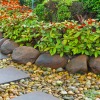
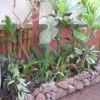
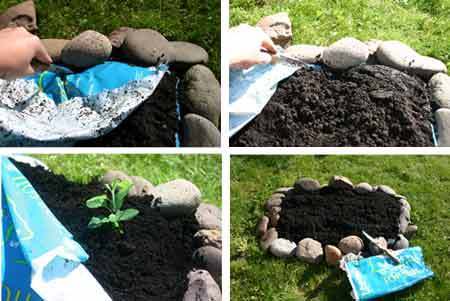
Bricks, rocks and stone pavers all work well for framing raised beds. Wood works well, but will eventually rot. Cedar and redwood are naturally less resistant to rotting than most other wood and will hold up the longest. Pressure-treated or chemically treated woods are rot resistant, but should not be used around beds containing food crops because their arsenic based toxins may leach into the soil. Old railroad ties are also suitable, but newer ties may leach creosote, which is harmful to plants.
No matter what method you choose to build them, or the shape or materials you use to frame them, raised bed gardening offers you space and crop versatility in a minimal amount of space.
By Ellen Brown
I have perennial plants only, not vegetables. It is necessary to closely monitor the height of the plants because the beds are already three feet off the ground, so yarrow for instance, would grow taller than the house if planted here! I have saved the compost only for the bed that will host strawberries and I put chicken wire only in the areas I have spring bulbs. I am extremely happy with them!
By Cheryl from upstate NY
This idea is very old, my grandmother used to have straw bale gardens. It was great for her not to have to stoop over to pick and weed her garden. I have done this type of gardening for the past 3 years and had very good results.
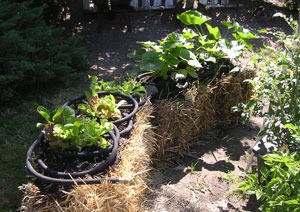
I'd like to see some pictures of various raised veggie garden beds you have made from recycled wood or other recycled items. The ones I see in books and on line aren't recycled items (but rather made of recycled materials).
What I have made works, but is rather "ugly". I don't want to buy the beds, or buy the materials, but am hoping to repurpose items already here on the farm, trying to be thrifty!
So, I am hoping some of you can give me some good ideas! I plan on going 100% raised bed gardening this year for my veggies.
Hardiness Zone: 5a
By April from NW MO
Hi April, we were lucky enough to have old rainwater tanks on our farm that were rusted out on the bottom. My husband cuts off the top and bottom, then cut them in two, he puts poly pipe slit down the middle and attaches it to the rough edges with cable ties after drilling hole all around the edge. All my beds are raised now the more tanks we find the better.Hope you have these galvanized tanks in the USA like we have here in Australia. Happy hunting gail

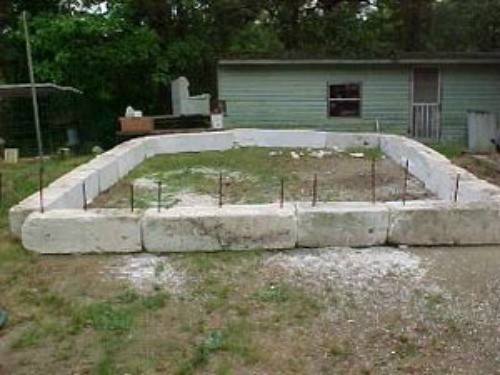
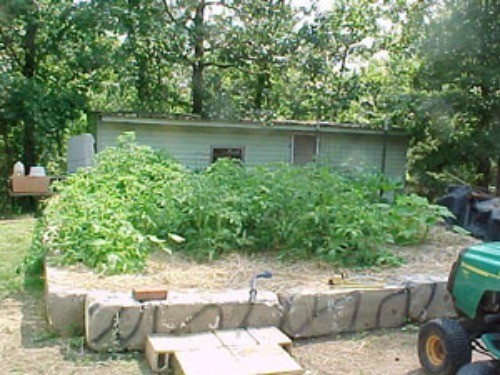
I would like to use all the rocks that seem to grow here to good use. Instead of buying wood to make raised beds in the garden I would like to try building it with the stones. The previous owner left three bags of quick-crete, so I was hoping to use that. Will I have to wash all the rocks first? Do I have to put down a layer of sand before I even start? How long will it have to 'set' before I put in the dirt?
Has anyone tried this before, and what worked and what didn't.
Any knowledge would be greatly appreciated.
I have a small hand book, stone gardens. You are more than welcome to it. Let me know, I will mail it to you.
I am looking for an economical way to edge my raised beds. I have a large garden and lumber is just way too expensive to do all of the beds. Any ideas?
Hardiness Zone: 6a
By Heidi from PA
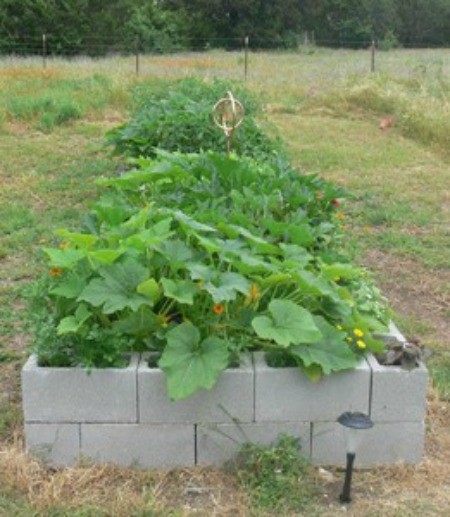
I have used 8x8x16 cinder blocks as the edging for my raised beds. I do "nail" them down with rebar so they don't shift. If you get a sale, they aren't too expensive, or check around colleges when school gets out and pick 'em up for free when the students leave them behind.
Can you turn an old fridge into a raised veggie bed? I would need to put drainage holes in the back and lay it back on ground. What are potential hazards?
By Bec B
Refrigerators are an environmental hazard that need to be specially disposed of, so turning one into a veggie bed isn't a good idea I'm afraid. Depending on the age of the fridge it might contain CFC's, mercury, and other baddies. Even newer ones have things you wouldn't want leaking into the soil. Better to see your fridge properly recycled. There are plenty of ways to make raised beds from reclaimed materials that would be a safer bet. Good luck with your garden!
![]() |
| 2x8's make great walls for raised beds. |
Also keep in mind that beds at a height of 3 ft will be both wheel chair accessible, and accessible when standing. For an easy reach from all sides, keep the beds no more than 6 feet across (most people have about a 3 foot reach) or keep a walkway in the center.
By Ellen Brown
http://www.sustainable-media.com
Additional tips on raised beds from our ThriftyFun community:
By Melissa1968
By Pat
We did ours against the block fencing but, if you wanted a completely free standing one, just do the same on both sides. To secure the logs, we drilled holes through them on each end and in the middle and trimmed down rebar and hammered through the logs into the ground.
My roses are doing wonderful in the planter and you can just mix some dirt and fertilizer in it. Also a tip is next time you go to Starbucks, they have a box or basket that has used coffee grounds to amend your soil.
By Allison
By Anonymous
![]() |
By Wyncia from Boulder, CO
By Robyn Fed
|
| Raised Garden Bed |
The construction was very simple. The boards are screwed into a 4x4 inch post on each corner and have a thinner support every few feet (to keep it from bowing). The 4x4 is longer on the bottom and we dug out a small hole in each corner to keep it set in place. We put two coats of stain on it before installing it so that it would have some protection from the weather and would look more attractive than bare wood.
When it was in place, we covered the bottom with landscaping cloth and then placed landscaping rocks to a depth of about 5-6 inches for drainage. The pumice rocks had been used in flower beds around the house and yard when we moved in and we have been slowly removing and replacing them with plants! We also got 3 yards of mixed soil delivered, which was more than enough. I believe we have half of it left for leveling parts of our lawn and filling in other flowerbeds.
We are just going to plant veggies in here, things that we would normally buy. It will get full sun until late afternoon and should work great.
Jess in Oregon

By sunnysideup
By TC in MO
By
By jess
Think about which crops your planting where in the bed. You don't want your tall crops to "shade" out other crops unless thats what you have in mind. For instance I always plant lettuce, radicchio, spinach etc under the feet of my bush beans. They love the shade and the beans love the cool feet.
Good luck, hope you get great production! (04/04/2008)
By doccat5
I am looking to find some free or inexpensive wood to build a raised garden. Other than Home Depot or Lowe's, any ideas where I can find this?
By Deno from Mesa, AZ
By iruiz27
By Robyn Fed
By kffrmw88
By Wynclute
By msburny
By rach1964
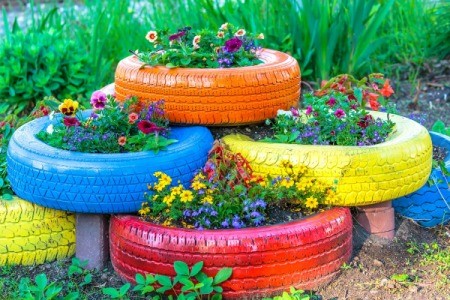
Use old tires painted and stacked two deep for raised beds.
By Wakaliz
By