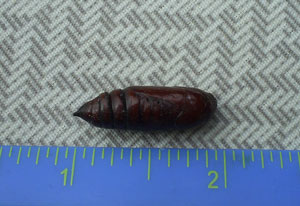
We found this in our backyard this weekend (end of April) when we were taking out a chain link fence. It was on the ground but might have fallen off of some plants (mint, clematis, morning glory or other weeds). My son said that is was "buzzing" in his hand. I saw another one of these when I was planting some seeds but that one had been squished so I didn't pay much attention to it.
Add your voice! Click below to answer. ThriftyFun is powered by your wisdom!
Was it one of these?
ukmoths.org.uk/
or the pupa toward the middle of this page:
or this?
commons.wikimedia.org/
(You will have to copy and paste the entire link because it isn't clickable)
Ooh, this article says this one wiggles when you touch it:
manduca.entomology.wisc.edu/
There's a site that is devoted to answering these kinds of questions:
www.whatsthatbug.com/
Hope this helps, and if it does, please update so we all can know what that is. :)
Hi, thanks for the links. I might send the photo to the What's That Bug site to see if they can positively identify it. It is hard to search through all their photos. It looks like it is a moth pupa of some kind. It mostly matches the description of the Manduca moth, the bollworm and the cutworm moth, but none of them are conclusive. I we find grubs in the ground all the time that my Western Garden Guide shows as cutworms but the pupa is bigger than it is supposed to be.
Jess
Sure looks like the pupa of a June bug, aka May bug or beetle. They're very common in Wisconsin, Don't know about Oregon. The grubs are white, about an inch long, and have a brown face. The grubs eat plant roots. The pupa always reminded me of the barrel-shaped buttons on car coats.
That is a moth pupa, most likely a sphinx moth. If you look closesly between it's eyes, you'll see a long, skinny line that is it's proboscis, or tongue. These moths fly like little hummingbirds and drink nectar from flowers. Also, if you tap on it's pointy hind end, it'll wiggle a lot :)
Hello, it's Jess. I talked to a master gardener at the zoo this weekend and she said that it was most likely a "leatherjacket" or crane fly. We always called these "skeeter eaters" growing up. One website called them the "daddy longlegs" of flying bugs and that is a pretty good description.
I guess there are two kinds, one that is destructive and one that is benign. As we don't have brown spots in our lawn, she suspected that we have the benign kind. Thanks for all the feedback and help solving this mystery.
Jess
Hi Jess
This is NOT a Leatherjacket pupa! Its a moth pupa. Not sure what specie of moth but its definitely not a Leatherjacket. Ive just had an infestation with be been dealing with and seen all stages of the Cranefly.
Thanks for letting us know. I still see them in the garden often.
Add your voice! Click below to answer. ThriftyFun is powered by your wisdom!