Few of us are aware of how much water we waste. Most of us merely turn on the sprinkler and walk away. In many places, water is not only scarce, it's expensive. How you deliver water to your lawn and garden can have a major effect on your water bill and ultimately, on the environment.
The goal of watering wisely is to deliver the right amount of water to the right location, the plant's roots. Any more, any less or anywhere else is simply a waste. Overhead sprinklers are outdated and inefficient because water is delivered to areas not needing it and significant amounts are lost to evaporation.
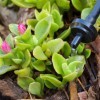
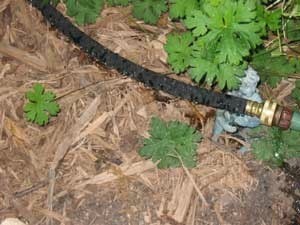
Low-pressure drip irrigation systems work best. Slow, thorough soakings encourage roots to grow deeply to where moisture supplies are more continuously available- ultimately reducing your need to water. Porous pipes, in-line emitter tubing and soaker hoses deliver water directly to the base of each plant, each drop soaking into the soil. These systems are flexible, simple to assemble, adapt to any site and reduce water use up to 70%.
Devise a simple drip watering system around trees and shrubs by punching holes into the bottoms of plastic jugs and burying them into the mulch under drip lines.
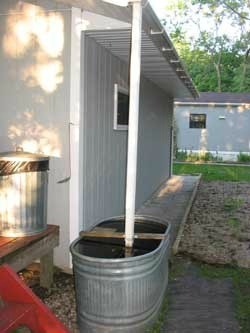
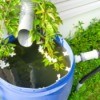
Rain barrels and livestock tanks attached to rain gutter down spouts are easy, inexpensive ways to collect and store water for gardening. Attach spigots and hoses to the bottom to create cheap, gravity flow drip-systems. Cover them to prevent children and small animals from falling in.
Water from the kitchen sink and bathroom toilets should not be used for irrigation due to health concerns. Water draining from the shower, bath, or laundry can be used, however, if you use chemically free soaps and detergents in your home.
The water used to rinse milk cartons is good for preventing certain plant diseases common to tomatoes, eggplants, petunias, peppers, and potatoes. It also protects cabbages from cabbage worms. Recycle water after cooking vegetables to enrich houseplants with valuable vitamins and minerals.
As a rule, water deeply, but infrequently. Most vegetables need about 1 inch of water per week. Trees and shrubs need only a half-inch. To determine how long to leave your system on, place several cans of the same size around areas being watered. Check the time when you turn the water on and leave it on until at least one of the cans is filled with an inch of water. Now you know how long to leave your system on.
Soil Type: Excellent, healthy soil will reduce your need for watering. Water percolates quickly through sandy soil and slowly through clay.
Soil Moisture: Don't base your decision on when to water solely on the look of your plants. Strong afternoon sun can temporarily cause plants to wilt despite moist soil. Overwatering can also cause wilting. Test your soil's moisture. If you have to dig deeper than 2-3 inches to find moist soil, it's time to water.
Plant Types: Corn prefers a lot of water, cantaloupes less. Plant thirsty plants together and keep in mind it can take transplanted seedlings up to two years to lose their root ball and develop downward roots. How you water those first two years can contribute greatly to root systems later on.
Mulching: A good layer of mulch around everything in your garden will hold moisture in and keep water-competing weeds out. Don't forget to mulch pots and planters, too.
Time of Day: Water early in the day before heat causes excess evaporation and so leaves have time to dry before nightfall, reducing the chance for spreading disease.
© 2005 ThriftyFun
About The Author: Ellen Brown is an environmental writer and photographer and the owner of Sustainable Media, an environmental media company that specializes in helping businesses and organizations promote eco-friendly products and services.
Add your voice! Click below to comment. ThriftyFun is powered by your wisdom!
I hate to waste water! I live in N.E. Florida and the water management folks are constantly preaching 'conserve water' because this area is growing so rapidly. My subdivision will max out at 7500 homes. 20,000 are going in just down the street from our sub-d and 15,000 will be going in just 10 miles away. Add to that the many subdivisions going in that are just 200-300 homes and we are talking serious growth! If we all just pitch in and save 10 gallons of water per day, that adds up to a lot of water we won't be pulling up from the Florida acquafer. So, I have found a great way to water wisely.....
Use pool water! Yup, been doing it for years. This is very good after a heavy rainfall or several days of rain. When your pool gets too much water in it, gotta do something with it!
For all of my container plants (and there are many) around the pool, I just keep a bucket handy. But for the rest of my yard, I use garden hoses to distribute it to the grass and plantings. Please read on....
Simple instructions: After the pool water goes through your pump, where it comes out of the pump (this is the pressure side) simply plumb in a water spigot (you may already have one). If you can't do it, any good handyman can. I have a large yard, so, on my spigot I have placed a 'Y' connector equipped with 2 shut-offs (costs about $2 for the spigot and $3 for the 'Y.' at Wal-Mart. I then attached a garden hose to each end of the 'Y' and just run it along the house foundation to different parts of the yard (one hose ends up in the front of my house, the other in the back). They are just there so I don't have to continually go to the side of my house where my pump is and drag a long hose all over the yard. I cover these hoses with mulch and on both ends I attached an inline hose timer (non-electric, buy at Wal-Mart about $10 in the garden center or any hardware store). This timer connects to the male hose end near my foundation. The timer allows the hose to be in the 'on' position in increments of minutes. This timer will shut off the water from the pool after say 20 or 30 minutes or whatever time I set it for just in case I have a yard sprinkler attached and don't want to stay there baby-sitting it. I have found in the past before I bought the timers, I would sometimes forget to turn the pool water off and thus waste water.
I do not use these hoses to water my plants or grass, but rather these hoses remain close to my house foundation and are just my supply lines (you could of course plumb in PVC pipe, but it is a bit more work and it should be placed underground. Using hoses is simple and fast and you will be watering the very same day you set this up. I also have in in-ground watering system that is connected up to city water. I try to use this as little as possible.
When I want to use my pool water, using the shut-off I open one side of the 'Y' at the pool pump and attach another garden hose to the hose timer near the foundation in the front or back (I use a hose holder on wheels for this hose) and water away! I use this water on all of my plants both flowers and veggies, grass and potted plants. The chemicals in the pool water don't do any harm to them. The only time I won't use this water is when the pool gets shocked. I wait until the next day. When finished, it is a good idea to release the pressure in the hoses near your foundation (they will last longer).
Instead of dumping 2-3 or 400 hundred gallons of water into sewer when my pool gets too high, I wisely use it in the landscape. Only on very dry months do I have to use my in-ground sprinkler system.
This is using water wisely and it really works!!
Great site and some very interesting points.
We are designing and supplying rainwater recycling systems for self-builders right up to large commercial buildings. It's really nice to see the whole thing taking off at last.
Hi,
Is there any problem with the chemicals in the pool water, especially Chlorine? I would think that the high concentration of chlorine would kill grass and plants?
Thanks,
dave
Before I plant any veggies in my raised garden, I bury a black soaker hose a few inches below the ground in trench. I cover the hose with soil and then plant the tomatoes, peas, beans and etc. next to the hose. I then attached a hose that is hooked up to a timer. When the garden needs water, I only have to turn the timer on for an hour or so and the roots are nicely watered and the plants are not. That sure helps with preventing mildew on the plants. They don't have to dry off after watering.
Source: Me! However, I am sure I am not the only one who thought of it.
We do something not mentioned here... sub-irrigate!
Five years ago my husband built me five 4x8 sub-irrigated raised beds. The beds are lined with several layers of 6 mil plastic. They have sections of 4" corrugated, perforated drain pipe laid so the entire bottom is covered, and permeable weed-barrier cloth laid over that. A drain tube goes from this reservoir to the outside at about 1/2" below the top of the pipes so the beds don't over-fill in a rainstorm, and a tyvec tube with one end in a drain pipe to prevent mud from clogging it is draped over the other end (fill tube). Soil is then piled on top of the weed barrier cloth, filling the raised bed. The soil pushes down between the drain pipes, creating "wicks" that draw water upward into the rest of the soil, creating a "damp" zone for the plant roots. I attach the fill hose to a hose from my 375 gallon rainwater collection tank and fill the reservoir until I see water starting to drip out of the drain outlet on the other end. I only have to do this once a week. When my plants are just starting, I'll hand-water from the top until they are established and the roots can reach the "damp" zone. I never have to use tap water in my garden, only collected rainwater.
Add your voice! Click below to comment. ThriftyFun is powered by your wisdom!