 Hostas are one of the most popular and versatile perennial plants you can have in your shade garden. As foliage plants, they offer an unmatched range of patterns, colors, and sizes and their leaves and delicate spiked flower stalked are stunning when mixed in with arrangements. Here are some tips for buying and growing hostas.
If you're looking for a specific variety of hosta, well-established leafed-out plants are much easier to identify correctly, as immature plants often change dramatically in appearance by the time they grow into adults and are prone to mislabeling. A good resource for identifying varieties is at: www.hostalibrary.org
Two diseases to watch for when buying hostas are the Hosta X virus (HVX) and foliar nematodes. When unknowingly introducing infected plants, the first can kill off your entire hosta collection and the second can wreak havoc on your entire garden. Big box retailers tend not to be overly concerned about "trafficking" these types of diseases, so if you buy from them, proceed with caution and keep in mind that at least in the case of nematodes, the brown streaky leaves may not show up until later in the season.
Ideally, your retailer should be able to certify and guarantee that the hostas they are selling to you have been inspected for viruses and foliar nematodes. Find a reputable vendor and stick with them. For a list of vendors recommended by the American Hosta Society, visit: www.americanhostasociety.org
For more information on HVX: www.extension.iastate.edu
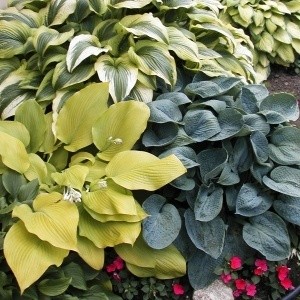
There are hundreds of kinds of hostas from light green to dark green, blue, silver, gold, variegated, and even white. There are also different sizes (miniature to giant) and leaf shapes (round to narrow), some have shiny leaves, others are dull. Here are 6 popular varieties to try:
Uses: Accent plants, groundcovers, rock gardens, edgings, front borders.
Planting: Plant in the spring. The planting hole should be large enough to take all of the hosta roots and spread them out, with 12-24 inches between holes. Buds should be 1 inch below the soil. Pack the soil and moisten well.
Soil: Hostas are very tolerant of a wide range of soils, but grow best in rich, moist soil. Mulch around the base of plants to conserve moisture and prevent mud splashes during rainy weather.
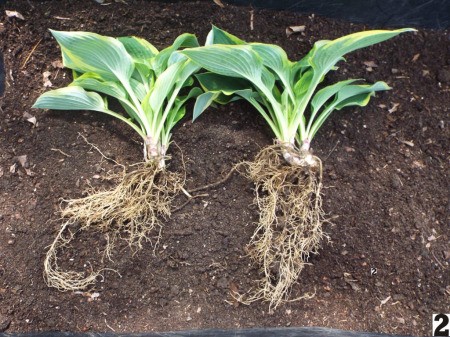
Dividing: A hosta plant grows slowly and is one of the last perennials to peak through in the spring especially in deep shade. It can be allowed to spread without ever being divided, or once well-established, can be divided into two or more plants depending on the size. Large plants should be sliced and divided with a sharp spade. As long as there's an eye (crown) when you divide, it will grow. Use a sharp knife to divide smaller plants.
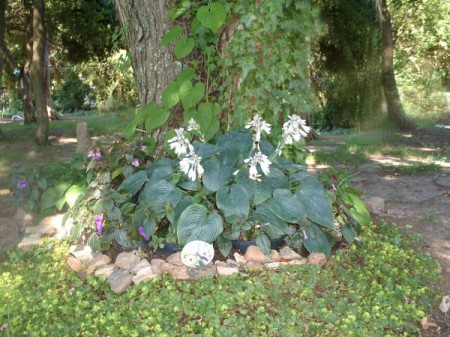
Growing Conditions: While most hostas prefer full to partial shade, many will also tolerate sun. Keep in mind that light conditions may have an influence the leaf color (cause them to fade). Light or dappled shade works well for most varieties.
Climate: Hostas need a dormancy period of somewhat colder weather. They grow best throughout the Mid-Atlantic, East Coast, Midwest, Northwest, and the Southeastern parts of the United States. Most hostas will not survive in tropical or subtropical climates.
Discouraging Slugs: Place shallow dishes of beer around your garden in areas that slugs tend to frequent. Slugs are attracted to the beer but they cannot get out again and drown. An alternative is to sprinkle crushed eggshells or diatomaceous earth around the base of plants. Slugs won't cross sharp barriers that risk injury to their skin.
Winter care: If slugs have been a problem, trim the dead foliage back in the fall. If not, leave the foliage undisturbed going into winter. While the ground is still frozen, rake off all of last season's decayed leaves. In harsh winter climates the freeze/thaw cycle may cause hostas to heave, so cover plants with a couple of inches of compost (or peat moss) to protect them going into winter. In early spring before the leaves start to emerge, gently rake off the compost.
Ellen Brown is our Green Living and Gardening Expert. Ellen Brown is an environmental writer and photographer and the owner of Sustainable Media, an environmental media company that specializes in helping businesses and organizations promote eco-friendly products and services.
This page contains the following solutions.
Slugs are common pests to Hostas and can munch large, unsightly holes in their leaves. Creating a barrier of coarsely crushed eggshells around the base of plants will make slugs think twice about crossing.
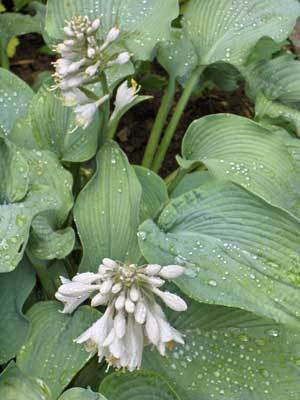
Hosta is said to be a shade loving plant. However, it will grow in full sun, sometimes producing large plants. I've seen long rows of huge plants placed where they get full sun all day.
Here are the questions asked by community members. Read on to see the answers provided by the ThriftyFun community.
How do I grow hostas from seed?
By Amanda
Wow. Have never seen hosta's in seed form, however, I know once you have the plants growing in the spring or fall, you can dig them up and you will find that the roots have multiplied, and can keep spreading as many times as you want to. I bought some small ones at Mernards 2 - 3 years ago at the end of the season, when they were 1/2 price and planted them along the entrance sidewalk to my office because as I'm getting older, I needed something that would return each year. Well they do, and are bigger each year and are absolutely beautiful.
Why would you want to? Just find someone with hostas and ask if you can have some when they divide them. Hostas are supposed to be split every few years. The last time I dug mine up, the person I gave my thinnings to lined their 300+ foot driveway with them. Given good soil, they grow very fast. I'd gladly give you some!
In the fall do I need to cut them back?
I never cut back my hostas and they always grow back bigger than ever in the spring. They will die back to nothing, like peonies do.
My new hosts were planted 4 weeks ago and are shooting about 2in high now. Should I take them in for the winter? I'm new to gardening so will be glad of any help.
By Paul from Portsmouth, UK
No, hostas will come back each year when left in the ground.
Hostas stay outdoors and we have cold winters
I have some hostas that are 2-3 years old. They come up each year, but never get any bigger. I have 3 different kinds and they all act the same so I don't think it is the type. They grow in constant shade between a large pine tree and the house. I have a feeling that the pine or cedar trees have something to do with it.
I have mulched them, fertilized them, even put new compost around and turned over the dirt. Last year they just didn't look very good, but they did not die. I have a friend that gave me some from her yard last year. They are in a different place, but there is a cedar tree there too.
By Vicki
Hostas don't like pine or cedar. I would remove them gently, and plant elsewhere or dig the hole out much bigger put in bagged dirt and replant. But, you would have to do that probably yearly.
I planted hosta bulbs this year and they are all coming up great expect it looks like something is eating the leaves. They look light brown and see through. Does this mean something else? Thanks for any help!
By kathy
It's probably slugs. Try putting a dish of Beer next to the plant. If you find snail like creatures in the Beer that's your problem. Using a hose end sprayer containing a can of beer, an ounce of dishwashing liquid and 2 ounces of listerene mouthwash spray until dripping. Good luck.
Something is biting off my hosta leaves at the base but not eating them. Any ideas and suggestions of what to do?
By Kathleen J
Is a raspberry splash too tall to plant in front of a hosta Francee?
By Tricia from Moose Jaw, SK
Check out these photos.
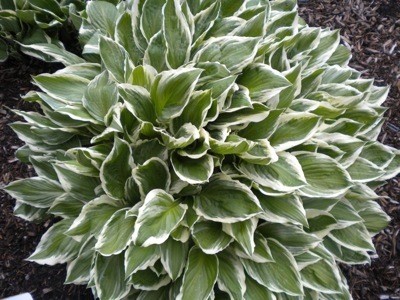
I took the photo of these Hostas one day when it was cloudy. The cloudiness really brought out the colors in the plants.
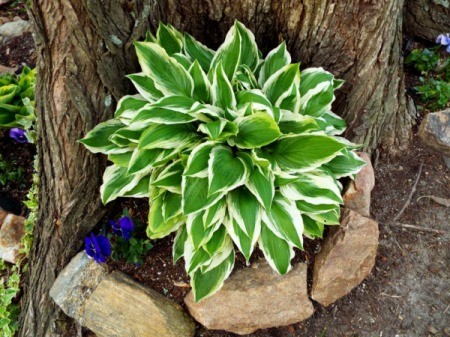
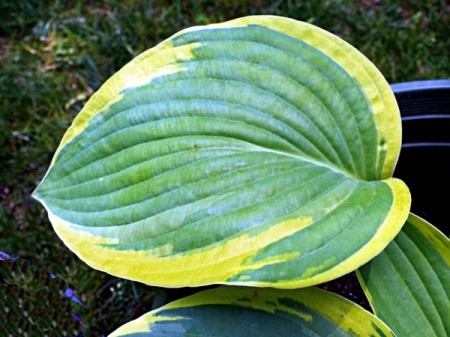
Not much going on here except that I enjoy observing patterns, shapes, and textures in Nature. This variegated hosta leaf fits the bill in all three categories. I wouldn't turn it down as a wall hanging for a quieter room in the home. Classy!
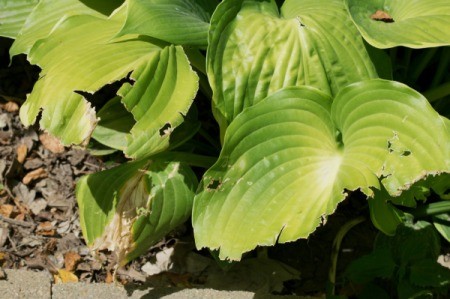
Deer love to browse in our gardens. If your hosta was part of their recent smorgasbord your plant can recover. This is a page about deer eating my hosta leaves.
This is a page about dividing hosta. Like many perennials hosta can be divided to give you multiple new plants to spread throughout your garden.