HomeBrowseNewslettersContestsAskShare 
AllGuidesQuestionsVideosBy DateRecent Feedback My AccountAbout Us
Crafts > Garden & Yard on April 22, 2012

Homemade Stepping Stones

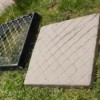
Stepping Ston With That well worn path can be paved with inexpensive stepping stones. This guide is about homemade stepping stones.
     

Solutions: Homemade Stepping Stones

Read and rate the best solutions below by giving them a "thumbs up".

Inexpensive Stepping Stones in 10 Easy Steps

Making Stepping Stones Stepping stones are an easy way to add functional creativity to your garden. Here's a simple and inexpensive way to make your own in just 10 easy steps.

Supplies:

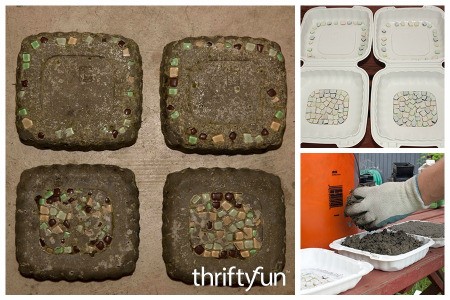
  • Mold. This can be made out of anything that will hold cement: pizza boxes, disposable pie tins, cake pans, vinyl pot saucers, plastic take-out containers, etc.)

  • Non-stick agent. This will "grease" your mold so the finished stone releases easily from the mold. You can use Vaseline, cooking spray, or plastic wrap.

  • Quickrete (or other fast-setting concrete). If you want to add embellishments, choose a product with a sandy texture for a smoother finish.

  • A bucket, stir stick, and large spoon. A one gallon ice cream pail is large enough to hold cement for one mold the size of a pie tin.

  • Chicken wire or hardcloth. This will give the finished stone extra strength. Cut a piece to fit your mold before you mix up the concrete.

  • Embellishments. Use your imagination here!

Directions:

  1. Gather supplies.

  2. Protect your work surface. It's helpful to use a piece of plywood or another movable surface for your work surface so you can move them to another location for curing. Then cover it with an old tarp, vinyl table cloth, or lawn-sized trash bags.

  3. "Grease" your mold. Cover your mold with a heavy coating of cooking spray, Vaseline, or line the bottom of the mold with plastic wrap. This will help your stone release easily from the mold. Pizza boxes, plastic saucers, and pie tins generally don't need to be sprayed. Simply peel the sides of the mold away from the stone after it sets.

  4. Mix up the concrete. Follow the directions according to the product's package. If necessary, add in more mix or water until the mix reaches the consistency of thick brownie batter. Take care to protect yourself with eyewear, gloves, and a face mask. Concrete dust can be hazardous when inhaled, and once mixed, cement can cause severe burns upon contact with your skin.

  5. Scoop half of concrete mixture into the mold. Level out the surface by gently tapping it on your work surface.

  6. Add chicken wire. Press the edges down so that no sharp ends are sticking up.

  7. Scoop remaining concrete into mold.

  8. Tap the mold gently (several times) on a hard, flat surface. This will level the surface and help release any air bubbles that might be trapped.

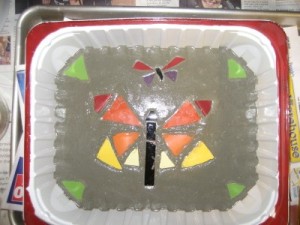
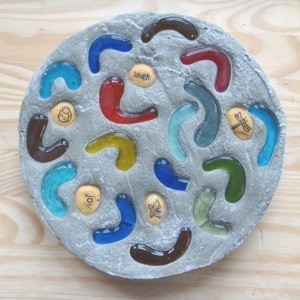
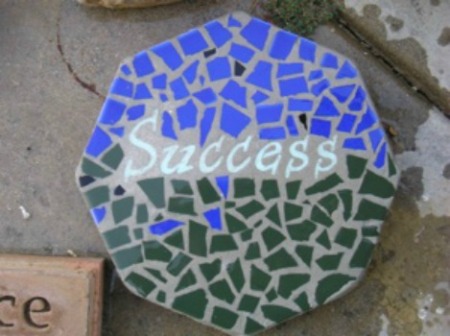
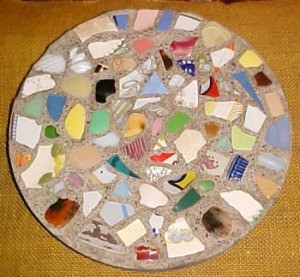
  9. Add embellishments. Press them gently into the surface. Use stones, tiles, stained glass, leaves, pine cones, pot shards, scrapbooking embellishments, or whatever captures your imagination. Letters and numbers made specifically for stamping imprints into stepping stones can be found at most large craft stores. Cookie cutters are also great for stamping and making imprints.

  10. Let it cure. Leave your stone to dry for 2-3 days before attempting to remove it from the mold. Plan to let it cure for at least another week before taking it outdoor and walking on it. As the stone continues to harden, mist it with water once or twice a day and keep it covered with plastic wrap. This will prevent it from drying too quickly and give it added strength.

Additional Hints:

  • Mix up only enough concrete to make one mold at a time.

  • Grease your mold, cut your chicken wire to size, and lay out your embellishments BEFORE mixing up the cement. Depending on what cement product you use, once it's mixed it usually sets up within a matter minutes.

  • DON'T wash cement products down the sink! To save your bucket to reuse, wipe it out with moist paper towels and throw them in the garbage.

  • Change the final color of the stone by adding acrylic or latex paint or cement dye to the mix. Stones decorated with paint after they cure should be sealed before being placed outdoors.

  • Place stepping stones in the ground so that no more than 1/2 to 3/4 inch of the stone breaks the surface of the ground. This will protect the stone from cracking while being walked on and help people avoid tripping.

By Ellen Brown

20 0SharePrintFollow6 Feedbacks

Making Stepping Stones

No need to buy a 'stepping stone form' to create your garden stones; just dig a hole 4 inches deep in the desired shape wherever you want the stone and fill with quick mix concrete. Be careful not to breathe in any concrete dust!

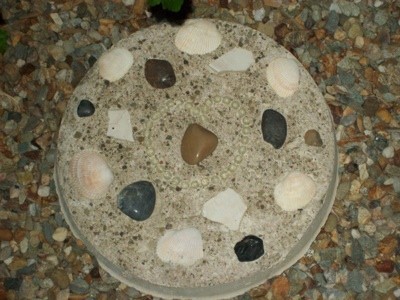
For decorative stones (not path stones), try digging the hole in sand, dirt, or the gravel on the driveway. Fill with concrete, smooth with trowel, and press in pretty stones. Leave to set over night and lift out in the morning. Just don't make these too large to lift easily.

I have one by my garden bench that says 'Listen'. It reminds me to slow down and listen to the birdsong and the brook.

By Barb from Acra, NY

7 0SharePrintFollow1 Feedback

Easy Concrete Stepping Stones

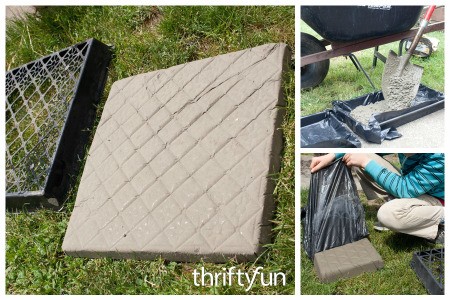
Use half flat plant containers to make fast and easy paving stones for your garden. We had a bunch of half flat containers left over from buying plants this spring. I thought they would make great stepping stone molds but wasn't sure how to get the best results and be able to reuse the molds for future projects. I got the idea to line them with plastic and turned out to be the perfect solution.

Supplies

  • Half flat plant containers
  • Plastic garbage bags
  • Scissors
  • Bag of concrete mix
  • Wheelbarrow or bucket to mic concrete
  • Shovel
Easy Concrete Stepping Stones

Instructions

  1. Cut the garbage bag along the side and bottom of the bag and unfold it to make 1 large plastic sheet.
  2. Easy Concrete Stepping Stones
  3. Cut the garbage bags to fit as a lining to the half flat containers. We found that we could easily get 4 from each garbage bag.
  4. Easy Concrete Stepping Stones
  5. Line the half flat containers with the cut pieces of plastic. We found it helpful to wrap any extra loose plastic around the bottom of the mold as it was a bit windy that day. Keep it as flat as possible because folds in the plastic will show on your finished stepping stone.
  6. Lining Molds with Plastic Garbage Bags Concrete Mix with Lined Mold
  7. Mix the concrete in your wheelbarrow or bucket. Use a shovel to stir the water in until it is the right consistency.
  8. Mixing Concrete in Wheelbarrow
  9. Scoop or pour the concrete mix into the molds
  10. Pouring Concrete into Mold with Shovel
  11. Lightly shake and tap the mold on the ground to level the concrete. This will also help push the concrete in to all the nooks and crannies of the mold design and reduce bubbles on what will be the top surface of the stepping stone.
  12. Let the concrete set-up for about 24 hours
  13. Setting Concrete
  14. After the concrete is set, flip the mold over and remove it.
  15. Removing Mold from Concrete
  16. Now peal back the plastic to revel your new stepping stone.
  17. Removing Pastic Garbage Bag Liner
  18. The concrete will continue to dry out over the next few days, but you can put it in place right away.
    1. Finished Stepping Stone Close-up of Concrete Stepping Stone

      By Jess from Hillsboro, OR

6 0SharePrintFollowPost Feedback

Craft: Lettered Step Stone

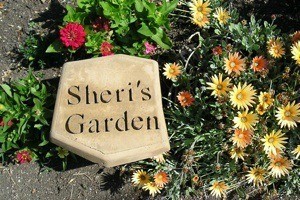
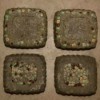
Sheri's Garden Stone Here is a stepping stone I designed and made last spring. Seems that stepping stones are perennial favorites on craft sites so thought this would be helpful. I use a hot wire machine to cut letters out of styrofoam, glue the letters to the bottom of the form used (in a mirror image) then pour the concrete mixture into the forms. After setting 24-48 hours, my stepping stone is ready.

By Creativeman from Chatswoth, CA

4 0SharePrintFollow4 Feedbacks

Personalized Stepping Stones

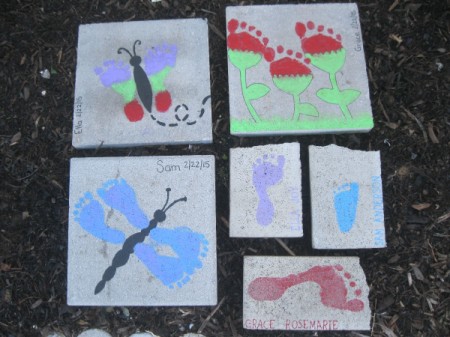
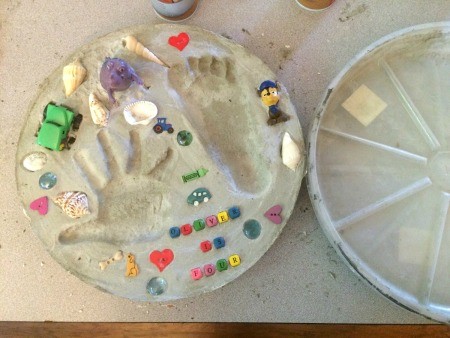
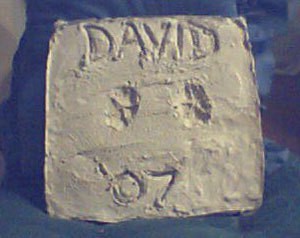
Stepping stone with David's name. I am making stepping stones with each family member's hand (or paw) prints and name! We are including all friends and family who visit and will be making one of my bf's mother who is 70! These are really fun and easy. I use Sakrete which is a kind of brick mortar. You shore up a small pizza box with duct tape and line it with a garbage bag. The Sakrete is less than 5 dollars for 80 pounds and I'm using 10 pounds per stone. Lily and Dennis's stones.
By Lily from South Bend, IN

2 0SharePrintFollow4 Feedbacks

Low Cost Recessed Stepping Stones

Seattle is known for it's rain. And with that rain comes muddy yards, so I needed stepping stones. But I didn't want to worry about my lawnmower hitting the stones, so I came up with a plan that worked perfectly! And all you need is cement or concrete, water and a shovel.

First of all, pick a day with no rain that's not very hot and cut your grass as short as you can in the area you want to place your stepping stones. Next (on the freshly cut grass) mark the exact outline of what you want each of your stepping stones to look like. (most people use a marking paint made for marking underground power cables, but I used plain white cooking flour which I sprinkled on with my hand).

The design I used was of "amoeba-like" asymmetrical and slightly interlocking "stones". Next, dig down into the ground about 4 - 6 inches (on and inside the line) while following the line you drew with your shovel. Lastly mix your cement with water (I mixed one bag at a time in a 5 gal bucket) then fill each freshly dug hole to the top with the wet cement. (The ground is your "mold")

*Buy about 1 small bag of concrete per hole depending on the size and depth of the hole. You can press several interesting sticks and leaves into the wet cement, these will look like "fossils" in the "stone". You can also stain the cement with a cement colorant so it looks like stone, (many colors are available) but I left mine plain and they turned out wonderful.

I chose a wavy path for my stepping stones (as opposed to a straight line) with one zigzag in it. This looks great with the "organic" interlocking shape of the recessed cement "stones" and I put a fountain with plants around it in the center where the path "zigged".

The stepping stones look like slate for a fraction of the price, but my favorite thing about them is that we could mow right over them with no harm to our mower blades! That and the way my shoes no longer got wet on my way to the car! I was told that without adding re-bar my stepping stones might crack, but they've been there for nearly 20 years now and have held up fine. But, truthfully, if they do crack, it just adds to the slate-like rock look. No big deal!
1 0SharePrintFollow5 Feedbacks
Share Your Feedback: Once you try any of the above solutions, be sure to come back and give a "thumbs up" to the solution that worked the best for you. Do you have a better solution? Click "Share a Solution" above!

Questions

Here are questions related to Homemade Stepping Stones.

Making Concrete Stepping Stones

Would I be able to use Elmer's glue as a super placticizer for making cement or concrete stepping stones?

By Annie from Boulder City, NV

SharePrintFollow4 Feedbacks

Most Recent Answer

By souzos 03/21/2010

Yes you can, but what you want to use is regular Elmer's Concrete Bonder or Elmer's Probond. It's used to bond new concrete to old. When mixed into the concrete it acts as fortifier making your stepping stones stronger and more weather resistant.

Sealing Plaster Stepping Stones

Does anyone have any idea as to what I can use to seal a plaster stepping stone? I had my grandson make a stepping stone from a kit. It turned out to be plaster which will disintegrate outside. I had him paint it today (with acrylic paints), but now I can't find anything to seal the whole thing with. I was told to use Minwax Polycrylic Protective Finish, but that is strictly for wood finishes. Please help!

By cuisinequeen

SharePrintFollow2 Feedbacks

Most Recent Answer

By angeltea9 06/29/2011

Go To Michael's Crafts or AC Moore Crafts stores & ask them.Or even Home Depot or Lowes-They all should know,if you tell them what you want to seal. Good Luck! : )

Making Stepping Stones Without Concrete

Is there a way to make garden stepping stones without using concrete?

By Penny W.

SharePrintFollowPost Feedback

Making Stepping Stones with Broken Coffee Mugs

I have 40 years worth of chipped and cracked mugs (you know the ones you save from kids, grandkids, sisters, and husband's parents and so on). I was thinking of breaking them up for stepping stones and was wondering if anyone has tried this?

By Wendy A

SharePrintFollowPost Feedback

Archives

Here are archived discussions related to this page.

Making Concrete Stepping Stones

By Ellen Brown

Question:

I have 2 16"x16"x1" concrete forms for making patios or just stepping stones. My question is should I use quick setting concrete or just concrete? Also, what would be the ratio of water to concrete? I don't want to mix a whole bag for only two forms.

Joyce from Near South Bend, IN

Answer:

Joyce,

Both types of concrete will work just fine, but quick setting concrete will give you faster results and it's usually cheaper. If you're looking for something other than standard gray concrete, you can create various colors using a cement/mortar tint. These products can be found at most hardware or home improvement stores. They really allow you to jazz things up a bit or even match the color to your home's foundation or to other elements in your landscaping. Some products are mixed in and change the color of the entire body of concrete, while others are applied as tints after the concrete sets and cures.

In regard to the correct water-to-concrete ratio, different mixes will harden at different rates depending on the air temperature during curing, the temperature of the water added, and the percent of cement in the mix. As a general rule, the more cement the faster the concrete cures. Also, the less water (or more cement) the stronger the concrete. Try a 4:1 ratio (4 parts mix, 1 part water) to start with. You can always add more water. Aim for a not-too-thick but not-too-thin consistency similar to brownie batter. Stepping stones need to be durable, so a slow, damp and cool cure is best for producing the strongest finished product. In other words, cover the form with a damp cloth while it cures and keep it out of direct sunlight.

Ellen

About The Author: Ellen Brown is our Green Living and Gardening Expert. Click here to ask Ellen a question! Ellen Brown is an environmental writer and photographer and the owner of Sustainable Media, an environmental media company that specializes in helping businesses and organizations promote eco-friendly products and services. Contact her on the web at http://www.sustainable-media.com


RE: Making Concrete Stepping Stones

I used the concrete calculator: http://www.concretenetwork.com/concrete/howmuch/calculator.htm

It says you'd need .01 cubic yards. There also may be information on there about the amount of water to mix in. Because it is such a small amount, look on the bag of concrete as to how much it makes and divide accordingly.

The thing that is nice about quikcrete is that it is all mixed, rock added, and gives instructions for how much water to add to mix it up. I'd recommend that if you are only making two. It also comes in smaller bags. (09/01/2006)

By ThriftyFun


Making Stepping Stones

What can I make stepping stones for my yard out of besides concrete? I have been thinking about using roofing shingles. Anything recycled would be nice, too. Any ideas will be appreciated.

By Robyn Fed from Hampton, TN


RE: Making Stepping Stones

I have created some neat flower beds using building materials I find laying around, like smaller pieces of flagstone, etc. You could try craigslist for people who are giving away stuff like that. Otherwise there is fun decorative gravel (white, red, blue) that would be a nice look. (06/04/2009)

By Allison5

RE: Making Stepping Stones

For a Sunday school project, we used pie plates. Fill with cement and add decorative stone, tile, gems. They are quite sturdy. (06/12/2009)

By battlespire

RE: Making Stepping Stones

Haven't tried it yet, but sliced up a fallen pine tree to treat/soak each piece, then use as pavers. (06/12/2009)

By MissmyHannah

RE: Making Stepping Stones

Just about everything other then concrete and rocks will break down over time. If you're talking about the asphalt shingles they won't last long being walked on. I have used Carpet Upside-Down and before you know it you have little pieces of carpet fiber all over your yard indefinitely, I have used wine bottles to edge my garden beds, but I would be afraid to walk on them. If you eat a lot of tuna or have a cat that use the small cans you can turn them upside down in a pattern. They will last but maybe two seasons and be careful once they rust they can cut your feet.

Any type of plastic breaks down fairly rapidly when left in the sun and if you walk on it that will speed up the process, plaster of Paris will not hold up in the elements. The wood will rot out and attract termites unless treated which I don't want the chemicals in my garden. So I'm sorry I think you're stuck with concrete, 1 thing that I've had little success with is the heavy grill from old Barbecue they do have a tendency to work their way down into the ground you'll have to keep pulling them up but they did last for years. I have heard of people getting misprinted and or broken marble headstones from cemeteries, at least they're not concrete. (06/13/2009)

By BABBIE

RE: Making Stepping Stones

This is still using cement, but the result is more than just a cement stepping stone. Get old pans that are fairly large but shallow. I have not tried lining them, but if you think you want to use the pans for additional pieces, try lining them with a garbage bag.

Pour cement into the pan at the desired depth. When the cement is beginning to set, decorate the top by pressing different leaves or branches just deep enough to leave a good impression. Make each one different. You can even print on some of them--"Beauty" "Peace" "Garden" or whatever you would like.

After they set you should be able to remove them from the pans because of the lining. The varied shapes and designs should give your yard a very personal touch. (09/24/2009)

By clynnaltemus

Follow ThriftyFun