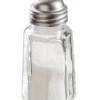
Keeping Salt Running Free... To keep salt from drawing moisture and hardening into chunks put a few grains of rice in the bottoms of the salt shaker. Works great!
By Robin
Add your voice! Click below to comment. ThriftyFun is powered by your wisdom!

Question - There has been a debate about the reason many people put uncooked rice in the salt shaker. Most will answer that the rice will absorb the atmospheric moisture instead of the salt so that the salt will not cake. I have trouble believing that rice is more likely to absorb moisture in the air than table salt. I believe the larger rice grains more likely "knock" the lumps out of the salt when it is shaken, rather than keeping the salt from absorbing water. So, what is the answer?
Stephanie
Stephanie,
I think both sides of the argument are correct. Indeed, the grains of rice will tend to "knock the lumps out of the salt." So would small glass beads. However, the porous starch structure of well dried rice is also very attractive to moisture by virtue of hydrogen bonds that can form between water molecules and the -OH groups in the starch matrix. Thus, dried starch grains make a fairly decent desiccating agent.
Regards, ProfHoff 713
Never really thought about this but your explanation makes sense. Rice does not readily absorb water. That is why you have to cook it for 10-20 minutes in boiling water -- so it would not seem to be very hydroscopic, does it? I tend to agree with your mechanical interpretation. You notice when you dissolve salt in water that the solution is hazy, that should not be. But if you look at the list of ingredients on the box you will find silica gel or aluminum silicate added (to prevent clumping). These fine particle powders DO absorb water and act as anti-caking agents.
Vince Calder
Source: Newton
a small bit of saltine cracker bits works good too. :)
can i put the silica gel packs in salt shakers to dry salt?
The silica gel packs are NOT food safe. Do not put them in salt shakers.
Salt shakers in restaurants usually clog when the humidity is high. Convincing managers to put salt in the shakers proves in Florida to be so far impossible. I would then assume that the reluctance is tied with health dept rules.
My mom had no problems with it when we lived with salt in the shaker for the life of our childhood and teenage years.
Removing the grains was usually every month or two, but restaurants could do so each time they washed the shakers.
I think if you take a the "sorb-it" plastic cans found in pill bottles and put them in your sugar cans, it would also stop the clumping.
This can be done by cutting a piece of net from a net fruit bag, like oranges, and taping it to the underside
of the can with the sort-it cans inside.
I don't understand the writer who says that rice does not absorb water, when that is the objective, when cooking one cup with one cup of water, then waiting until the water absorbs in the rice.
I was talking to someone just yesterday about the problem of using rice in sugar dispensers because they would just come out of the hole. He said: 'How about puffed rice?" Cracked me up. Think I will try it.
Add your voice! Click below to comment. ThriftyFun is powered by your wisdom!