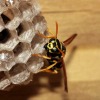
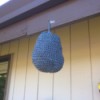
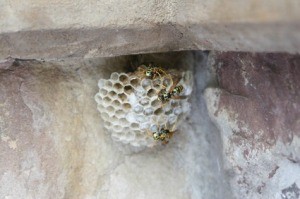
 We have been invaded by a yellow jacket nest in the middle of the front yard. We have sprayed twice with a 20 percent foam spray. They are still here. 1. Would there be an extra problem because we have mole trails beneath the yard? 2. Any ideas other than setting them on fire. I wouldn't want to break any city ordinance.

Yellowjackets are another dangerous wasp encountered around homes and buildings. Nests are often located underground in an old rodent burrow, beneath a landscape timber, or in a rock wall or wall of a building.If the nest can be located, it can usually be eliminated by carefully applying a wasp spray insecticide into the nest opening.
Sevin (tm), or Ficam (tm), dust is also very effective provided a handduster or similar type applicator is used to dispense several puffs of the insecticide dust in to the nest opening (an empty, dry liquid detergent bottle, filled no more than halfway with dust and shaken before dispensing works well).
Treatment should be performed late at night after all yellowjackets are in the nest and less active. It's best to pinpoint the nest opening during the daytime so you will remember where to direct your treatment after dark. Approach the nest slowly and do not shine the beam of the flashlight directly into the nest entrance as this may startle the wasps; instead, cast the beam to the side to illuminate the nest indirectly and place the light on the ground rather than in your hand. Similar to hornets, yellowjackets are extremely aggressive when the nest is disturbed. It may be prudent to call a professional pest control company, particularly when access to the nest is difficult.
Department of Entomology, University of Kentucky
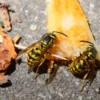
Most people know and fear the yellow and black striped yellow jacket wasps that are common, uninvited guests to late summer picnics. Their stings are painful and for those people allergic to insect venom, they are dangerous. Many people confuse bees, which are fuzzy and only feed on flower nectar, with wasps, which have shiny bodies and are predators. What most people don't realize is that yellow jackets capture enormous numbers of flies, caterpillars and other insects to feed their young. They have been seen bringing in more than 225 flies an hour to a single nest; one study found that over a three day period, just two wasps collected 20 grams of imported cabbage worms. It is usually only in late summer, when their populations are at their peak and wasps are attracted to plants with ripening fruit or aphid honeydew deposits on the leaves that most conflicts arise between humans and yellow jackets. Although they are touchy defenders of their nests, most stings are a result of accidentally trapping or pinching a wasp.
Between 0.4 and 0.8 percent of humans are allergic to social wasp and bee venom. Nearly 80 percent of all serious venom-related deaths occur within one hour of the sting. If symptoms are more serious than localized swelling, reddening and pain or mild headache and fever, a physician should be consulted. Multiple stings are especially dangerous. Some people may develop sensitivity to venom after repeated stinging episodes over a short or long period of time.
You can avoid being stung by following a few rules:
Remove all outdoor food sources attractive to wasps. Feed pets indoors and keep garbage cans tightly covered and wash cans regularly to remove spilled food. Bury fallen fruit and table scraps deep in compost piles and don't compost meat scraps or bones.
Watch where you sit or step (don't go barefoot!). Be especially careful to look before reaching into berry bushes or picking fruit. Thirsty wasps are attracted to moisture so be cautious when sitting on or handling wet beach towels.
Never swat at a yellow jacket hovering around you--it is a good way to get stung. Instead, quietly move away or let the wasp leave of her own accord. The only exception to this is if you have accidentally disturbed a nest and hear wild buzzing. In this case protect your face with your hands and RUN!
Pick fruit in the early morning or evening while it is cool and most wasps are still in their nests.
To reduce yellow jacket problems at picnics and barbecues:
Minimize the length of time food is available by keeping it tightly covered until just before it is to be eaten. Clear away scraps and dirty plates as soon as the meal is over.
Serve sweet or alcoholic drinks in covered cups with drinking straws through the lids so wasps can't get inside and then sting you in the mouth as you drink. When drinking out of a can, keep the opening covered with your thumb between sips.
Some yellow jackets and hornet species scavenge for meat in addition to preying on live insects. Others are attracted to the sweets and sugars of candy wrappers, soda cans, and pastry deposited in garbage cans. These local populations can be reduced by removing the waste frequently and maintaining tight lids on all trash receptacles. Pesticide strips containing dichlorvos (Vapona or No- Pest Strip), attached to the inside of garbage can lids, will also help to reduce both fly and yellow jacket presence.
Set up baited yellow jacket traps around the edge of the picnic area or on the end of the table to attract wasps away from the food to capture them. Small disposable cardboard traps or reusable ones made of wood and metal screen are sold at garden centers. They work by attracting wasps to bait placed under an inverted funnel. When the wasps have had their fill and instinctively fly upwards toward the light at the end of the funnel, they are trapped in an enclosed chamber above. One can buy any variety of ready-made traps with a wide range of effectiveness. The following two companies (among others) have produced successful traps:
Seabright Laboratories, 4026 Harlan Street, Emeryville, CA 94608, (800) 284-7363 or (415) 655-3126
Sterling International, Inc.
P.O. Box 220
Liberty Lake, WA 99019
(800) 666-6766
[FAX: (509) 928-7313]
In early and midsummer, 1-2 traps should be enough for most picnics. In August and early September, however, 6 or more traps might be necessary. For much of the season, the best baits are Spam, ham, fish, cat food or meat scraps. Later in the summer, when wasps need less protein because they aren't rearing their young, sweet baits such as jam, honey or rotting fruit are often more attractive. Make very sure they are dead before cleaning out reusable traps.
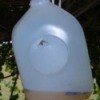
One can also construct a simple and safe trap at virtually no cost - an example follows. Start with a one gallon translucent milk bottle. With a razor blade, cut a couple of small slits downward from one point (three quarters of an inch across at the bottom), a little more than halfway up the sides. Bend the point so formed inward. Fashion part of a wire coat hanger into a hook at the bottom and thread it through a small hole punctured into the cap so that the hook will be down about halfway to the bottom of the bottle when inserted. Bend the top of the coat hanger piece so that it can be suspended from the lid. Fill the bottle about one-third full of soapy water. Then pierce a small piece of turkey ham, salami, or ham (small enough to go through the bottle opening) with the hook and put the lid, hook, and meat in place in the bottle's neck. Hang the bottle in a tree or bush upwind from the area where wasps are not wanted. You might also dig a hole and place the bottle in the ground so the downwind opening is at ground level (wasps often search along the ground for food). If no gallon bottles are available, a one-liter transparent soft drink bottle should suffice.
Removing Wasp Nests
Although the number of yellow jackets in late summer invariably prompts many concerned inquiries on how to control them, usually there is little that can be done. The wasps will all die in a matter of weeks as fall approaches. Even if a nearby nest is discovered late in the summer, eliminating it may not have the desired effect because wasps can fly in from up to a mile away. It is never advisable to put out poison baits because children and pets may get into them and because other, beneficial, insects may take the bait and be killed. It is also a terrible idea to pour gas or kerosene into an underground wasp nest where it poisons the soil. If yellow jackets do build a nest in a location likely to cause problems with people or livestock, the best time to remove it is early in the season, while it is still small. This is a job for a very careful person or a professional pest control service. Chemical wasp sprays are available, but if you use them, consider very carefully where the stream of pesticide that misses the nest will land. Always use such products according to direction on the label. Remove an exposed nest that has been sprayed as soon as the wasps are dead. Wear rubber gloves and dispose of the nest to prevent birds from eating the poisoned larvae left inside.
Removing a Hanging Wasp Nest Without Using Chemicals
First, it is a good idea to get a helper. To be safe, both of you should wear protective clothing from head to foot. Although a beekeeper's suit with hat and veil is ideal, you can assemble a similar suit for the occasion from heavy coveralls, a hat with a wide brim and a length of fine screening. Wear boots with your pants cuffs pulled outside the boot tops and seal the cuffs around the boot top with rubber bands so that wasps can't get up your legs. Wear gloves and pull your sleeve cuffs screening over the hat (the brim should keep it away from your face) and tie it around the neck, over the collar of the coveralls. Make sure there are no openings around the collar or base of the veil. You should wear another layer of clothing underneath the overalls because wasp stingers are long enough to reach through one layer of cloth. To remove the nest, approach in the evening or at night when the wasps are all home and less active because it is cool. Have your helper hold open a large, heavy bag or a box with a tight lid under the nest while you cut the attaching stem of the nest as quickly as possible using a long handled pruning hook, or other tool. When the nest is in the bag or box, close it immediately and seal shut. Kill the wasps inside by putting the whole package in a deep freeze for 24 hr. or by directing a wasp spray into the package through a small hole for several minutes. Don't neglect this last step because wasps can eventually chew their way out of almost anything.
Wasp Nests In Walls
Never block up the opening as wasps can chew through wood or follow wiring to the interior of the house. In the fall, when the nest is definitely vacant, caulk or repair the crack to prevent recolonization next year.
Underground Wasp Nests
This is a job better left to a pest control operator, who can dig and vacuum out the nest, however, you can pour several gallons of boiling water into the nest. Wear protective clothing as described and be extremely careful not to scald yourself with the boiling water.
US ARMY CENTER FOR HEALTH PROMOTION AND PREVENTIVE MEDICINE
When we had one in the middle of a flower bed, we put a clear bowl over the main exit to the hive. The sun baked the hive and the workers could not get out. We never did find the secondary entrance, but after a couple of weeks, the colony had died anyway.
Do this at night when they're dormant!
I've been looking into removing a nest on my kids playtoy (got stung yesterday--that's how I found out about the nest!) Spraying aerosol poison can be risky. Even at night, when the stream hits the nest some yellow jackets can escape. Plus you risk poisoning birds and others who feed on wasps and their larva. Gasoline seems like a very bad idea. It will kill any grass or plants it touches, leech into the ground (possibly contaminating groundwater) with the next rain. I'm going to fill my shop vac with soapy water (kills the wasps), suck in the whole nest and plug the hose til they die!
Two summers ago, we had a terrible yellow jacket infestation in the outside wall of our house.
Very large insects were squeezing in through our kitchen door and tinier ones were sneaking in through the living room window.
Finally, the colony started infiltrating my sister's bedroom, whose windows were directly above the outside colony entrance.
Because my sister was away at the time, we ended up having to close her door and plug it with beach towels to keep the yellow jackets from spreading.
It got so bad, we finally had professional exterminators over, who estimated the colony in the thousands.
They administered poison in the colony's entrance, but after a couple of weeks, the problem was no better.
We threatened to put a hold on the uncashed check, so the exterminators came back, and put more poison in.
However, we didn't see a complete end to the bothersome visitors until a bitterly cold snap in the fall.
My father caulked over the entrance as a final measure, and that was that.
You can still find a previously unnoticed corpse under a piece of furniture or in a window sill every now and then.
I can only imagine the pile of yellow jacket bodies inside the wall that will never be exposed.
For yellow jackets in the ground nest I return at night and mix up a strong one gallon cocktail of Malathion and Diazinon in a bucket. I quickly pour the cocktail down the hole and set the empty bucket on top so the yellow jackets are trapped in the nest and leave it there until the next day. Usually one treatment works but I keep an eye on the nest for the next few days.
Here are the questions asked by community members. Read on to see the answers provided by the ThriftyFun community.
I would like to know value of the 30 volume set which comes with five New American Supplements. Published by The Werner Company, Akron, Ohio 1905.
This is an antique, over 100 years old. Take it to several book dealers for appraisals
Considering the book are over 100 years old the price you receive will all depend on the condition of the books. The only way to actually determine this price is through an auction house in your area. They are the best places to check because they will give you a better price than a book dealer will. They have many professionals that work at the auction house and can appraise your books almost immediately for you or ask you to make an appointment.
Wow! I was shocked that there are none on eBay at the moment either in current or completed auctions. The best way I use to value books is to find them on eBay in the sold section. That gives you today's current market value.
Never use active auctions...only sold as that tells you what someone will actually pay for them. Be sure to check back to eBay periodically and look for exact matches to yours (condition, etc.) If a pristine one sells you can usually devalue yours upwards of 15-20% if yours is less than pristine...you would need to take off more if yours are in bad shape.
If you are trying to insure these, tell the people you are trying to get bids from as you will get a more accurate value than if you tell them you are trying to sell them.
If an auction house doesn't help, you may want to find a trusted antique dealer as some of the better ones have access to sites that us lay folks only dream of having access to (some just cost too much to join).
The challenge with value is it may be worth something, but your profits will be less as almost any way you sell it, you will have to pay fees or commissions. Selling heavy items on ebay is a nightmare because of shipping. Even though the buyer pays for it, they have kanipshins when the price you want and shipping costs are sky high. Postage is costly--even media mail :(
Some of the auction houses around me take 35% and some of the antique dealers take up to 50% of the selling value.
It's like on the TV show American Pickers...people want retail value for their items, but the sellers need to have a little "meat on the bone" so they make some money also!
Good luck with your sale!
these clearlh have some value especially if in great condition. What you actually can expect to get from them is a different story, but i would be hard pressed to imagine someone into book collecting not being interested in these, though it is good to keep in mind that the current marketplace is not clamouring to buy old books at the moment
to giveyou an idea the 1911 version on ebay values at $2000 www.ebay.com/
I would take any very old books to an appraiser in a larger city, to get the real value. Good luck!
Yellow jackets bored a hole through the outside wooden window frame and set up a nest. Somehow they were able to enter the kitchen underneath the inside wooden frame. When accidentally disturbed, we had a swarm of yellow jackets attacking us. We could only use magazines to take care of them. Then we went and bought wasp and yellow jacket spray and sprayed inside and outside.
Called professional guy who also sprayed the window sills inside and out. There are no bees inside, but they are flying in and out of the outside area. What do we do now? We have been stung multiple times and been to the doctor's twice. Help.By CJ
I had this problem 2 years ago. First make sure there is no way they can get inside your house. Tape ALL wall openings,electrical outlets, window and door frames, etc.. Then buy a couple of cans of expanding insulation foam; the kind you spray into cracks and it foams up. Stick the nozzle as far into the hole they made as you can. Get the can with the long thin straw-like extension, and fill that hole with as much foam spray as you can get in there!
Wait until after dark and it's cool out, so all the yellow jackets will be in the nest. The foam cuts off their oxygen supply and traps them inside, that's why you have to make sure there is no way they can get into your house! I haven't had any come back since I did this. Good luck!
Long ago I discovered that yellow jackets had a fatal urge to eat the maple syrup we made, although I'd venture they would like just about any syrup. I put syrup in a wide dish with rim, so they had no place to perch and sip. They would land in the syrup and that was the end of them. It was amazing to visit the bowl after a few hours and see nothing but black and gold stripes covering the entire dish.
I have a beautiful Boston fern in a pot that now has a yellow jacket nest in it. I want to kill the yellow jackets, but not the fern. Can anyone help?
You could try an electronic bug zapper. The yellow jackets will be attracted to its glow. Be aware that these are very aggressive members of the hornet family. People die from their stings. You might want to call an exterminator.
Be aware: Yellow Jackets (and also some similar hornets) can be very aggressive and their bites are usually bad and really deadly for some people.
you could try to smoke them out by lighting a torch or a paper ball attached to a stick - we got rid of a hornet's nest that way. Of course if you are indoors this could present a problem
i would wear some sort of protective gear (even if just a jacket and ski mask), open whatever windows there were to open, close all doors leading to other parts of the house, and smoke them out. Once they all flee, you can then kill/treat the nest by removing it and squashing any larvae you see
I had yellow jackets in dormer and they came inside of the house. I had to cut a hole in ceiling and took shop vac and sucked the nest out. My question is should I cut holes in the other dormers and see if there are nests in them?
By Frank from Leesville, SC