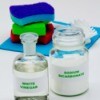
 Do you have a recipe for a cleaning solution consisting of vinegar and bleach?
Thanks,
Sue from Elkhart, IN
Editor's Note: Bleach and vinegar should not be mixed, especially in quantity, because it creates a toxic gas that could be deadly. Feel free to respond with homemade cleaning recipes, but please do not mix bleach and vinegar (or bleach and ammonia).
Bleach and ammonia are a disaster if you mix them. One time when I was a kid, I got the idea to clean the cement floor in the basement for my mom. She never said not to mix products, so I mixed ammonia and bleach in a bucket. Before you could say jackrabbit, it sparked and plummed a cloud of noxious gas. I almost choked to death, before I could run up the stairs. I coughed for days. I was extremely lucky to have lived.
Vinegar increases killing power of bleach
Adding white vinegar to diluted household bleach greatly increases the disinfecting power of the solution, making it strong enough to kill even bacterial spores. Researchers from MicroChem Lab, Inc. in Euless, Texas, report their findings today at the 2006 ASM Biodefense Research Meeting.
"Laundry bleach is commonly diluted about 10 to 25-fold with tap water to about 2000 to 5000 parts per million of free available chlorine for use as an environmental surface disinfectant, without regard to the pH value of the diluted bleach. However, the pH value is very important for the antimicrobial effectiveness of bleach," says Norman Miner, a researcher on the study.
At alkaline pH values of about 8.5 or higher, more than 90 percent of the bleach is in the form of the chlorite ion (OCl-), which is relatively ineffective antimicrobially. At acidic pH values of about 6.8 or lower, more than 80 percent of the bleach is in the form of hypochlorite (HOCl). HOCl is about 80 to 200 times more antimicrobial than OCl-.
"Bleach is a much more effective antimicrobial chemical at an acidic pH value than at the alkaline Ph value at which bleach is manufactured and stored. A small amount of household vinegar is sufficient to lower the pH of bleach to an acidic range," says Miner.
Miner and his colleagues compared the ability of alkaline (pH 11) and acidified (pH 6) bleach dilutions to disinfect surfaces contaminated with dried bacterial spores, considered the most resistant to disinfectants of all microbes. The alkaline dilution was practically ineffective, killing all of the spores on only 2.5 percent of the surfaces after 20 minutes. During the same time period the acidified solution killed all of the spores on all of the surfaces.
"Diluted bleach at an alkaline pH is a relatively poor disinfectant, but acidified diluted bleach will virtually kill anything in 10 to 20 minutes," says Miner. "In the event of an emergency involving Bacillus anthracis spores contaminating such environmental surfaces as counter tops, desk and table tops, and floors, for example, virtually every household has a sporicidal sterilant available in the form of diluted, acidified bleach."
Miner recommends first diluting one cup of household bleach in one gallon of water and then adding one cup of white vinegar.
I use an empty quart size bottle with a sprayer cap. I put in 1/4 cup white vinegar and then fill with water. That is it. I use this to clean counters, cabinets, appliances, floor, bathroom, everything. For the floor, after sweeping, I spray to solution on the floor, then mop with a damp mop. Very cheap way to clean.
I use vinegar to wash my floors because it makes them shine. But, I also use bleach once in a while to really clean them good( I have 6 dogs) I didn't know that bleach and vinegar didn't mix and I could not breath because I had not rinsed the vinegar out of my mop before using the bleach water.
I was wandering if it's not good to mix bleach & vinegar; is there any other product we shouldn't mix either? And how can I use alcohol and peroxide? Any recipe suggestions out there? And can I mix them? Thanks....Laura Perry Norfolk, VA
Bleach is a base and vinegar is an acid, so when they mix it's normally always bad. Mixing and thing with a high base rating and low acidic rating can be deadly.
Bleach is a base. Also, it is bases that have that slippery feeling.
For instance, bleach has a pH of 9-11. Anything over 7 is a base.
Bleach and ammonia are toxic - separate - and esp. mixed. I prefer not to use either.
I'm sure there are safer products to use. You are producing chlorine gas here, which is certainly not safe. Why not use fresh bleach, or a bleach at a higher concentration?
This is a rediculous conversation. Vinegar and bleach dont mix because vinegar nutralises bleach rendering it ineffective. If you bleach something and want to be sure the bleach is out of the fabric just rinse it in a little vinegar. Ammonia is the chemical you must never mix with beach also but it is because you will make a gas that can damage your lungs. If you want to clean with bleach just add a little laundry soap for extra suds.
I believe you have been misinformed. Here is some information directly from Washington State's Department of Health website:
(blockquote)"Don't mix bleach with ammonia, acids, or other cleaners. Mixing bleach with common cleaning products can cause serious injuries. Be sure to always read the product label before using a cleaning product.
. . .
Products containing acids include vinegar and some glass and window cleaners, automatic dishwasher detergents and rinses, toilet bowl cleaners, drain cleaners, rust removal products, and brick and concrete cleaners." (/blockquote)
www.doh.wa.gov/
There are also many personal stories on this page I found on a quick search. I would definitely be cautious about using bleach in general.
www.thoughtco.com/