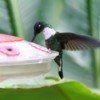
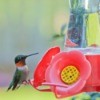
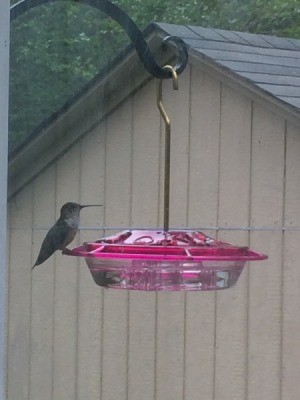
 Making your own hummingbird food is easy and much cheaper than buying the concentrate. Plus you can make it without the red dye, as it is generally unnecessary for attracting hummingbirds to your feeder.
Supplies:
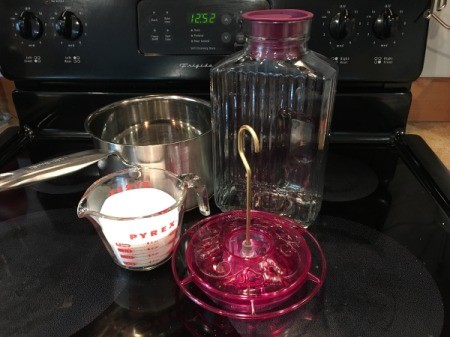
Steps:
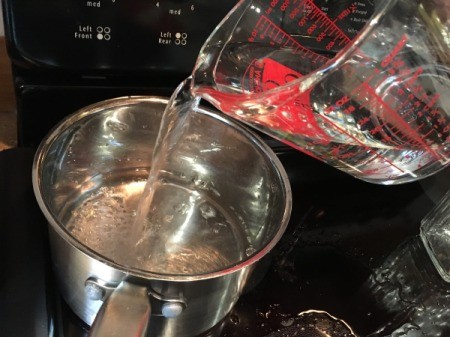
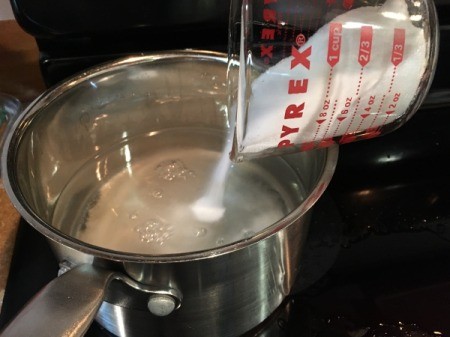
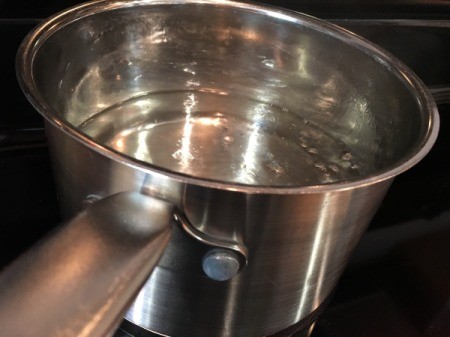
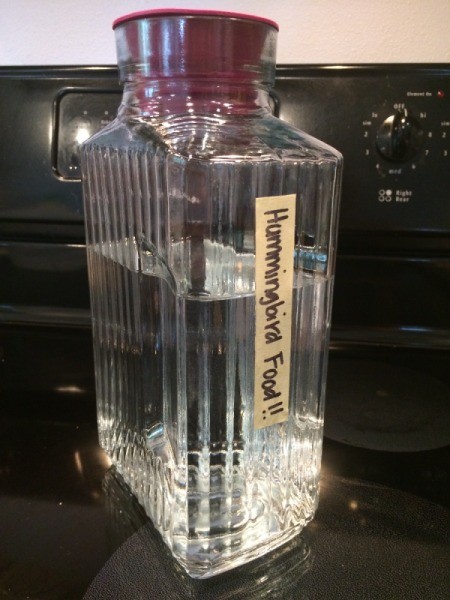

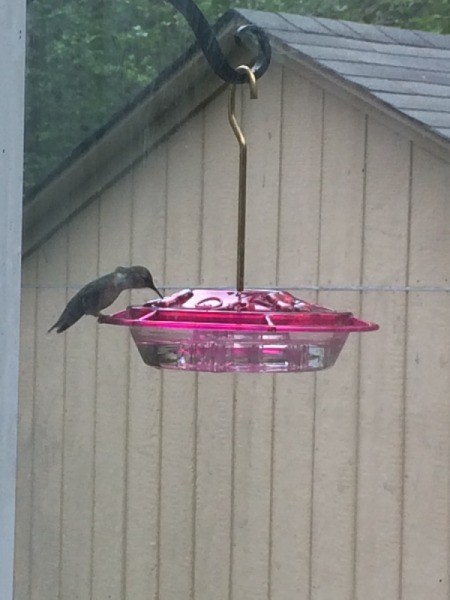
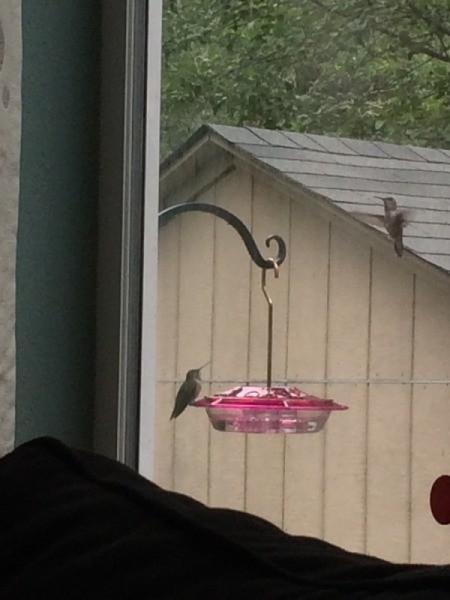
This page contains the following solutions.
The mixture is 3 parts water to 1 part sugar. There is no need to boil the water, just use hot water, mix and stir. Add a tiny drop of red food coloring (so you can see when it is empty).
I have always used one part sugar to four parts water and it works for me. Clean out your feeder every time you change the food and you will eventually get hummingbirds.
This mixture can be stored in the refrigerator for about 1 week.
Here are the questions asked by community members. Read on to see the answers provided by the ThriftyFun community.
Is it OK to substitute stevia for sugar in hummingbird nectar?
By amberwolfone@gmail.com from southern Ontario, Canada
I would not do that! The sugar provides calories for energy, and stevia is popular with humans as it is so low calorie. Also, it may not be metabolized safely by the hummers. Stick with ordinary table sugar.
No! Stevia is a sweetener for couch potatoes who can't resist sweets; it has almost no calorie value for hummingbirds, who work and need energy. Even greener stevia is close to calorie-free.
No. What is this latest " let me feed some phony stuff to the hummers. I'd love to fool them"? Hummers need sugar water. Always have, always will. If they have flowers for nectar they prefer them. In the season when they cannot get enough nectar, we help them to survive with sugar water. Please be kind and feed what is needed.
How much sugar do I add to 2ltrs of water to feed my hummingbirds?
By D
When making hummingbird nectar at home, my solution turns golden before it comes to a boil. Is it being burned? I used medium-high heat and it takes forever to come to a boil (electric ceramic stovetop). Any suggestions?
By Mary D.
If you are using sugar, it could be that the sugar is being caramelized. I have a glass top stove, and mine using an on/off cycle to cook. The important question is; do the hummers like it?
Another question might be your ratio, are you using a 1 to 4 ratio? One cup sugar to 4 cups water is what is usually recommended.
When we make hummer food we put a cup of sugar in a metal pot, add 2 cups of water, bring it to a slow boil, stir it a bit with a spoon, take the pot off the heat and add the other 2 cups of water.
We let it cool pretty much completely before we put it in a feeder. We try to keep a good bit in a pot at all times. If we fill up a feeder and use up the juice we make more immediately and let it set until the next filling. We also rotate feeders (we have 3) and clean them each time we bring in an empty one.
The only time the fluid gets color is when they have set outside for a while. The water gets foggy and the birds won't eat it. This usually happens at the beginning of spring when only one or two hummers have arrived. When summer is in full swing we have no worries about foggy water (we're too busy trying to keep feed in them :)
Are you using 1 cup of sugar to 4 cups of water the equivalent? I put mine in a 4 cup pyrex measuring cup and microwave it for at least 3 minutes. Stir once about half way through. Then let it sit for a minute or two before opening the microwave. Voila! Hummingbird food.
Let it cool and fill the feeder. Left over food goes into the fridge for the next time. I got this recipe and the directions from my avian vet.
I make my own hummingbird food by putting 1cup of water in the microwave for 2 minutes or until it boils. I then stir in 1/3 c. of sugar until it dissolves. I let it cool completely then fill the feeder. I have a regular flock of hummers at the feeder.
I clean the feeder once a week with hot water and a bottle brush. If the weather is really hot, I clean it before I refill it every other day. It will ferment when the weather is scorching. I really don't want a bunch of drunken hummers dive bombing me :0)
You don't have to boil the water. Just add 1 cup sugar to 4 cups water and stir til it is dissolved completely. Then fill your feeders. Any leftover can be kept in the fridge for a few days! Aren't the little hummers fabulous to watch?
You don't need to cook the hummingbird food. I did for years until I found out it isn't necessary. Just mix and serve 1 cup sugar to 4 cups water (well water). They love it, and come back every year.
Thanks for the homemade Humming Bird Recipe. It sure beats buying it. Can you put red food coloring in it to make it look like the store bought kind? : )
Correction: Humming Bird Nectar Recipe. Boy,I got a Good Laugh at myself when I realized what I wrote & posted the 1st time. No I don't eat humming birds! LOL.
Some friends are using a mixture (of what I call harmful) of 1 cup sugar to 1 cup water. This does really attract the birds, but I know that it must be very harmful for the birds. Am I correct?
By Joan from Signal Mtn., TN
Is using red food coloring in homemade nectar harmful to the hummingbirds?
By Betty
It can be; and it is not necessary. Save your food color, all you need is sugar and water! Four parts water to one part sugar. It is best if you can wash your feeder every night, let it dry, refill and put it out again; helps to keep the molds and fungi at bay (which can be harmful to the birds).
Ditto Jilson. I make my mix stronger, 2 cups of water to 1 cup sugar. They like it better. This is the time of year when they will start to fatten for their long trip south. If you watch them at the feeder, you can see them gain weight. It starts as a lump near the tail and then fills in up their backs. There will come a day when they will come in to feed heavily, fly up in a circle and head south. Males leave first, then the females and then the young so keep your feeder up until well after you are sure they are all gone.
Yes, red dye can be harmful to the Hummers. It can cause mouth and throat cancer. The red color on the feeders is enough to attract them no need for colored sugar water.
Yes, it is. They don't need it to attract them anyway. Your feeder has enough color to get their attention. Make your own solution without the red coloring.
I agree, and love my hummers! They don't need the red dye. Usually they come to my home in the middle of April for early birds I start putting my feeders out by the first week in April, no red dye but I do add a large red bow to my shepherd's hook for symbolic reasons I think like the song "tie a yellow ribbon around the old oak tree" ) I sing to my hummers (hehe) it's been one whole year and I do miss thee (hehe)
I read once in Birds n Bloom that the same hummers will come back to your yard every year, anyone else read that? Also I read that hummers can fly 500 miles without stopping, wow, now that's a strong little flyer! :)
@ Chloelizabeths comment: I was thinking the other day about making my mix a little stronger too. I'll try yours after all your only adding a 1/2 cup more and if they didn't like it you can be sure they won't drink it and yours are so thank you that's what I will do with my next batch. I love my hummers and soon will be missing them!
I agree with those who say no red or any color dye. Hummers can see the clear solution. I disagree about the amount of sugar to water ratio. Hummers also need protein they get by catching small flying insects (gnats, etc.). If too much sugar is in the solution, they may not feel the need to catch the nutrients/protein since they have empty calories.
I read this in Birder's Magazine. The recommended ratio is 1/3 cup sugar to 1 cup water. Too much sugar can also lead to other problems. You can go to Wikipedia or a birders web site to confirm this.
Does diluted pancake syrup make ok hummingbird food?
I would say no, only for the reason that it's full of preservatives and such. I do know that Hummingbird "food" is sold in the stores, WalMart and such.
Here is a recipe I found on-line, sounds a lot like the one my Grandmother used to use, but at that time they used the red food dye (it also helped us kids, we knew not to drink the bright red drink in the fridge!).
Hummingbird Nectar Recipe
1 part sugar/4 parts water
Boil the water first, then measure and add sugar, at the rate of 1/4 cup of sugar to 1 cup of water.
Let cool and store excess in refrigerator until ready to use.
Do not add food coloring, honey (which ferments), or artificial sweetener, which has no nutritional value.
You will need to clean your feeder every few days, with hot water and a mild (10%) bleach solution to inhibit mold. Rinse thoroughly before refilling with water syrup.
Hope that helps.
Michawnpita is correct. This is the recipe that I have used for many years. I boil the water for it gets the chlorine out and any impurities. Do not add color for it is bad for them. Do a Google on hummingbirds and it will tell you. We love watching the sweet little birds. They are outside if our slidding glass door and we watch them while sitting at our dining room table.
NO! Use only a mixture of sugar and water as given above.
An easy way to make hummingbird food: 1 cup water, 1/4 sugar, in a glass measuring cup. Microwave to a boil, and boil until sugar is dissoved. Cool. The ratio is 4 to 1. If this is the first time you've fed hummingbirds at that location, add some red coloring to the mix. Once they become used to looking for the feeder, you won't need to color it anymore.
On the nectar you buy in the store, the package directions say 3 parts water to 1 part water. What are they meaning? 3 cups water to 1 cup of nectar? Please help me clarify this. I'm not sure what that means? Can anyone help asap?
By Christina
Is is OK to substitute brown sugar for white sugar in nectar?
By Bridgitte J
Brown sugar contains molasses, whereas white sugar doesn't. I would stick with white sugar only.
Agree with MCW. I have herd of other people asking about substituting white cane sugar in hummingbird feeders and many people say don't do it. Someone asked about using sugar substitutes like Sweet and Low. Others have asked about using honey. The answer is always the same... stick to normal sugar and water at a 1 cup sugar to 4 cups water ratio.
Substitutions of any kind kill. Good white sugar and water only. I use 4 to 1. I have a few that winter over so I use 3 to 1 for winter months. I shine a light on the feeder to keep it from freezing. I adore my hummers. Would never substitute and kill them.
My hummingbird nectar (4 parts water to one part sugar) gets moldy after about one week. Am I doing something wrong or is this normal and what can I do to prevent it?
By Deborah
Why does my hummingbird food turn cloudy during the cool down time. I've been making it for years with the same sugar and bottled spring water. They don't like city water even after we boiled it. Now it is turning cloudy even before it's cooled. What do I need to change?
By Dan T.
This is a page about canning homemade hummingbird food. One way to have homemade hummingbird nectar on hand whenever you need it, is to make large batches and can it.

This is a page about feeding hummingbirds. These beautiful birds enjoy a liquid feeder. Most red flowers will invite hummers to your garden.
ThriftyFun is one of the longest running frugal living communities on the Internet. These are archives of older discussions.
What happens if you put too much sugar in the water to make the nectar? Can it harm the birds?
With regards to the hummingbird feeders they say no red dye, do they mean red food coloring?
If you are like we are, we have several hummingbird feeders around our yard. Yes, you can buy the hummingbird food, but this get costly and there is not much in the packages.