I used to do a lot of sewing and it was so hard to get the patterns back in the package, so just put them in a large baggie and it keeps them nice and neat. If you spray them with spray starch it will help keep them from tearing.
Also, when my pins would get dull, I would just sand them with a little sandpaper, or an emery board. Your sewing machine needle will sharpen if you sew through very fine sandpaper.
I hope these tips work for you, they have worked for me. Hope they will help you enjoy your sewing!
By Dorothy from New Creek, WV
I have always had trouble getting my thread started on my bobbin before loading it onto the bobbin winder on the sewing machine. It seems that the hole in the bobbin gets smaller every year!
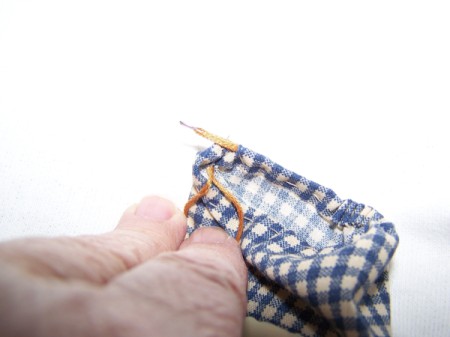
I decided to try my little Dritz needle threader and it works beautifully. Just insert the little wire piece from the outside edge of the bobbin, then push the end of your thread through that and pull it through the hole. Wind it around a couple of times and you are ready for the machine bobbin winder.
You don't have to let a bunch of clear plastic contraptions gain mastery over you! And what is better, you don't have to give up sewing just because you can't see your hand before your face. I remember as a little kid my mama had so much trouble with her sewing. I was a middle age baby so I was underfoot during the time she was struggling with the vision problems and oversized hands. I got my big hands from her.
Approximate Time: Less than 5 minutes
Directions:


By Marty Dick
When using thread, take a dryer sheet, and run it up and down it. The thread will have less knotting.
By Renee from Sterling Heights, MI
When I make sweaters for myself or family, I mark the front of the sweater on the right side with a small safety pin. I use safety pins for holding sweater pieces together for sewing them. They are small and easy to spot.
By Linda from Kearney, MO
I am adding iridescent ribbon to the ruffles on my daughter's prom dress and was having a difficult time seeing to sew. I found that using a head-lamp, the kind that you strap onto your head for hiking, etc. is wonderful to use when hand-sewing.
You can aim the light right at the fabric and see the stitching so much better than if you drag a big lamp over to wherever you are working. With the adjustable head-lamp, I am just flying through the seven layers of ruffles.
By MooseMom from Elk Grove, CA
I have two new toys in my sewing stuff. Each one costs less than 5 dollars.
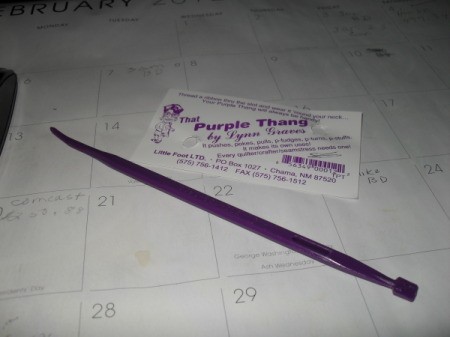
One is called "That Purple Thang". It comes from a company called Little Foot, Ltd in New Mexico and is made by Lynn Graves. It is for pushing the corners of pillows and collars after you sew them. They turn so nicely with one of these. I had been using the handle of a wooden spoon. This is much nicer.
The other item is called a Bobbin Buddy. It comes with 4 on a little plastic piece. You separate them by twisting the plastic. Just spread it apart with your fingers and put it on a full bobbin. No more thread ends driving you nuts. My bobbin box is so neat now. I tossed the packaging on it, but they can be ordered from J Hittle in Kentucky. You can Google "bobbin buddies" or J Hittle. They are a wholesaler of sewing and quilting supplies.
I haven't looked, but they might be available at your local fabric store.
Source: I saw these in a weekly sale flyer I got via email from J Hittle. I order a lot of my thread and supplies from them because I am not to be trusted in a fabric store. I go online and order what I want. Even with shipping it's much cheaper that way.
By Marty from Knoxville, TN
I found this at J Hittle in Louisville, Kentucky. I buy a lot of my supplies from them because I am not to be trusted in a fabric store. I can order just a few things. The sewing machine needle is inserted into the end with the flat side toward the back of the machine. Just move it around a bit and it will slide right into the proper place and will leave you a free hand to tighten the screw.
I have hands like a lumber jack and I've always had trouble changing out my needle. This is a Dritz product and is available where they sell Dritz. It has a little brush on the end for dust removal. I have used it already and it will extend my sewing life for several years. The person who has very large hands or those who have arthritis will love this little trinket. I have both problems and I am enjoying it.
Approximate Time: 2 minutes


By Marty Dick
When I am doing machine sewing, I set up 2 small wastebaskets - one on each side of my chair. That way I can drop scraps, thread, etc. with either hand. Saves a lot of time and waste motion.
By DeBushe from Gilroy, CA
I have been sewing for many years now! I used to get so frustrated trying to add set in sleeves until I came across this helpful tip; first stitch with regular stitch length from underarm area of sleeve to the notch.
Raise your needle, then lengthen stitch length as long as it will go. Now stitch to the notch on the other side of sleeve underarm, then raise needle again and put stitch length back to normal. Finish sewing to the other edge of underarm. This stitching should be 1/2 inch from armhole edge. Next pin sleeve to armhole BEFORE sewing side seams. Ease from shoulder seam down, by using a pin or needle and pulling up a single thread and easing toward the underarm edges. When stitching, be careful to keep easing even.
By Judy from Birmingham, AL
This tip is for all sewers! I'm 65 and I learned this from my mother when I was about ten or twelve. Many times it is hard to sew a straight seam because your machine's markings aren't clear or easy to see. I use an ordinary Band-aid along the seam width I need. First, I fold back a small amount of the tape to make it easy to remove. Next I place the Band-aid along the seam allowance starting quite a ways before the machines markings. This helps to align the fabric before it reaches the presser foot. Try it. You'll like it!
By Judy from Birmingham, AL
Plackets are used in shirt and blouse construction to create an opening either at the neckline or at the sleeve cuff. My tip will help you create the perfect opening by preventing 'over-stitching' the slash lines and also preventing cutting through the pivot point after stitching the slash line. And it is SOOO simple!
Approximate Time: Ten minutes, tops!
Yield: One perfectly prepared slashed placket opening
Supplies:
- 1 long, sharp pin-I like the ball topped quilting pins for all sewing projects ($free-should be in your sewing supplies already)
- 1 pair of dressmaker scissors ($free-should be in your sewing supplies already)
- 1 sleeve or neckline you need to create a slashed placket opening on ($cost will vary-depends on what you are using for your garment)
Steps:
- I'm using a sleeve I'm working on (husband's newest shirt) to illustrate this tip, but this will work the same way for neckline plackets as well.
Trace the stitching line as shown on your pattern piece-make sure the pivot point is clearly marked on the fabric.
Now take one of your pins and place it just ABOVE the marked pivot point.
Then take your marked fabric to the sewing machine and carefully stitch your first stitch line along the marked line right up to the pin.
Leaving the needle in the fabric, lift the presser foot and remove the pin from the fabric then turn (reposition) the fabric so that you can stitch the pivot point stitches.
Lower the presser foot and make your pivot by taking 1-2 stitches across then turning to stitch the other line by again leaving the needle in the fabric, lifting the presser foot and repositioning the fabric. Lower the presser foot and stitch the other marked line.
Lift the presser foot, cut your threads, and go to Step 2...
- Lay your stitched fabric out on your working surface and replace that pin, this time placing it just BELOW the pivot point. (See the pivot stitches just above the pin in the first picture)
Cut confidently (but carefully)-because you have the pin effectively blocking the pivot point, you cannot cut through it!
To photograph the sleeve after I cut, I positioned the scissors in the slash with the tip right at the place where the pin stopped the cutting action. 

- Check the slash-you'll see that the cut stops precisely where it should:)
By Frugal Sunnie
I have two sewing machines both of which have a variety of stitches for fancy work. In order to better see what each stitch looks like on fabric, I make a sample of each stitch on a plain piece of medium weight fabric. One for each machine. I keep them with the machine for reference. I also write the number of each stitch next to it using a pen.
By Judy from Birmingham, AL
I used to do this when making pull on pants for the toddlers in my life to make it easier to insert the elastic. After pressing the seams open I just sewed a few stitches on either side of the open seam and when you fold it down to make the pocket it won't bunch up or partially close on you.
I am making a beach tote from double sided quilting and I don't need any more thicknesses when I put the lining in so I remembered this tip which I got off a sewing pattern more than 30 years ago. I just ran a few stitches down either side of the pressed open seam to hold it in place. After I get the lining in the stitches won't be visible from the outside. I put them in what will be the seam allowance for sewing the lining in.
Source: A sewing pattern from eons ago. Probably Simplicity (for the simple - me)
By Marty D from Knoxville, TN
This one is for sewers, (or if you drop a nail when hanging a picture) whether you have a "bad" back or need to reach into a tight space, this works for me. Stick a magnet onto the end of a knitting needle or yardstick, etc. Then you can easily pick up those pins, etc. that always seem to fall where they cannot be reached.
By Barbara from B.C. Canada
I use my vintage (1970s Stylist, and a 1930s treadle) Singer sewing machines to sew, for home sewing and crafting. I also teach sewing, specializing in teaching home sewing newbies. Often my students don't even know how to thread a hand sewing needle on the first day of class.
One special tip I stress to my students is to always remove the thread spools, bobbins, and the machine needle at the end of each project.
In home sewing and crafting on a sewing machine, it's rare for the fabric to be exactly the same for every project so the needles and threads used on the machine will need to be of different sizes and types depending on the thickness and type of the fabric.
Making a habit of always removing the needle and threads will prevent sitting down at a machine loaded with the wrong needles and threads for the next project. Avoiding the frustrations of broken or bent needles, and puckered stitches due to using the wrong needle and thread for the fabric means a project completed with a smile:)
By FrugalSunnie from Scotland
"Appliqué is a versatile art form that can be used on quilting projects, for garment decoration, for decorative home accessories and for many other items. Basically, appliqué is a technique of layering one fabric over another to create a colorful design. When done by machine, the design is finished using zigzag or satin stitches of various widths to secure fabric pieces to the desired location" - College of Agriculture and Home Economics New Mexico State University
Sewing Hint: Have someone shine a laser beam on a piece of material you need to cut a straight line on. Just follow the laser line. Works great.
By Lois from Ontonagon, MI
I am beginning to cut out a robe for my granddaughter. The pattern has several views. I am going to take the pattern pieces which go to one view and fold them together and secure with a paper clip or safety pin. The ones which are to be used for more than one view, I will keep together securing them in the same way. That will make the pieces easier to keep up with and there won't be as much searching for certain pieces
By MartyD from Houston, TX
While you're working with cording, some endings can come unraveled. End that by putting a tiny drop of super glue on the end of the cording that you are working with and smash it together, working it into the fibers at the ends of the cording. Get the glue off of your fingers with fingernail polish remover with acetone dabbed onto a cotton ball. You could also try the product "Fray Check", but super glue is cheaper, stronger and longer lasting.
When you get near the end of your cording with the glue on it, either sew it into your pattern or cut it off and add the new piece and continue. Since it is only on such a small area, little is wasted.
By Kelly from Mission, TX
To stop getting knots in the thread when you are hand sewing, pass the thread through beeswax. You can purchase a beeswax notion at fabric stores. This just works wonders! There will be no wax residue left behind.
By Janette from Parkersburg, WV
I have one of those cutting mats for sewing, laid out on a large table. This morning I went down one side to mark the size of the tote bags I am making. I have the length of straps for an adult bag, the width including seam allowance and depth with allowance for the top seam with a note to fold this piece. I wrote it with a ball point pen in my small scribbles. On the other side I have measurements for placemats, and valances with headers. This makes my life much easier.
By Marty D from Knoxville, TN
When doing any craft work with a needle, I keep a hotel bar of soap handy, they are small, when you finish or need to sharpen your needle or it needs to slip in easy, wipe it down with the soap or poke end of needle in the soap. It makes it easy to use.
By Bert
I use hydrogen peroxide (3%) on a cotton ball to remove blood spots when quilting or sewing, from the needle sticks. Removes with no trace of stain. I use it on other spots on clothes. When applying make up, if a spot gets on a blouse, this removes it in seconds, dries with no tell tale sign, and you are good to go. I've used it on carpets and drapes as well.
By Diane from Allentown, PA
For those of you who sew: I've found that tuna cans and small cat food cans work great as "weights" to hold patterns down when cutting them out. This way, no pins are needed! And when you're done, back in the cupboard they go!
Source: I saw this on "Sewing with Nancy" on PBS TV.
By Cyinda from near Seattle
I make a lot of clothes and swimsuits for my three girls. I use many multi-size patterns. I trace the patterns in the size I need onto other paper. I have found it extremely helpful to label these papers with my daughters' names, the year I made that size, and my daughters' measurements.
Fitting swimsuits is very difficult, and this has made my life much easier. All I have to do is get last year's pattern out, compare measurements, and go from there. I find that many times I only have to adjust for one or two of the measurements. Of course, sometimes I have to start with a completely different size. It always helps to know what I did last year though.
By Mary from Montrose, SD
Grabbing the thread on a new spool so you can use it is easy when you use a pair of tweezers. Grab the thread between the tweezers (I use old pair of scissors tweezers) and just pull. The thread comes off and it is so easy. It's much faster then trying to get the thread with the fingers. I also keep the tweezers where I keep my thread so I can find them easily.
Rosemary
By meis54 from Tipp City, OH
For gloves that help you grip slippery fabric for sewing, get "one size fits all" knit gloves and embellish the palm and fingers of each glove with puff paint.
By fossil1955 from Cortez, CO
If you sew a lot and do mending or alterations, use invisible thread for the top thread and change bobbins for different colors. You will save a lot of time by not having to re-thread the needle every time you do a different colored garment. (I wish I had found this tip when I was trying to make the mending pile disappear LOL.)
Source: local TV guide
By Cinnamon from Williams Lake, BC