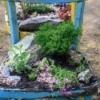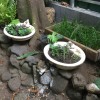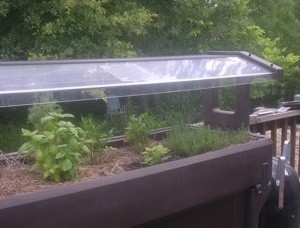
My husband is in the construction business. One day he brought this old salad display home. It is the large kind you see at buffets. It has a sneeze guard on the top. I put it on my back porch and planted herbs in it.
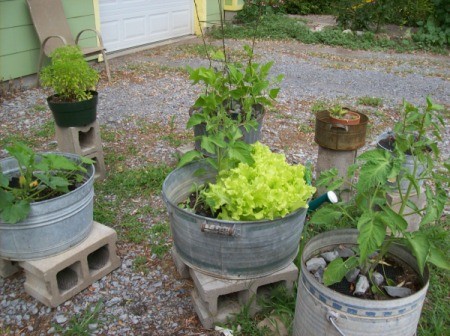
There's not much chance of our many rabbit families getting at these veggies, since I put them up on cinder blocks for added height - this also saves my back while tending. I secured rain gutter mesh over the top of the soil to foil the squirrels and chipmunks who love to dig up anything I plant (usually the night after I plant it).
Set in the sunniest place in our yard, this year's veggie garden is coming along nicely - lettuce is ready for the salad bowl. When the lettuce is finished up, the tomato plant will have plenty of room to stretch its roots.
This system works great when you have limited space or have a mostly shaded yard.
By Gloria from western NY
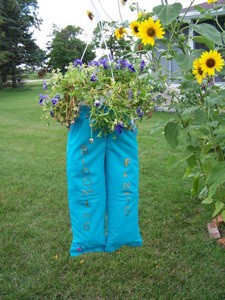
The pictures show nasturtiums growing in a hollow of a thriving tree, cucumbers just starting in a pair of old boots, Swiss chard in an old dishpan, potatoes in a storage bin (and a hammock strategically placed to keep the deer out of the garden and yes, it worked wonderfully), and tomatoes, peppers, and eggplant thriving in reusable shopping bags that we paid 50 cents for. We cut or drilled holes in containers that had no drainage, except the tree, and some old stumps.
All of the plants did very well and gave us a lot of delicious veggies. So far it looks like all of them will be used again next year and beyond, though the garden is still growing, and the containers not inspected. Containers like storage bins are great for storing the other pots and equipment.
By Copasetic 1 from North Royalton, OH 
Planning ahead for the seasons can add challenges to spring planting. Instead of planting each season, plant now to create an entire yearly display for much less than you'll pay to replant it each season. Why pay money to purchase plants and then throw them away? Think about the year ahead instead. We consider an entire season's planting when digging flower beds in the yard, but we often ignore them in potted displays. While pansies and winter cabbage are attractive, save them for your yard and keep them out of the potted plants. Instead, think about plants that will die down and reappear each year. Yearly plantings should be reserved for the larger planters.
As the frost line approaches your home, consider covering the planter with an old bed sheet at night. This will keep your flowers blooming and healthy longer. When the cold comes on strong, if you live in a colder climate, you'll have to add to your planter manually. Prune some interestingly shaped branches from around your yard and add them to the planter. If they have colored leaves, this will add to the display until the leaves dry. Bare sticks will continue the autumn look while adapting to the harsher temperatures.
For those who live in planting zone 6 and further north, this time period of autumn into winter is tricky for planters. Explore your recycling options. Continue to add the bare sticks as well as any dried berries and fall items you might find in your yard. Then, recycle the jack-o-lantern by turning his face to the back, covering it with the sticks and findings, and using the orange color to accentuate your display.
With a little investment, purchase a small evergreen for the center of your pot. Keep the other flowers growing around it, and decorate it according to the season. The evergreen will look lovely with smaller spring bulbs around its base, small summer flowers such as sweet alyssum around its base, sticks and marigolds in autumn, and mulch in the winter.
It's important to mulch your planter during the winter. Keeping it close to the house or under a porch will help to protect it. Adding pine needles as mulch is also a cheap and decorative solution.
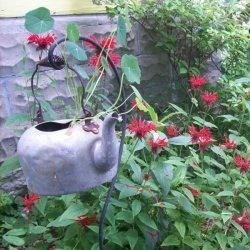
Interesting focal points in your garden don't always have to include terra cotta pots. See what you have around the house that would make a creative planter. I like the contrast of old metal against the softness of the plants. Here is a vintage tea kettle with a young nasturtium plant. I've hung it from a wrought iron stand in a patch of bee balm.
Don't forget to put drainage holes in the bottom of your new containers, or make a layer of stone before adding soil.
By gloria from western NY
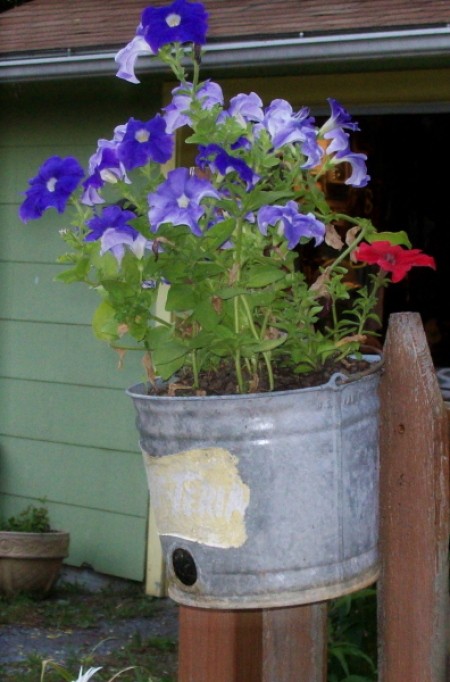
I keep my eyes open for any old galvanized buckets, tubs, and pails that I can use in my garden. This one was once a "calf-a-teria" complete with rubber udder where the hole is at the bottom. It now hangs on my garden fence with the bracket once used for hanging on the calf pens.
By ~gloria from upstate NY
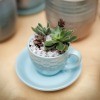
This simple project is a wonderful way to use the china teacups gathering dust on your shelves. Filled with soil and ivy they make dainty and long-lived planters. 
Many household objects can be used as containers in the garden. I love to use old chairs in the garden to add height and interest to an area that might be otherwise plain without it.
Many can be found on trash day, free for the taking. This one was without a seat, so I stapled a wire basket to the underside of the chair and added a cocoa liner. A layer of newspaper in the liner helps to retain moisture as cocoa liners can dry out easily in the heat of the summer. Fill with plants and good quality potting soil that contains a slow release fertilizer and moisture holding crystals.
By Dottie from Pennellville, NY
This fall I'm going to get a few different sized mums and pumpkins and decorate my porch and yard.
By Caroline D. from New Jersey
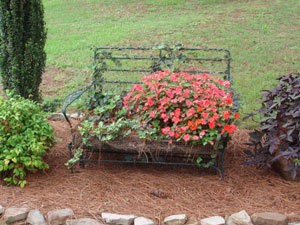
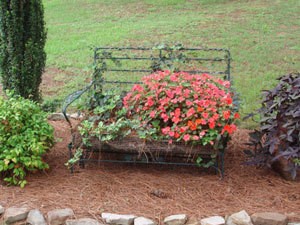
Want something different for your front lawn or garden? Use an iron chair or glider and fill it with ivy and flowers. My husband put some wooden sides on it and I lined the bottom with coconut liners. I filled the bottom with several inches of potting soil and planted away topping off with pine straw. Every year I try a new plants for variety.Take off the lids and let any remaining paint dry, you will not need the lids. After the paint dries, take a nail and punch some holes in the bottom of the can to allow for drainage, otherwise the can will collect too much water and rust.
If the can has a paper label, peel it off and you will have a plain can that you can paint or leave plain. If the product information is printed right on the can, you can spray paint over it to cover.
You can loop the can handle over a picket fence stake, and the can will sit flush against the fence, or you can hang it from a hook. Plant directly in the can, or to make cleanup easier, use large yogurt or cottage cheese containers with holes cut for drainage - the can will hide the plastic container, and you can pop it out easily at the end of the season.
These look especially nice with cascading plants, but you can put anything you like in them.
By Regina from Rochester, NY

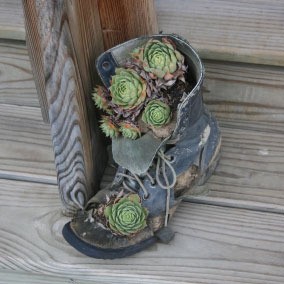
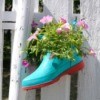
An old work boot with the toe cut out becomes a planter for a variety of succulents and decorates the steps of a wooden porch.
I had several items in my yard that I was using as yard art; wear and tear of these items in the weather elements caused rust and corrosion. I changed these items; painted them and they are again a nice addition to my yard art collection. I had an old milk can that the bottom had rusted out; it was painted black a few years ago and had been placed in a flower bed among the day lilies and irises; it had no top on it so I used it as a vase to put fresh flowers in; I painted it and used a spatter technique to finish it; I put a flower pot in it and placed a peace lily in it; I will change the flowers now according to season or holiday. It sits at the entrance of my back door on my backyard deck.
I also had an old tea kettle that was bent and had rusted; I painted it and used the spatter technique on it; it sits on an old rusted small pot bellied stove that sits on our backyard deck; I punched holes in the bottom of the tea kettle; this fall it will have pansies in it and will bring lots of color to that area of our deck. The rusted pot bellied stove is inoperable and is used as a garden ornament; I like the rusty color so I will not paint it.
By WandaJo from TN
Editor's Note: Here's is WandaJo's earlier post with the tea kettle on the old, rusted stove:

Vintage Wooden Toolbox Planter
Note: Holes were drilled for drainage and the sides lined with plastic to protect the wood
By Lisa from Halifax, Nova Scotia
By Renee from San Diego, CA
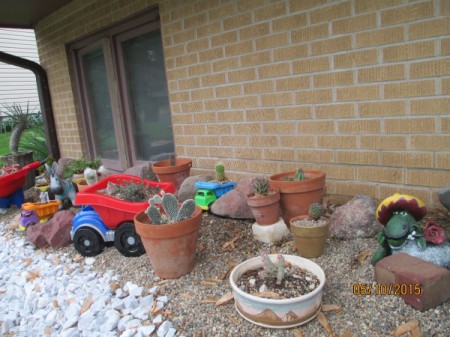
Here's a picture of a flowers planted in an old truck. Do you have any creative planter ideas to share? Post your ideas below.
I am wondering what is "no dirt" soil also. Could the person with that post please tell us what it is? Thank you
I have a business with a sunny front and a low window. I want to plant flowers outside below the window. It is about 8 feet in length and 2 feet high. I need some unusual ideas for planters. Preferably some things that are long.
By Cindy E
Don't know what your zone is, but this window box in Charleston South Carolina blew my socks off! It looks to me like the white in the center is allysum, the pink are petunias, the blue could be scaviola,and there could be other stuff in there as well. Just remember to use the best soil you can find, add lots of a timed release fertilizer (maybe also a bit of miracle grow in your watering),Buy the healthiest plants you can find and pack them in! If you can find some variegated ivy or vinca, that would creat a trailing effect. Good Luck! Anne in NC

I want to make a planter out of work boots. Do they have to be lace up ones?
Linda from NW Iowa
By thriftmeg
![]() |
![]() |
Boots make great planters!
By moonseekerjade from Onset, MA
By mulberry204
By PupperMom