Often it is recommended that certain seeds be started indoors in order to get a jump start on the growing season. This is a guide about starting seeds indoors.
When it's time to transplant my seedlings into larger pots, I usually have a good supply of recycled plastic yogurt cups. But this year, I ran out of them. This turned out to be a good thing as it forced me to try something new. And probably even better. I went to my stash of paper towel tubes that I save for kids' crafts. I found that I could get 3 pots from one tube.
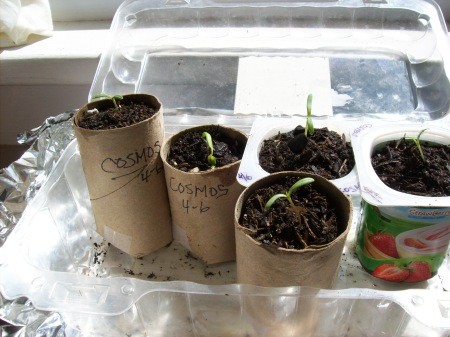
After cutting the tube into thirds, I cut 3/4" slits around one end of the tube. Then folded the cut parts in to form a bottom for the pot. A bit of tape will keep it secure. You'll remove the tape before planting if you intend to plant the tube pot in the ground along with the seedling.
Fill partially with soil and tuck your seedling into its new pot. Add the rest of the soil and water. By the time the seedlings are ready to plant outdoors, the pot should be softened up considerably from watering and will add good stuff to the soil.
It might be necessary to open up the bottom and tear the pot somewhat in order to allow roots to reach the soil easily. Or you can remove it completely if you want and put the used pot on your compost pile.
By June from upstate NY

Most major home stores sell fully assembled, 4-foot long shop lights for between $20-$30. Each will hold two to four 40-watt fluorescent tubes, which are an additional $4-$5 each (or sold in larger packs). If you have the space, this is the ideal set up for starting several flats of seeds. If your space is limited, you may need to locate flats piecemeal in whatever space is available and use smaller fixtures or lamps that hold a single 40-watt fluorescent bulb.
By Ellen Brown

Growing Space: You'll need an area of indoor space that you can dedicate to growing seedlings for as long as 6-8 weeks. Ideally, the space should be heated, yet still be cool (e.g. a heated basement). Use an old table or sheet of plywood laid across sturdy saw horses to hold seed trays. Inexpensive metal shelving units, like those designed for garages and workshops, are another good option. Dirt and water spills are inevitable, so if you're concerned about damaging work surfaces make sure you protect them with a cheap vinyl table cloth or plastic tarp.
A Strong Light Source: Although many seeds prefer to germinate in darkness, growing seedlings need a strong source of light. There's no need to purchase expensive "plant lights." Inexpensive fluorescent shop lights work just as well. Suspend the lights so they are not more than 2 - 4 inches above the leaves of the seedlings and gradually adjust their height as the plants grow. Seedlings need about 16 hours of bright light per day, which can be accomplished by connecting the lights to a small adjustable timer.
The Ability To Control Heat: Most seeds prefer warm soil to germinate, between 75-85 degrees F. Heat mats designed for germinating seedlings are an easy way to control soil temperatures. Because seedlings tend to be happiest growing in semi-cool temperatures, once seeds germinate, you can simply move them off the mats. During their growth, temperatures of between 60-70 degrees F are a good mid-range for most seedlings (10 degrees cooler at night). Cold-tolerant flowers and crops prefer it a little cooler, between 50-60 degrees F, whereas heat-loving plants will grow best in temperatures ranging between 65-75 degrees F. Signals that the temperature is either too warm or too cool include spindly growth (too warm) or seedlings that are smaller and slower growing (too cool).
Seeds: Not every type of seed grows best when started indoors. For example, certain vegetables like beets, beans, carrots, and corn, and salad greens are best sown directly into the garden. Check the back of your seed packets for specific growing information on how to start seeds indoors. Many include instructions on when to sow them, how far apart to space the seeds, and when to transplant the seedlings outdoors.
Seed-Starting Pots: These can be of any size, from a clean yogurt cup to a cottage-cheese container, to an ice cream pail. If you plan to use last year's pots, sterilize them with 1 part bleach to 9 parts water, rinse thoroughly, and let them air dry. You can also purchase peat pots or seed starting plugs from a garden center, but depending on what you are growing, you may end up having to move it to a larger pot (to prevent it from becoming root bound) before transferring it outdoors. Another caution for transplanting peat pot seedlings into the garden is to make sure none of the sides of the pot stick out above the soil line. The pots will act like a wick, pulling moisture from the area around the seedlings and creating a barrier that is hard for the roots to penetrate.
Seed-Starting Mix: Make your own, or purchase a ready-made soilless mix. There are dozens of home-made seed-starting recipes floating around, but most boil down to the same basic ingredients.
Soilless Seed Starting Mix
Modified Commercial Potting Soil
Ample Moisture: Water is essential for seedling growth, but over watering usually means certain death. Seedlings should be kept evenly moist, but never wet. The safest way to water them is from the bottom. One way to gauge whether or not it's time to water is by the weight of your seed trays. Fill your tray with seed starting mix and feel the weight of the tray before you water. Now moisten the seed starting mix and check the weight again. Notice how it feels heavier. Check the weight of the tray daily; when it starts to feel light, it is time to water.
By Ellen Brown
I have my medicine in my purse so I always stuff the doser cup with toilet tissue or facial tissue. It makes these darling little seed starters. I am going to make some of these for this spring, and put a little bit of honey in the bottom of it and then keep them for the spring. I wonder if it will keep the shape or if I should wait until spring actually gets here? After
four hours of being in the doser cup, they hold their shape!
They are so cute. Honey is a homemade antifungal or rooting hormone for plants roots to keep them from getting root rot.

By Robyn
You know the clear egg cartons and the clear croissant or cookie containers with clear lids that you get at the grocery store? Don't throw them away! Buy seed starter discs and soak them in these containers. Drain off the water and add the seeds. Close the containers! Sit under a plant light. When your plants are tall enough, transplant outside
An economical way to start seedlings and completely reusable!
Source: My husband thought of it! :)
By Gooby from Straughn, IN
An easy way to sprout seeds is to put the seed on a coffee filter and fold it over. Wet it and put it in a baggie. Close the baggie and wait for it to sprout.
By Robyn
Source: Disney Fun Magazine Spring Issue in February I believe.
By Ginger from Westport, CT
I am going to start this by saying, "My husband is the best." He helps me with everything and he is always encouraging me to find new things that I love and enjoy. Now granted he has not liked listening to my gardening plans repeatedly day after day, but he has been patient. So when I showed him that some of my seed choices would have to be started indoors, he was eager to help with the lighting situation (our kitchen is sunny but never sunny enough).
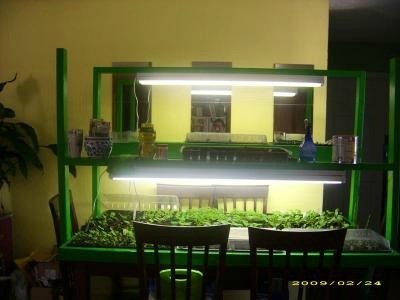
So his mother had some scrap 2x5's (I think) and we had a fluorescent light (cheaper but works just as good) and he made me the best seed germinator ever. I used simple seed starting trays. And it ended up costing nothing since we already had everything. Plus he painted it green so it looks better in the kitchen.
In the seed catalogs, something like this can get really expensive.
Jesikarena from Trinity, NC
Sowing seeds indoors is a great way to get a jump on the growing season - especially for vegetables and flowers that take a long time to reach maturity. Because you control the growing environment, young plants are protected from harsh weather and hungry animals while they are in their most vulnerable stages of development. By the time you transplant your seedlings to the garden, you've also extended your growing season by as much as two months. Here's how to go from indoor seeds to transplanted seedlings in 12 easy steps. By Ellen Brown
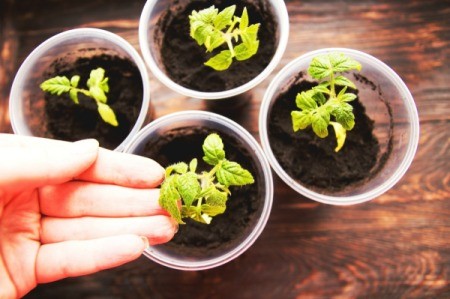
Put a small hole in the bottom for drainage and fill with potting soil. I got my potting soil at a dollar store and $2 worth was more than enough for 38 starter pots. I put 3 tomato seeds to a pot and separate them later when I put them in the garden.
By kemperjl from Gilbertsville, NY
Starting your own seedlings is an easy and economical way to get a jump on the growing season. It gives you the opportunity to experiment with hundreds of different plant varieties and gives you the satisfaction of knowing that your garden will be organic right from the very start.By Ellen Brown
For slow maturing plants and gardeners with short growing seasons, starting seeds indoors can be a crucial element to achieving success. To figure out the optimal time to start your seeds indoors, all you really need is a bit of backwards thinking.By Ellen Brown
By Cait from Ireland

Starting Seeds In February
I live in Nebraska and have decided to start my own garden. I was wondering when do you start planting the seeds indoors so that I can later put them outside?
Hardiness Zone: 4b
By Teresa from NE
Teresa, First you need to know when is a safe time to put your plants in the ground for your area. If you call your local County Extension Service, they can give you an idea as to a safe time. Look at the plant seed packet, calulate how low it takes for those seeds to germinate. They will get embryo leaves, then continue to grow to a stage where you can transplant them into small containers.
Once the weather starts getting a bit warm (not freezing)you need to let these baby plants get use to the outside elements like, sun, wind, etc. Just set them out for a few hours a day, this will strengthen them, so when you finally put them in the ground they will be nice and sturdy. If you put them it direct sun right away you may destroy these little tender plants-baby them and be nice to them until they are strong enough to take the outside elements.
This process of dragging the baby plants in and out can take a few weeks, be patient-it will pay off. This technique I used while living in Conn. where we had some long winters it worked every time. Some times we could not even put tomatoes in until Memorial Day! If you build your self a cold frame out doors you will not have bring the plants in and out. But you still have to lift the lid on those frames or you may bake your plants. all for now, jeannette (fla)
I have a vegetable garden and this was my first. It did very well, however, I want to start seeds inside and transfer them into the ground next time. So my question is when should I start my seeds inside? I live in the Lubbock, Texas area.
By wondaful from Lubbock, TX
Google the name of your local university plus the words cooperative extension service for the website of the local extension office-tonnes of fantastic information geared to your locale:)
I would like to start some perennial seeds indoors, basically, carnations, dianthus, poppies, etc. How and when do you start them indoors to plant by next spring? I am in zone 5 (Michigan). Also, I have some of the seeds, but don't know how long they are good for. I would be grateful for any help.

By Linda from Brighton, MI
Start your seeds indoors, and after they sprout put one plant per small pot in a cold frame outdoors. You can space you plants correctly for maximum production and get early crops. Here I am with Lettuce and beets ready for harvest in May.
By Rich
By Tami
Every year I hear people complain they missed starting their plants indoor.
If you are in Missouri, or growing regions 5 (really just check your local USDA zone map), this is the time to start.
In 2-3 weeks I will be planting my tomatoes indoors, in egg shells filled with potting soil. I place them in cut down egg cartons and put a domed clear plastic cake cover (from a Walmart cake) over the top.
They will be ready to plant by garden season. Later, I will also start inside my watermelon and zucchini and a few other plants.
If you are further south, you will want to start this process sooner.
By mom-from-missouri from NW Missouri
If you don't know your average last frost date, call your county extension (check your phone book government pages for the number) to find out when it is. Then take a calendar, mark the date, and number off the weeks before and after. Most seed packets will say when to plant the seeds and/or transplant starts relative to that date: for instance, start tomatoes 6-8 weeks before last frost, transplant after last frost. Cabbages can be planted out a few weeks before last frost if hardened off, and take about 4 weeks to get to transplant size, so you start them 6 weeks prior to last frost. Squash get planted out 2 weeks after last frost, beans about the time of last frost, etc.
So you can then take this information from the seed packets, go back to your calendar, and write in which weeks to start different kinds of seeds. Keep in mind that some crops, like lettuce and radishes, you may want to plant several small plantings of several weeks apart, so they aren't all ready at once. You can save this calendar and use it year to year, too. Who cares if the days of the week don't match this year.
If you plant fall crops, you will also want to find out your average first fall frost date, too, so you can determine what the latest date is that you can plant a crop and still have it mature. If beans take 60 days from seed to picking, you don't want to plant them when the frost date is only 40 days away. (02/16/2010)
By Contester
Save empty yogurt cartons to start plant seedlings for your garden in the spring. Empty cardboard egg cartons also work good. So do clear plastic containers from the bakery-mini greenhouses.
By Melanie
By
I love to recycle the plastic containers from single applesauce servings and even plastic baby food containers. I'll poke holes in the bottom of the containers with a pair of scissors, then fill the containers with moistened potting soil. I either plant a seed or transplant a newly sprouted seedling to the container.
If it's still cold in the house, I cover the container with plastic until late February. These are the perfect size for me to start working on growing plants that will go into my garden when no chance of frost remains.
I also reuse drink bottles from Fuze to grow seedlings in. Their design makes it easy to cut in half evenly. This picture is a rose seedling I'm growing! I'm gradually preparing my garden I'll have in the Summer now.
By Sharon from Fairview, NC